
“We love the Wave-Up concept. Our guests can use the equipment entirely on their own, a real plus for the resort.”
Léa, manager, Camping Maïana Resort, La Grande-Motte
See the station at Camping Maïana ResortKayak, depending on configuration, on quote
The Wave-Up station is built for stand up paddle and surfing. Kayaks are not part of the standard offer: they are studied according to the configuration of your site, on quote. Here is what we can make available as self-service at your site, and under what conditions.
The problem
You operate a pond, a lake, a stretch of river or a base on the edge of an inland body of water. The demand for craft is there, and kayaks come back every season because a quiet outing requires no particular technique. Running them is another matter: carrying the boats down to the launch in the morning, counting the paddles and life jackets, waiting for the returns, hauling everything back up in the evening. One person spends their day on it, and it only works at full capacity a few weeks a year.
Self-service solves the question of presence, then runs into two obstacles that are better known before going further. The first is size: a kayak is carried lying down, with both hands, and nothing stores it upright within a station's footprint. The second is regulatory: as soon as you organise the use of a paddle-propelled craft, you enter a sports code regime from which the stand up paddle board is expressly excluded.
The solution
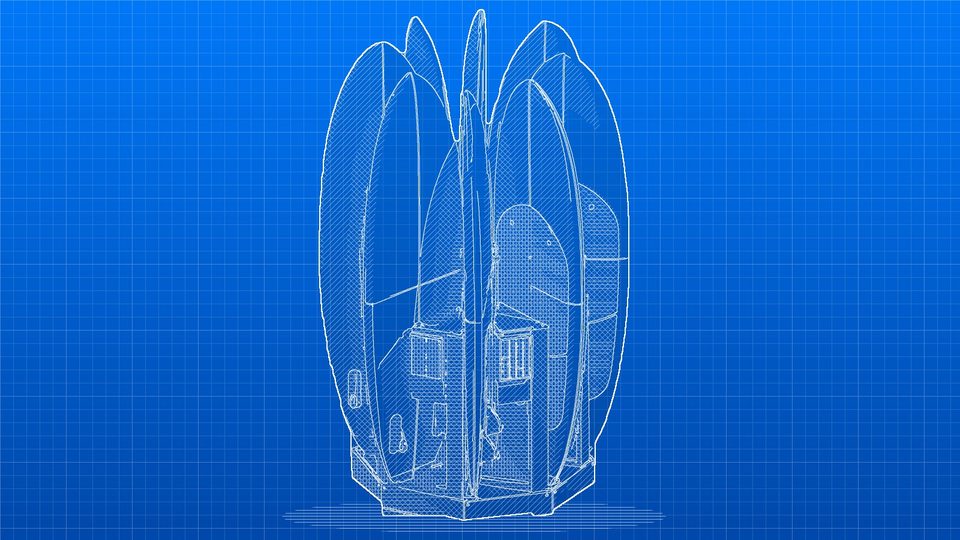
The Wave-Up station is a self-service rental locker placed at the water's edge: eight slots for stand up paddle or surf boards, eight clips for paddles, eight lockers for life jacket, leash and waterproof pouch. Powder-coated 316 stainless steel, about 1.30 × 1.30 m of ground, or about 1.7 m², 1.80 m high excluding boards, about 180 kg empty. Solar panels and 12 V 15 Ah battery as standard, about 3 W consumed, several days of reserve without sun, no electrical connection: a bank with no power box can receive it just as well as a base entrance. The eight electric strikes are monitored remotely by a 4G modem.
The visitor's journey starts in front of the station: they scan the QR code displayed on it, choose 1 h, 2 h, 4 h or 8 h, pay by card, open their locker, leave with board, paddle and life jacket, and put everything back in the same locker on return. The kayak is not in the standard catalogue: it is studied according to configuration, on quote, because neither the footprint nor the regulatory framework are the same. On a calm inland body of water, the board often meets the demand you attribute to the kayak, the leisurely outing along the water; the kayak or paddle comparison helps you decide for your body of water.
A kayak and a stand up paddle board do not take up space in the same way, and this is the first reason why the standard station takes one and not the other. A board is stored upright, on its edge, against an upright. A kayak is stored lying down: its length becomes rack length, its hull cannot stand on an edge, and its hollow shape holds water and sand.
With equal footprint, the difference is clear. The station fits in about 1.30 × 1.30 m, or about 1.7 m², and rises to 1.80 m high excluding boards. Eight boards fit in it upright. Eight kayaks do not: you would need length, so a structure of a completely different order and a handling lane in front of it.
Size also weighs on launching. A board is carried under the arm to the edge, even along a narrow path or a bank staircase. A kayak is carried by two people, or rolled on a trolley, and needs a clear access from the storage point to the water. If your bank is steep, sunken or far from the parking, this carrying decides the project before the budget does. Our guide to getting started with kayaking gives an idea of what the user actually handles.
Describe your bank, your access and the number of craft you are aiming for in your quote request: the answer will say what is possible at your site, and in what form.
What it changes
You know from this page what the station offers as standard, stand up paddle and surf, and what is studied separately, the kayak. No surprises at delivery.
No hut, no keys, no logbook: the visitor books, opens, returns. Your teams do not move.
Built-in solar panels and battery, 4G modem, no electrical connection: the station can be placed on an isolated bank as well as at the foot of a pontoon.
Before renting anything, know which category your body of water falls into. Article L431-3 of the environmental code applies the freshwater fishing regime to all watercourses, canals, streams and bodies of water, except those it excepts. Article L431-4 takes out ditches, canals, ponds, reservoirs and other bodies of water into which fish cannot pass naturally: these are closed waters. Article R431-7 specifies that this impossibility must stem from the configuration of the place, excluding exceptional hydrological events, and that a fish-interception device is not enough to characterise it.
This qualification mainly tells you who controls passage. On a watercourse, article L214-12 of the environmental code provides that, in the absence of an approved water development and management scheme, the circulation of non-motorised recreational craft is free, in compliance with police laws and regulations and the rights of riparian owners; the prefect may, after consultation, regulate it on non-state-owned watercourses. In other words, beside a river you rent out a craft, you do not sell the passage; on a closed pond, access depends on you.
The kayak then brings a regime that the board does not have. Article L322-2 of the sports code requires establishments where physical or sports activities are practised to provide hygiene and safety guarantees defined by regulation. Article A322-42 designates those covered by the canoe-kayak subsection: the establishments referred to in article L322-2 that organise the practice of canoeing, kayaking, rafting, white-water swimming and navigation with any other paddle-propelled craft, with the exception of the stand-up paddle board. The board is outside the text, the kayak is inside.
The consequence weighs heavily on a self-service project. Article A322-3-1 of the sports code requires the operator who organises an activity referred to in article A322-42 to ask the user to attest to their ability to swim twenty-five metres and to submerge, or to present a certificate of success in the Pass-nautique test provided for in article A322-3-2, or one of the equivalent certificates provided for by the text. The code does not say how to collect this attestation, but it adds a step that board rental does not have, and this step is settled site by site. Have the departmental youth, engagement and sports service confirm whether your activity falls within this scope.
One last point, often confused with the previous ones: article L212-1 of the sports code reserves to holders of a diploma, a professional title or a qualification certificate listed in the national directory of professional certifications the right to teach, lead or supervise a physical or sports activity for payment. Renting equipment is not supervising. As soon as you add an introduction or a guided outing, you cross to the other side. If your site operates under direct management or delegation, also see the station for leisure bases.
Economics and installation
The station is ordered as a kit, on quote; the offer and the volume discounts are detailed on the Pricing page. This grid applies to a stand up paddle and surf station: the kayak is not in it.
For a project that includes kayaks, describe your site, your body of water and the number of craft wanted in the quote request. Wave-Up replies within 24 business hours, free of charge and with no obligation, with what is possible, what is not, and at what price. The revenue potential, for its part, depends on your footfall, your prices and the season.
They installed it
“We love the Wave-Up concept. Our guests can use the equipment entirely on their own, a real plus for the resort.”
Léa, manager, Camping Maïana Resort, La Grande-Motte
See the station at Camping Maïana Resort
“A top-quality installation and zero management on our side. Our guests book their equipment in two clicks, it's great.”
Camille, manager, Camping Palmira Beach, Vendres
See the station at Camping Palmira Beach
“A modern service that people really like. The paddleboards are gone first thing in the morning, we want more.”
Julie, manager, Camping Roucan Plage, Vias
See the station at Camping Roucan Plage
“Our guests love it. The Wave-Up locker has transformed access to watersports on our beach. A real plus for the campsite.”
Savinka, manager, Camping Nouvelle Floride, Marseillan-Plage
See the station at Camping Nouvelle Floride
Camping Méditerranée Beach Garden, Marseillan-Plage
See the station at Camping Méditerranée Beach Garden
Camping La Tamarissière, Agde
See the station at Camping La TamarissièreFrequently asked questions
Not as standard. The eight slots are designed for boards, stand up paddle or surf. The kayak is studied according to configuration, on quote, because the size and the regulatory framework differ. If your project depends on it, say so from the quote request: you will get a clear answer on what is possible at your site.
No. The station fits in about 1.30 × 1.30 m of ground, or about 1.7 m², and is 1.80 m high excluding boards: it stores boards upright, on their edge. A kayak is stored lying down and needs length. You can judge the real bulk on the 3D model of the station.
For an outing on a pond, a lake or a calm river, often yes: the board is used standing or kneeling, suits families and requires no experience. For a white-water descent or a loaded outing for two, the answer is different. Specify your use in the quote request.
Simple rental is not supervision. Article L212-1 of the sports code reserves to holders of a diploma, a professional title or a qualification certificate listed in the national directory of professional certifications the teaching, leading and supervising of a physical or sports activity for payment. If you add an introduction or a guided outing to your rental offer, this obligation applies, including to an employee of your establishment.
For the kayak, yes. Article A322-3-1 of the sports code requires the operator who organises an activity referred to in article A322-42 to ask the user to attest to their ability to swim twenty-five metres and to submerge, or to present a certificate of success in the Pass-nautique test of article A322-3-2, or one of the equivalent certificates. Article A322-42 expressly excludes the stand-up paddle board from its scope. This is one of the points to settle before imagining a kayak journey without staff.
Article L431-4 of the environmental code classes as closed waters ditches, canals, ponds, reservoirs and other bodies of water into which fish cannot pass naturally; article R431-7 specifies that this impossibility must stem from the configuration of the place, excluding exceptional hydrological events. Outside these cases, article L431-3 applies. It matters because on a watercourse, article L214-12 lets non-motorised recreational craft circulate freely in the absence of an approved water development and management scheme, whereas on a closed body of water you control access. The departmental directorate of territories can confirm the status of yours.
Yes. Solar panels and a 12 V 15 Ah battery are built in as standard, consumption is around 3 W and the reserve covers several days without sun, with no connection at all. A 4G modem reports the state of the lockers: the network must therefore reach the intended bank. The station is designed and manufactured in France by the industrial partner, in powder-coated 316 stainless steel, with a 2 year manufacturer's warranty on parts and labour, excluding vandalism.
Six campsites in the Hérault are equipped: Camping Maïana Resort in La Grande-Motte, Camping Palmira Beach in Vendres, Camping Roucan Plage in Vias, Camping La Tamarissière in Agde, Camping Nouvelle Floride and Camping Méditerranée Beach Garden (installation to come) in Marseillan-Plage. Each station is installed within the grounds of the establishment that hosts it: access conditions are those of the establishment. The pages are gathered on the references page.
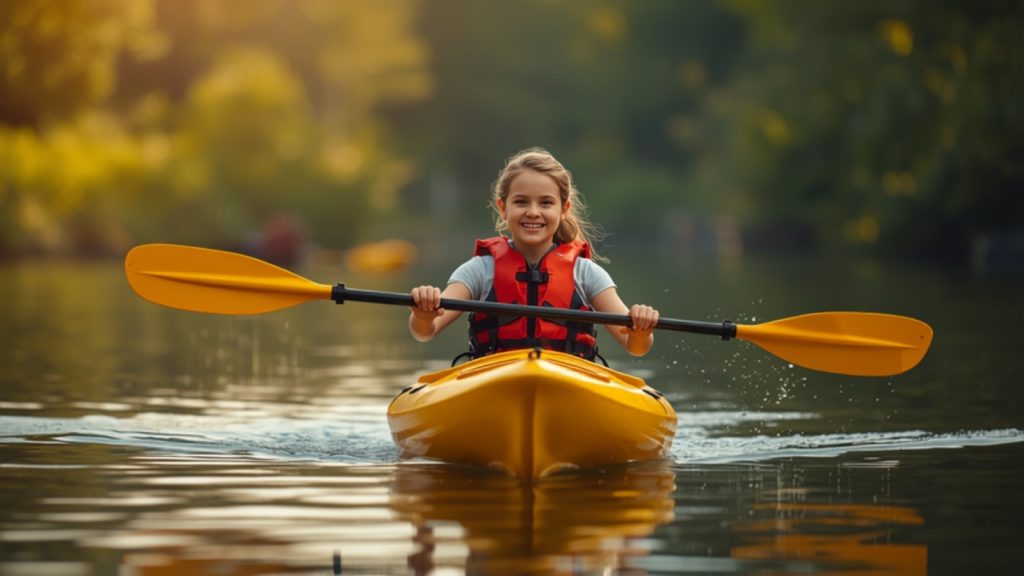
Choosing your kayak, holding the paddle, going straight, getting back on after capsizing: the step-by-step guide to making your first…
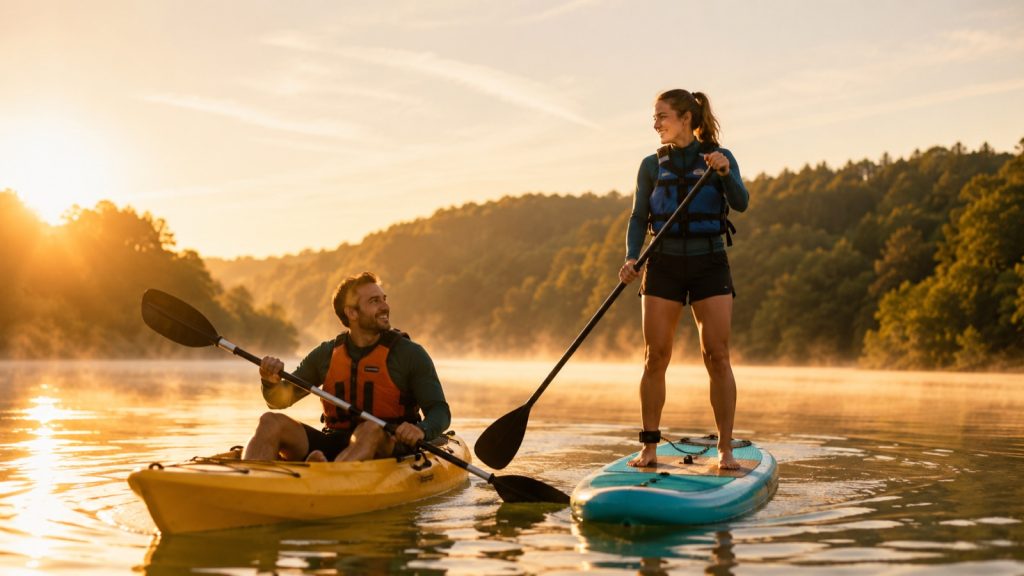
Position, effort, speed, family: the honest comparison between kayak and stand up paddle to choose your craft, or decide not to…
Paddle or surf as standard, kayak depending on configuration: describe your body of water and your project in the quote request, free and with no obligation. Wave-Up tells you what is possible, within 24 business hours.
