
“We love the Wave-Up concept. Our guests can use the equipment entirely on their own, a real plus for the resort.”
Léa, manager, Camping Maïana Resort, La Grande-Motte
See the station at Camping Maïana ResortPrivate beaches and concessions
On a beach concession, every square metre counts. The Wave-Up station fits on 1.7 m² and adds a water activity to your beach: your customers scan the station's QR code, book on their phone and help themselves.
The problem
A beach plot is managed by the square metre. Every row of mattresses and parasols has a known yield, turnover and day rate. Water activities, on the other hand, need a hut, a seasonal employee for the hot hours, a separate till and equipment to bring in every evening. When the season starts, it is the line that gets pushed back to next year.
On top of that comes a constraint that shops on the promenade never face. On a conceded beach, everything you put down must be able to leave again: Article R2124-16 of the Code général de la propriété des personnes publiques only allows equipment and installations on a beach that are removable or transportable, with no element designed to anchor them durably to the ground, and whose size and cost remain compatible with the purpose of the public domain and the length of occupation. A rental hut with a cable run from the promenade becomes one more file to handle. Meanwhile, your customers walk back up to the harbour to rent a board for an hour, and the revenue goes with them.
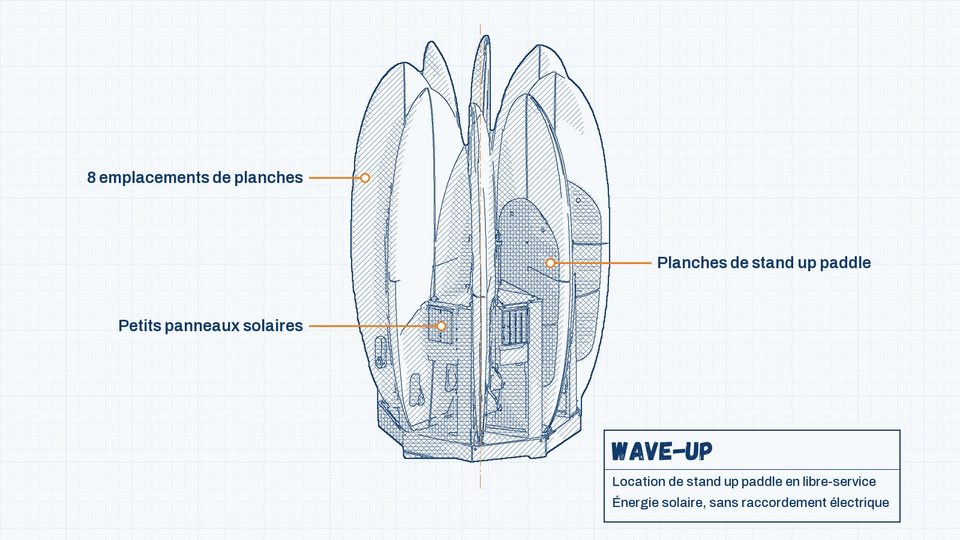
The Wave-Up station is a self-service rental locker and a connected locker for the beach in powder-coated 316 stainless steel, the marine grade: eight slots for stand up paddleboards or surfboards, eight lockers for lifejacket, leash and waterproof pouch, eight clips for paddles, eight electric strike plates. It takes up about 1.30 × 1.30 m, roughly 1.7 m² of floor space, stands 1.80 m high without the boards and weighs about 180 kg empty. Solar panels and a 12 V 15 Ah battery are built in as standard, for a consumption of about 3 W and several days of autonomy without sun: no connection, so no trench and no cable to run down to the water. A 4G modem lets you monitor the state of the lockers remotely. It is delivered as a kit, designed and made in France by an industrial partner. See the station in 3D.
On your plot, it fits within the footprint of a sun lounger, where your customers already walk, between the last row of mattresses and the water. Its position, its method of installation and its end-of-season removal are defined in the quote, then validated by your concession holder against the specifications of the plot: it is the concession holder who answers for the public domain to the State. The customer scans the QR code displayed on the station, books 1 h, 2 h, 4 h or 8 h from their browser without installing anything, pays by card and opens their locker with a code or QR code. The board comes back to the same locker, the door closes, and your team has not left the bar.
If your beach is conceded, you are not operating a piece of land: you occupy a plot of the maritime public domain under an operating agreement. No one may occupy part of the public domain without holding a title that entitles them to do so (Article L2122-1 of the Code général de la propriété des personnes publiques), and the beach regime is set out in Articles R2124-13 to R2124-38 of the same code. Three rules there decide what you may put on the sand, and a fourth decides who has to say yes.
First, removability. Article R2124-16 only allows equipment and installations on a beach that are removable or transportable, with no element designed to anchor them durably to the ground, and whose size and cost are compatible with the purpose of the public domain and the length of occupation. They must be designed so that the site can be returned to its original state at the end of the concession, and their location and appearance must respect the character of the sites. Only public sanitary facilities and safety posts may be given fixed positions, except in a remarkable area. A slab, a sealed fixing or a buried connection therefore falls outside the framework, and it is your concession holder who judges, plot by plot, what fits.
Next, surface area. The same article requires that a minimum of 80% of the length of the shoreline, per beach, and of 80% of the surface of the beach, within the municipal boundaries, remain free of any equipment and installation, the surface to be taken into account being that at mid-tide. In the case of an artificial beach, these limits cannot be lower than 50%. The calculation is made at the scale of the beach and the municipality, not of your plot alone: it is the beach plan annexed to the concession that keeps track of it. Your right to occupy is therefore capped upstream, and it is counted by the square metre. That is the best argument for compact equipment rather than a rental hut.
Finally, the calendar. The surface of the conceded beach must be free of any removable or transportable equipment and installation outside a period defined in the concession, which may not exceed six months. In classified resorts within the meaning of the Code du tourisme, this period may be extended to a maximum of eight months a year if the municipality has declared itself in favour by a deliberation reasoned in light of tourist numbers (Article R2124-17). Your operating season is written in the title, not in your schedule. As for the concession itself, its term may not exceed twelve years (Article R2124-13): after that, everything is back in play.
That leaves the grantor's agreement. Article R2124-14 allows the concession holder to entrust all or part of the activities to one or more subcontractors under operating agreements, but it remains personally liable both to the State and to third parties, and the agreement may not run beyond the end of the concession. These agreements are not awarded by mutual consent: when the concession holder is a local authority, Article R2124-31 refers to the advertising and competitive tendering procedure of the Code général des collectivités territoriales; in other cases, Article R2124-32 requires an advertising procedure allowing several competing offers to be submitted. In both cases, the draft agreements are submitted to the prefect for approval before signature, with no reply within two months counting as approval. Before ordering anything, put the question to your concession holder in writing.
What it changes
On the footprint of a sun lounger, the station rents eight boards. You set your own prices; Wave-Up takes care of booking, payment and after-sales service.
The customer books, pays and opens their locker without going through you. No separate till, no keys to manage.
Built-in solar panels and battery: no cable to run down to the water. The station goes in the busiest spot on your beach.
Economics and installation
Station delivered as a kit, price on quote. Manufacturer's warranty of 2 years on parts and labour, excluding vandalism. Volume discount, from −5% for 2 stations to −25% for 20 stations.
Revenue potential depends on the footfall on your beach, your prices and the length of your season. The simulator starts from default assumptions, €15 per hour, 6 hours a day from April to September, 20% occupancy, and displays a prudence coefficient of 25%. Wave-Up installs the station and replies within 24 working hours; the quote is free and without obligation.
On a beach plot, the end of the season is not a standby: it is a removal. Article R2124-16 links the two ideas in the same sentence: installations must be removable or transportable and designed so that the site can be returned to its original state at the end of the concession. What you buy, you will pack away again: how it packs away is therefore part of the purchase, just like its yield.
Three lines to put in your quote, and to have validated afterwards by your concession holder. Who dismantles it and with what means, given that the station weighs about 180 kg empty and takes up about 1.30 × 1.30 m. Where it spends the winter, boards and paddles removed, since you need a storage room. And what you leave on site, given that it has no meter to cancel and no cable to unplug, its energy coming from its solar panels and its 12 V 15 Ah battery. The station is delivered as a kit: the arrangements for assembly, removal and reinstallation are settled at the same time.
Exemptions from dismantling exist, but they are narrow. Article R2124-18 allows the concession holder to ask the prefect for an approval, valid for the duration of the concession, to keep removable or transportable beach establishments in place beyond the operating period. To qualify, the site must be in a classified resort that has had for more than two years a tourist office classified 4 stars within the meaning of Article D. 133-20 of the Code du tourisme, and can show an average opening per day, between 1 December and 31 March, of more than 200 rooms in classified hotels. The special annual authorisations that follow require in particular an opening period of at least forty-eight consecutive weeks in the year, four days a week, an application filed at the latest three months before the end of the operating period, and proof that keeping the installation in place is compatible with the action of the sea and wind (Article R2124-19). If your plot does not fall into this case, plan the storage room from the time you order.
For the rest of the layout, read developing and making the most of your beach and the guide to laying out a private beach. If the municipality relaunches its procedure, our article on the beach concession and the call for tenders sets out the timetable. To put a figure on your case, go through the simulator, then the quote.
They installed it
“We love the Wave-Up concept. Our guests can use the equipment entirely on their own, a real plus for the resort.”
Léa, manager, Camping Maïana Resort, La Grande-Motte
See the station at Camping Maïana Resort
“A top-quality installation and zero management on our side. Our guests book their equipment in two clicks, it's great.”
Camille, manager, Camping Palmira Beach, Vendres
See the station at Camping Palmira Beach
“A modern service that people really like. The paddleboards are gone first thing in the morning, we want more.”
Julie, manager, Camping Roucan Plage, Vias
See the station at Camping Roucan Plage
“Our guests love it. The Wave-Up locker has transformed access to watersports on our beach. A real plus for the campsite.”
Savinka, manager, Camping Nouvelle Floride, Marseillan-Plage
See the station at Camping Nouvelle Floride
Camping Méditerranée Beach Garden, Marseillan-Plage
See the station at Camping Méditerranée Beach Garden
Camping La Tamarissière, Agde
See the station at Camping La TamarissièreFrequently asked questions
Install it, yes, but the way it is set down must be validated with your concession holder. Article R2124-16 of the Code général de la propriété des personnes publiques only allows removable or transportable equipment on a beach, with no element designed to anchor it durably to the ground, and designed to allow the site to be returned to its original state at the end of the concession. On the station side, there is nothing to connect: the energy comes from the solar panels and the 12 V 15 Ah battery, the link from a 4G modem, and the whole unit is delivered as a kit, weighs about 180 kg empty and takes up about 1.7 m². The installation method, the exact position and the end-of-season removal are defined in the quote, then confirmed against the specifications of your plot.
Yes. Article R2124-14 allows the concession holder to entrust all or part of the activities to subcontractors under operating agreements, but it remains personally liable both to the State and to third parties, and the agreement may not run beyond the end of the concession. If the rental of water sports equipment is not among the activities provided for in your agreement, an amendment must be requested; it is not a decision to make mid-season. Draft operating agreements are, moreover, submitted to the prefect for approval before signature, with no reply within two months counting as approval (Articles R2124-31 and R2124-32).
About 1.7 m², roughly 1.30 × 1.30 m on the ground, for eight rentable boards. Article R2124-16 requires that a minimum of 80% of the length of the shoreline, per beach, and of 80% of the surface of the beach, within the municipal boundaries, remain free of any equipment and installation, the surface to be taken into account being that at mid-tide. Mind the scale: this ceiling is calculated on the beach and on the municipality, not on your plot alone, and it is the beach plan annexed to the concession that keeps track of it. Record the exact footprint of the station there before having it validated.
On the occupancy threshold, yes. Article R2124-16 provides that in the case of an artificial beach, the limits of 80% of shoreline length and surface to be left free cannot be lower than 50%. The rest does not change: removability, no element designed to anchor it durably to the ground, operating period defined in the concession. The classification adopted for your beach appears in the concession deed.
It leaves the beach. The surface of the conceded beach must be free of any removable or transportable equipment and installation outside a period defined in the concession, which may not exceed six months, raised to a maximum of eight months a year in classified resorts whose municipality has declared itself in favour by a deliberation reasoned in light of tourist numbers (Articles R2124-16 and R2124-17). Plan the storage room, the handling equipment and the removal schedule from the time you order: they are costed in the quote, just like the position.
You buy the station, you own it and you set your own prices. The customer pays by card at the time of booking, and Wave-Up provides the booking and payment app, manages the rentals and the holidaymaker service; maintenance of the station is not included. To estimate this revenue for your footfall, go through the simulator.
1 h, 2 h, 4 h or 8 h. They scan the QR code displayed on the station, choose their duration and pay from their browser, without installing anything. On a beach plot, it is the short rental that makes sense: the customer books, paddles, puts it back, and the locker becomes available again for the next one. The conditions and access hours remain those of your establishment.
To rent, no. Article L212-1 of the Code du sport reserves to holders of a diploma, a vocational title or a professional qualification certificate the right to teach, lead or supervise a physical or sporting activity for payment, on a regular, seasonal or occasional basis: this covers lessons and guided outings, not simple rental. As soon as you offer any supervision, even by a member of the beach staff, a qualified instructor is required. Also check with your insurer that your policy covers making water sports equipment available to your customers.
It is possible if the agreement for your beach plot authorises the rental of water sports equipment: in the Hérault, the prefecture lists paddleboard rental among the main activities of a plot. On a conceded beach, only removable or transportable equipment is allowed, and the beach must be cleared of it outside a period set by the concession, six months at most except for derogations in classified resorts (Article R2124-16 of the Code général de la propriété des personnes publiques). Before ordering a Wave-Up station, which takes up about 1.7 m² of floor space with no electrical connection, have the municipality and the DDTM confirm that it meets this requirement.

Zoning, materials, services, off-season: the method for developing a private beach that delights customers, and earns its living all…
On a conceded beach, a plot is obtained through an operating sub-concession awarded after a competitive tender. Procedure, occupation rules and application, texts…
Salt, sun, humidity, theft: the solutions for storing water sports equipment by the water, their limits, the occupation rules of a…
Request a quote for your concession: free, without obligation, reply within 24 working hours.
