
“We love the Wave-Up concept. Our guests can use the equipment entirely on their own, a real plus for the resort.”
Léa, manager, Camping Maïana Resort, La Grande-Motte
See the station at Camping Maïana ResortMunicipalities and local authorities
A Wave-Up station makes stand up paddleboards and surfboards available to beach users, with no staff on site and no mains connection. Your departments open no premises and run no till.
The problem
A municipal beach costs money before it earns any. Cleaning, lifeguard post, toilets, parking: the expense returns every summer, yet visitors find nothing to rent. Offering water sports equipment usually means premises, a seasonal employee from June to September and a till to run on the sand. That is three operating cost lines for two months of activity, and it is most often where the project stops.
The other route, delegation, requires a procedure, a specification and a candidate. On a mid-sized beach, few operators will travel for two months of trading. The municipality ends up with a well-kept beach and no service, while its residents go and practise elsewhere. The question put to the council has never been about the equipment: it is about who will run it.
The solution
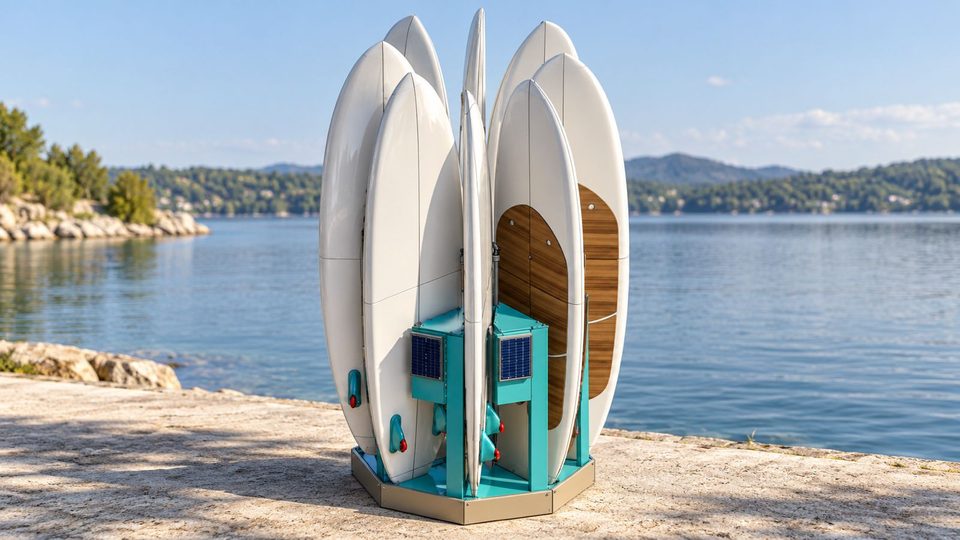
The Wave-Up station is a connected beach locker: eight bays for stand up paddleboards or surfboards, eight lockers for a life jacket, leash and waterproof pouch, and eight clips for paddles. It stands on 1.30 m by 1.30 m of ground, about 1.7 m², rises to 1.80 m excluding boards and weighs about 180 kg empty. Solar panels and a 12 V 15 Ah battery come built in as standard: about 3 W consumed, several days of autonomy without sun, no mains connection. For your technical departments, that means no trench, no cabinet and no meter to open. See the station in 3D.
Users scan the QR code displayed on the station, book from their smartphone without installing anything, pay by card, open their locker with a code or a QR code, then return the equipment to the same place. A locker opens only with the code of the current booking. Eight electric strikes that withstand sea mist lock the bays and a 4G modem reports their status remotely: no staff member needs to be on the sand to open or close a locker. The durations offered are 1 h, 2 h, 4 h or 8 h, and the service opening periods are whatever the municipality sets for its beach.
Buying a station means buying supplies: it is delivered as a kit and installed without foundations. Article R2122-8 of the French Public Procurement Code allows the buyer to award a contract with no prior advertising or competition when the estimated value of the requirement is below €60,000 excluding VAT for supplies and services, and below €100,000 excluding VAT for works. These amounts have appeared in that article since Decree No. 2025-1386 of 29 December 2025, which raised the threshold for supplies and services from €40,000 to €60,000 excluding VAT for consultations launched from 1 April 2026. The amount of your quote is the figure to compare with the threshold: it is the quote that determines the procedure, not the item bought. The offer is detailed on the pricing page: purchase of the station, then Wave-Up’s support, remunerated on rentals.
A useful caveat: if you are also having a base, a decking area or the path leading to the station built, that part of the operation is a works contract and falls under the €100,000 excluding VAT threshold of the same article, not the supplies threshold. Two needs, two estimates.
Being exempt from a procedure does not mean being exempt from method. The same Article R2122-8 imposes three requirements on a buyer who uses it:
Below the European thresholds, Article R2123-1 of the French Public Procurement Code opens up the adapted procedure: it is an option, and you set its terms yourself according to the amount and subject of the contract. Nothing about the station makes competitive tendering complicated: it is bought delivered as a kit, its characteristics fit into a few lines of specification, and the boards, paddles and life jackets belong to the operator.
That leaves deciding who operates it. Article L1412-1 of the French General Code of Local Authorities provides for direct management (régie) for the direct operation of an industrial and commercial public service, after the opinion of the Local Public Services Advisory Commission. Article L1411-1 opens the other route: entrusting management of the service to an economic operator under a public service delegation agreement, defined in Article L1121-3 of the French Public Procurement Code. Article L1121-1 of the same code states what characterises it: an operating risk is transferred to the operator, and the potential loss it bears cannot be purely theoretical. Our comparison is in leisure centre in direct management or under delegation.
Two points on timing and one on budget. Above 10,000 inhabitants, Article L1413-1 makes the Local Public Services Advisory Commission mandatory, and its opinion is required before any public service delegation project and before any project to create a direct management service with financial autonomy. Next, if the municipality runs this rental service as an industrial and commercial public service, Article L2224-1 requires a budget balanced in revenue and expenditure, and Article L2224-2 prohibits it from charging the expenses to its own budget, apart from limited exceptions and by a reasoned resolution on pain of nullity, without this support amounting to the outright covering of an operating deficit. The prices you set must therefore keep the service going.
If the water body is already managed by a municipal base, the equipment attaches to an existing service rather than a service yet to be created: see the page station for leisure centres. Six campsites in the Hérault are now equipped and all references are public.
What it changes
Residents and holidaymakers rent a board without depending on a shop's opening hours. The beach gains a new use without losing its character.
No seasonal worker to recruit, no premises to open, no till on the sand. Booking and payment happen at the station, by QR code, with remote supervision.
1.30 m by 1.30 m, 1.80 m high excluding boards. The station is installed with no trenching and no mains connection; the conditions for occupancy and fixing are settled with your departments in the quote.
Economics and installation
The station is purchased, delivered as a kit, on quote. To equip several beaches, a sliding discount applies, from −5% from 2 stations to −25% from 20 stations. Wave-Up then takes care of booking, payment and after-sales service. 2-year manufacturer warranty, parts and labour, excluding vandalism.
Installation takes place at the spot defined with your departments. Request a free, no-obligation quote: Wave-Up replies within 24 working hours.
A rental station is not a supervision system and shifts none of your policing duties. Article L2213-23 of the French General Code of Local Authorities gives the mayor the power to police bathing and water activities carried out from the shore with beach craft and unregistered craft. At sea, this power extends to 300 metres from the water's edge. The mayor marks out one or more supervised zones and sets the supervision periods, and outside those zones and periods the activities are practised at the participants' own risk. The text gives a figure for this limit only at sea: on an inland body of water, it refers to water activities carried out from the shore, without a distance.
The same article requires the mayor to inform the public through appropriate notices, at the town hall and at the places where these activities take place. Siting the station is therefore also a policing decision: place it on the side where your order authorises launching beach craft, away from the supervised bathing zone, and display next to it what that order provides. On leased beaches, the split between uses is settled in the title itself: our page on the tender for a beach concession sets out the framework.
The second point is the route to reach the station. If you are building out that path, the Order of 20 April 2017 on accessibility for disabled people of public-access buildings on construction and of facilities open to the public on development gives the values to meet. Its Article 2 notably provides:
The station itself is installed without foundations or trenching, which leaves the location open until the last moment. So it is the ground around it and the route from the car park or promenade that decide the real accessibility of the service. Better to look at them before fixing the location in the quote, while moving it costs nothing.
They installed it
“We love the Wave-Up concept. Our guests can use the equipment entirely on their own, a real plus for the resort.”
Léa, manager, Camping Maïana Resort, La Grande-Motte
See the station at Camping Maïana Resort
“A top-quality installation and zero management on our side. Our guests book their equipment in two clicks, it's great.”
Camille, manager, Camping Palmira Beach, Vendres
See the station at Camping Palmira Beach
“A modern service that people really like. The paddleboards are gone first thing in the morning, we want more.”
Julie, manager, Camping Roucan Plage, Vias
See the station at Camping Roucan Plage
“Our guests love it. The Wave-Up locker has transformed access to watersports on our beach. A real plus for the campsite.”
Savinka, manager, Camping Nouvelle Floride, Marseillan-Plage
See the station at Camping Nouvelle Floride
Camping Méditerranée Beach Garden, Marseillan-Plage
See the station at Camping Méditerranée Beach Garden
Camping La Tamarissière, Agde
See the station at Camping La TamarissièreFrequently asked questions
Yes, within the occupancy permits that you issue or hold. The station occupies 1.30 m by 1.30 m, about 1.7 m² of ground, weighs about 180 kg empty and needs no mains connection. The choice of location and the permits remain the responsibility of the local authority; Wave-Up delivers and installs at the agreed spot. If the beach is leased, first check what your title allows you to install.
The station is a supply. Article R2122-8 of the French Public Procurement Code allows a contract to be awarded with no prior advertising or competition when the estimated value of the requirement remains below €60,000 excluding VAT for supplies and services, an amount set by Decree No. 2025-1386 of 29 December 2025 for consultations launched since 1 April 2026. If you are also having a base or a path built, that part counts as works and has its own threshold of €100,000 excluding VAT. Below the European thresholds, Article R2123-1 opens up the adapted procedure; so start by requesting a quote, as its amount decides.
The station is bought by the operator, who may be the municipality or the body it appoints to run the beach, and the operator supplies the boards, paddles and life jackets. Wave-Up then provides the booking and payment app, manages the rentals and user service; payment is made by card online at the time of booking, with no till to run on site. Maintenance of the station remains the operator's responsibility.
It depends on how the service is classified. If it is run as an industrial and commercial public service, Article L2224-1 of the French General Code of Local Authorities requires a budget balanced in revenue and expenditure, and Article L2224-2 prohibits the municipality from charging the expenses to its own budget, apart from limited exceptions and by a reasoned resolution on pain of nullity, without this support amounting to the outright covering of an operating deficit. The prices you set must therefore keep the service going, and the classification is settled with your public accountant. The simulator gives an order of magnitude, never a promise.
No. Article L2213-23 of the French General Code of Local Authorities gives the mayor the power to police bathing and water activities carried out from the shore with beach craft and unregistered craft, at sea up to 300 metres from the water's edge. The mayor marks out the supervised zones, sets the supervision periods and informs the public through appropriate notices, at the town hall and on site. The station rents equipment: it carries out no supervision and does not change this division of responsibility.
As soon as you build out that path, the rules of the Order of 20 April 2017 apply. Its Article 2 provides for a width of 1.40 m free of any obstacle, reducible to between 1.20 m and 1.40 m over a short length where a localised narrowing cannot be avoided, a slope of 5% or less and a level change of 2 cm at most, raised to 4 cm if its slope does not exceed 33%. As the station is installed without foundations, the location is chosen according to that route rather than the other way round.
Your departments, according to your procedures. Wave-Up processes no application on your behalf and does not stand in for the local authority. The characteristics useful for your file fit into four lines: 1.30 m by 1.30 m footprint, 1.80 m high excluding boards, about 180 kg empty, no mains connection. The location and the conditions for fixing to the ground are settled together in the quote.
Its thermolacquered 316 stainless steel structure and its sea-mist-resistant electric strikes are designed for the marine environment. Whether to leave it in place outside the season or remove it is decided in the quote, depending on the length of your occupancy permit. As nothing is connected, both options stay open, and the 2-year manufacturer's warranty covers parts and labour, excluding vandalism.
DETR, DSIL, green fund, Agence nationale du sport: who funds what, at what rate, by what date to apply, and the document…
Accessibility obligations, campsite classification criteria, Tourisme & Handicap and Handiplage labels, adapted practice: what an operator needs to know before…
On a conceded beach, a plot is obtained through an operating sub-concession awarded after a competitive tender. Procedure, occupation rules and application, texts…
Request a quote to equip your beach: free, no obligation, reply within 24 working hours.
