Who decides: it all depends on who owns the ground
It all starts with one question: who owns the ground? On public land, whether the owner is the State, a municipality or a public body, the rule is the same: no occupancy without a permit.
| Site | Who gives the agreement | What you need to obtain |
|---|---|---|
| Your campsite, hotel, residence or leisure base, if you own the land | You | No occupancy permit; the PLU must be respected, prior declaration possible depending on the area |
| A third party's private land, including a site you operate without owning it | Its owner | A written agreement: location, duration, customer access |
| Square, car park, promenade, public riverbank | The public body that owns it: often the municipality, sometimes the State or a public body | A temporary occupancy authorisation (AOT), with a fee |
| Conceded beach | The municipality, with the prefect's agreement | A beach lot allowing the rental of water sports equipment |
| Maritime public domain outside a concession | The State (DDTM) | An AOT for the maritime public domain, with a fee |
“These rules and principles apply to all public bodies (the State, local authorities and their groupings, as well as public establishments).”
On your own land: no AOT, but the local urban plan applies
On your own land, planning rules remain. Service-public.fr gives a benchmark: a garden shed of up to 5 m² of floor area is exempt from formalities, but requires a prior declaration in a protected area. A Wave-Up station takes up about 1.7 m² of ground.
This benchmark is not a legal classification: it is the town hall's planning department that says whether the station is regarded as a construction, whether the land is in a protected area and what the PLU provides. Ask the question in writing.
In a coastal municipality, check the 100 metre strip: outside urbanised areas, the Coastal Act forbids new constructions and installations there, except for a limited list of exceptions. It applies in particular to the seashore, to the banks of salt lakes and of inland bodies of water of more than 1,000 hectares.
“In all cases, you must consult the PLU of your municipality”
“outside urbanised areas, constructions or installations are forbidden on a coastal strip of 100 metres”
On public land: the temporary occupancy authorisation
Square, car park, promenade, riverbank: you need a permit, by order or contract, issued personally. It is temporary, precarious and revocable for reasons of general interest.
It is paid: any occupation of the public domain gives rise to a fee, except where the law provides otherwise. Its amount takes account of the benefits obtained by the holder; for a local authority, it is in principle set by its deliberative body.
It is not reserved for the first to ask. Since 1 July 2017, a permit allowing an economic activity is, with some exceptions, granted after a prior selection procedure. If the request comes from you, the authority must check through sufficient publicity that no other candidate comes forward. Factor in this delay before ordering a machine.
“a prior selection procedure between potential candidates guaranteeing the impartiality of the public body's choice must be put in place”
“The fee due for the occupation or use of the public domain takes account of the benefits of every kind obtained by the holder of the authorisation.”
On a beach: AOT, beach lot and removable installations
Outside a concession, any private occupation of the maritime public domain requires an AOT from the State. In the Hérault, it is issued by the departmental directorate of territories and the sea (DDTM); the file states the surface area, the nature of the installations and the period of occupation, and the fee is set by the departmental directorate of public finances.
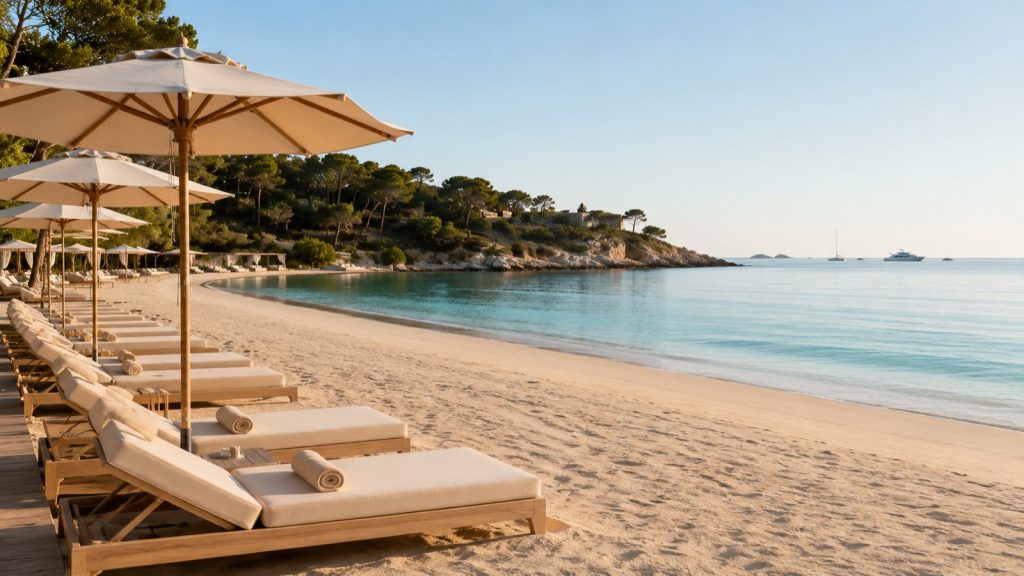
On a conceded beach, the municipality awards lots by public service delegation, with the prefect's agreement. The Hérault prefecture lists the rental of water sports equipment, paddleboards included, among the main activities of a lot. The obligations: 80% of the surface and length of the beach remain free of any occupation, installations are removable, and operation lasts 6 to 8 months a year.
If you already operate a lot, check that your agreement allows the rental of water sports equipment, and have the municipality and the DDTM confirm, before any order, that the station meets the requirement for removable installations.
“Any private occupation or use must be the subject of an authorisation issued by the departmental directorate of territories and the sea (DDTM) of the Hérault.”
“the rental of beach equipment (mattresses, deckchairs), of water sports equipment (paddleboard, pedal boat)”
What a rental station needs on site
Once the right to occupy the ground is secured, here is what the location must offer.
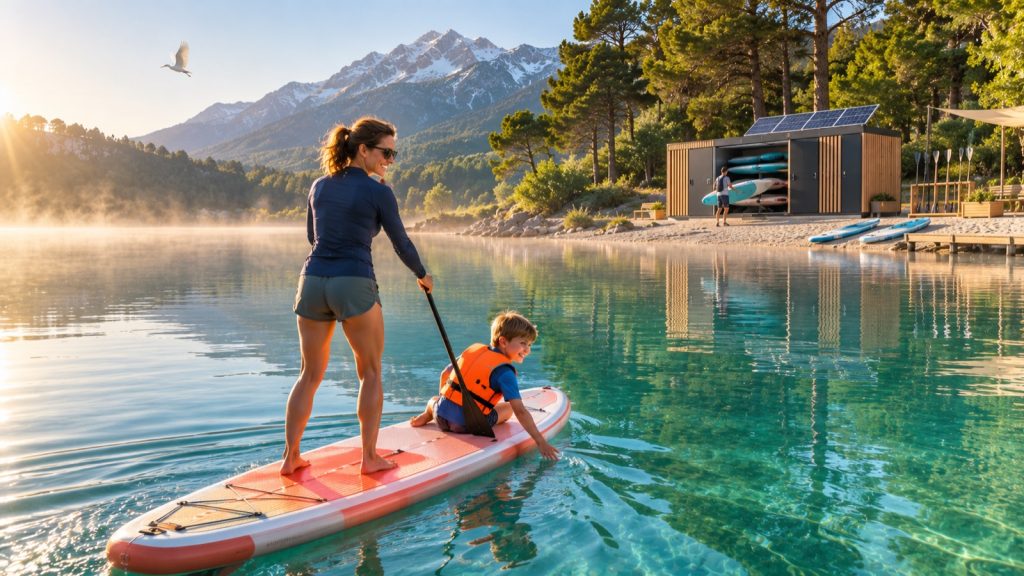
- Surface: about 1.30 × 1.30 m of ground (1.7 m²), 1.80 m high excluding boards, plus clearance to take the boards out.
- Ground: about 180 kg empty; plan for flat, stable ground.
- Energy: no connection. Solar panels and a 12 V 15 Ah battery are built in, about 3 W of consumption, several days without sun. Avoid a spot in the shade all day.
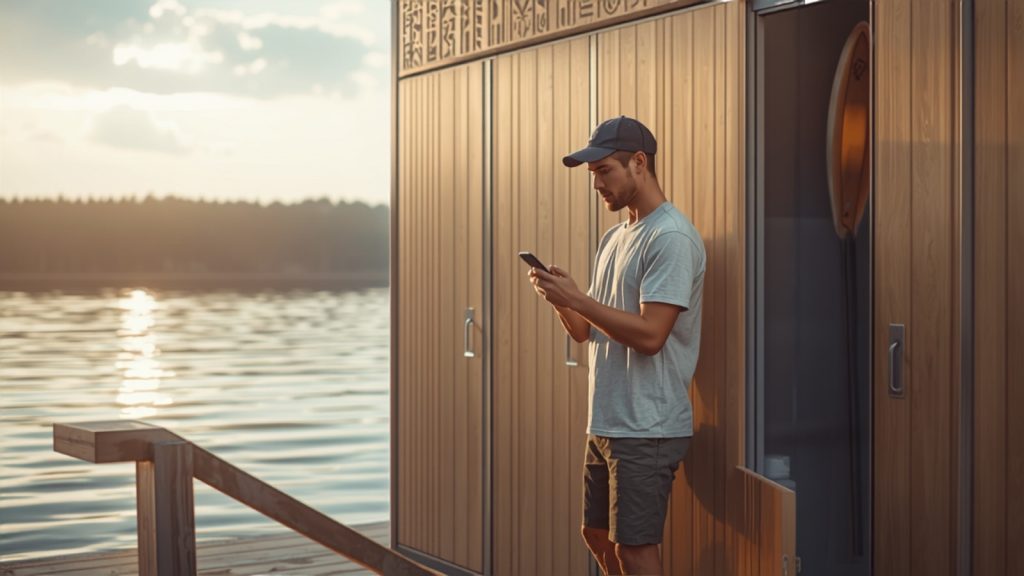
- Mobile network: a 4G LTE modem remotely monitors the state of the lockers. Arcep's “Mon réseau mobile” map shows simulations produced by the operators, whose reliability Arcep checks: check the coverage there, then confirm on site with a phone.
- Water access: choose a location from which the path to the water is short and visible.
“The required reliability threshold is 98%.”
Who can install a vending machine?
Anyone who has the right to occupy the location: the owner, an operator with the owner's written agreement, the holder of an AOT or of a beach lot. For the maritime public domain, the AOT application file of the Hérault prefecture covers the case of an individual, a legal entity or a local authority.
With Wave-Up, you buy the station and own it. It is delivered as a kit and installed by Wave-Up. Six sites are equipped, all in the Hérault: Camping Maïana Resort (La Grande-Motte), Camping Palmira Beach (Vendres), Camping Roucan Plage (Vias), Camping La Tamarissière (Agde), Camping Nouvelle Floride and Camping Méditerranée Beach Garden (installation to come) (Marseillan-Plage).
Renting paddleboards: the obligations that come on top of the location
No qualification for rental alone: the sports code reserves paid instruction to qualified persons, but does not equate the provision of equipment with it. If you offer lessons or guided outings, the qualification requirement applies.
Obligations of a physical and sports activity establishment: the Loire-Atlantique prefecture includes in this category those who make equipment available, in particular with the display of the civil liability insurance certificate and a rescue organisation chart. Have the departmental youth, engagement and sports service confirm what applies to your station.
Visible safety information: for sea paddleboarding, sports.gouv.fr reminds users to always use a leash and to check the forecasts, in particular offshore wind that pushes you away from the coast. On a river with a current, the same site states on the contrary that the leash is forbidden. Display the rules of your body of water near the station.
“The provision of equipment intended for practitioners [...] cannot be equated with the functions designated in the first paragraph of article L212-1.”
“All types of structures or persons making available animals and, or equipment enabling the practice of a physical and sports activity are also considered as such.”
The steps, in order
Start with the ground, not the machine: on the public domain, it is the award procedure that sets the timetable.
| Step | What you do | With whom |
|---|---|---|
| 1. Choose the location | Water access, footfall, surface area, sun, 4G coverage | You, on site, with the Arcep map |
| 2. Establish your right to occupy | Title deed, owner's written agreement, AOT or lot agreement | Owner, municipality, DDTM |
| 3. Check planning rules | Protected area, PLU, 100 metre strip | Town hall planning department |
| 4. Request the quote | Purchase of the station on quote; Wave-Up then provides the app, manages the rentals and handles after-sales service (station maintenance not included) | Wave-Up: free, no-obligation quote, reply within 24 business hours |
| 5. Prepare the activity | Insurance, signage, rental conditions, prices | Insurer, departmental youth and sports service |
| 6. Install and open | Kit delivery, installation, launch of the booking and payment web app | Wave-Up |
The Wave-Up offer: your station, our support
1. You buy the station
Price by quote, delivered as a kit: it belongs to you and you set your rental prices.
- The complete station, delivered as a kit
- Your rental prices, set by you
- 2-year manufacturer's warranty
- Boards, paddles and life jackets
2. Wave-Up runs the rental for you
Booking and payment app, rental management, guest support and after-sales service: your teams have no schedule and no till to manage.
- Booking and payment app
- Rental management and holidaymaker service
- Wave-Up after-sales service
- Maintenance of the station, at your expense
Does the station really belong to me? Yes: you buy it, price on quote, and you set your rental rates. It is neither a rental nor a subscription. Wave-Up then takes care of booking, payment and after-sales service. No rent, no franchise fee, no entry fee. Quote within 24 working hours. See the pricing
Frequently asked questions
Do I need authorisation to install a vending machine on my land?
No occupancy authorisation if you own the land; if you operate it without owning it, you need the owner's written agreement. Depending on the surface area, the area and the PLU, a prior declaration may be required: have the town hall's planning department confirm the procedure in writing.
Can I install a vending machine on a pavement or a square?
Only with a temporary occupancy authorisation issued by the public body that owns the land; contact the town hall first. It is paid, precarious and revocable, and for an economic activity it follows, with some exceptions, a selection procedure or prior publicity.
How much does an authorisation to occupy the public domain cost?
There is no national rate: the fee takes account of the benefits obtained by the holder. For a local authority, it is in principle set by its deliberative body; on the maritime public domain of the Hérault, by the departmental directorate of public finances.
Do you need an electrical connection or an internet connection?
Not for the Wave-Up station: solar panels, a 12 V 15 Ah battery and a 4G LTE modem are built in. You do need 4G coverage at the location, to be checked on the Arcep map and then on site.
Can the station be left on a beach all year round?
On a conceded beach, as a general rule no: removable installations, operation limited to 6 to 8 months a year. According to the ministry in charge of the sea, year-round opening is possible for the most touristic municipalities that enjoy favourable weather conditions. On private land, see the PLU and, in a coastal municipality, the Coastal Act.
Do you need a qualification to rent self-service paddleboards?
Not for the mere provision of equipment, which the sports code does not equate with instruction. A qualification becomes necessary again if you offer lessons or guided outings for payment.
Are the rules the same for a drinks or snack vending machine?
For the location, yes. Selling food adds hygiene rules: service-public.fr states that any operator who distributes or sells foodstuffs of animal origin to the final consumer must declare their establishments. Ask the departmental directorate for the protection of populations (DDPP or DDETSPP depending on the department).
Sources
- Collectivites-locales.gouv.fr: the legal conditions for occupying the public domain of public bodies (accessed 13 September 2026), https://www.collectivites-locales.gouv.fr/animer-les-territoires/gestion-des-biens-de-la-collectivite/le-cadre-general-et-legal/les-conditions-juridiques-de-loccupation-du-domaine-public-des-personnes-publiques
- Collectivites-locales.gouv.fr: practical guide to using the general code of public property (accessed 13 September 2026), https://www.collectivites-locales.gouv.fr/files/files/3.%20Animer%20les%20territoires/8.%20La%20gestion%20des%20biens%20de%20la%20collectivit%C3%A9/Guide_pratique_CG3P.pdf
- Entreprendre Service Public: which planning authorisation to file to install a garden shed? (checked on 21 March 2025, accessed 13 September 2026), https://entreprendre.service-public.gouv.fr/vosdroits/F662
- Entreprendre Service Public: prior declaration (DP) (checked on 13 February 2026, accessed 13 September 2026), https://entreprendre.service-public.gouv.fr/vosdroits/F17578
- Ministry of Ecological Transition, coastal and planning: the 100 metre coastal strip, June 2021 (accessed 13 September 2026), https://www.ecologie.gouv.fr/sites/default/files/documents/La%20bande%20littorale%20de%20100%20m%C3%A8tres_0.pdf
- Hérault Prefecture: temporary occupancy authorisation (AOT) of the maritime public domain (updated 24 March 2026, accessed 13 September 2026), https://www.herault.gouv.fr/index.php/Actions-de-l-Etat/Mer-et-littoral/Domaine-public-maritime/Autorisation-d-occupation-temporaire-AOT/Autorisation-d-occupation-temporaire-AOT
- Hérault Prefecture: beach concession (updated 24 March 2026, accessed 13 September 2026), https://www.herault.gouv.fr/index.php/Actions-de-l-Etat/Mer-et-littoral/Domaine-public-maritime/Concession-de-plage/Concession-de-plage
- Ministry in charge of the sea: conceded beaches (updated 18 January 2023, accessed 13 September 2026), https://www.mer.gouv.fr/plages-concedees
- Arcep: how to use “Mon réseau mobile”? (accessed 13 September 2026), https://www.arcep.fr/mes-demarches-et-services/consommateurs/fiches-pratiques/comment-utiliser-mon-reseau-mobile.html
- Pôle ressources national des sports de nature: article L212-4 of the sports code (accessed 13 September 2026), https://www.sportsdenature.gouv.fr/recueils/art-l212-4-c-sport
- Loire-Atlantique Prefecture: obligations of a physical and sports activity establishment (updated 25 October 2024, accessed 13 September 2026), https://www.loire-atlantique.gouv.fr/Actions-de-l-Etat/Jeunesse-sport-engagement-vie-associative/Sport/Reglementation-des-activites-sportives/Obligations-d-un-etablissement-d-activites-physiques-et-sportives
- sports.gouv.fr, water sports: stand up paddle (accessed 13 September 2026), https://www.sports.gouv.fr/activites-nautiques-1225
- Entreprendre Service Public: declaration for handling animal products (checked on 30 October 2025, accessed 13 September 2026), https://entreprendre.service-public.gouv.fr/vosdroits/F33822