Operator advice
Open a water sports rental point with no premises and no employee
Premises, counter, seasonal staff: what if none of that were necessary? How to run a water sports rental point…

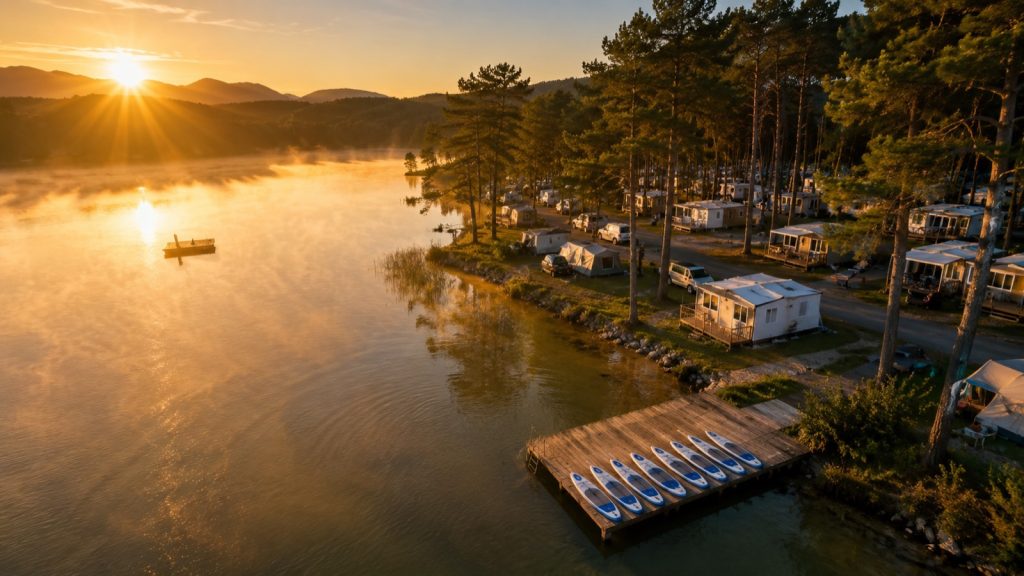
Seven in the evening, late July, on a campsite beach. The boards are drying against the fence, life jackets are piled on a table, two paddles lie in the sand. Everything must be put away before nightfall, while the storeroom is at the far end of the site.
Storing water sports equipment at the water’s edge means protecting it from salt, sun, humidity and theft without spending your evenings on it. Here is what the equipment endures, the possible storage options and their limits, the rules of a beach and the maintenance that makes it last.
The Canadian Conservation Institute, a public body, describes the first three threats well.
Each solution is a trade-off between protection, proximity to the water and handling.
| Solution | Strengths | Limits |
|---|---|---|
| Locked storeroom | Protects against theft and sun; large capacity, winter storage possible | Often far from the water; someone opens and closes; ventilation needed |
| Container | Sturdy, lockable, movable | Sheet metal exposed to salt; volume to ventilate; formalities depending on the land |
| Open shelter or canopy | Shade and air drying | No protection against theft |
| Outdoor racks | Inexpensive; the equipment dries | Ultraviolet rays; theft; daily handling |
| Connected lockers | Closed, at the water’s edge; can serve as a rental point | Investment; fixed capacity; network coverage needed |
Two levels work well together: at the water’s edge, the day’s equipment; in a ventilated room, the reserve and winter storage.
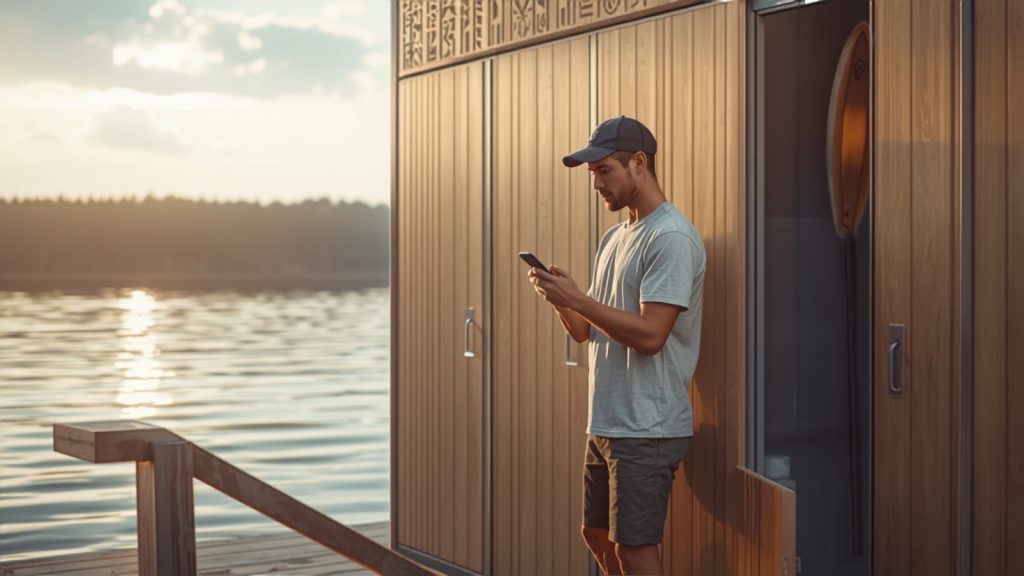
A connected locker opens with a code or a QR code, often linked to an online booking: the equipment stays locked up at the water’s edge.
This is the principle of the Wave-Up station: 8 slots for stand up paddle or surf boards, 8 lockers for the life jacket, leash and waterproof pouch, 8 clips for paddles, on about 1.7 m² of ground. It is made of powder-coated 316 stainless steel (marine grade); its 8 electric strikes withstand sea mist and a locker opens only with the code of the current booking. Solar panels and battery are built in, with no electrical connection, and a 4G modem monitors the state of the lockers remotely.
Its limits: a large fleet exceeds the capacity of one unit, the 4G signal must get through, and nobody rinses the equipment between two rentals unless something is planned. See also how to open a water sports rental point with no premises and no employees.
The seashore (everything the sea covers and uncovers up to where the highest tides reach, excluding exceptional weather events) belongs to the State’s public maritime domain. Free and no-cost use by the public is the fundamental purpose of beaches.
For storage: no permanent building on a concession beach, and a fallback point for the off-season. Have the municipality and State services confirm in writing that the planned facility falls within this framework; the guide on installing an outdoor vending machine details the steps.
On your own land, there is no occupation permit, but planning rules apply.
For the inflatable life jacket, the Sauveteurs en Mer advise, in a fact sheet from the ministry responsible for the Sea, not to store it in the sun, to rinse it with clean water after each use, to let it dry and to check its maintenance periodically. The same logic applies to foam life jackets, boards, paddles and leashes, according to the manufacturer’s instructions.
On a concession beach, only removable or transportable installations are allowed, during the operating period; for anything else, check your sub-contract or your permit. Outside and without a lock, equipment remains exposed to theft and sea spray: bring it in or lock it up.
On public domain, yes: an occupation permit is needed. On your own land, a container placed for three months at most is exempt from planning formalities (fifteen days in a listed site or near a historic monument). Beyond that, ask your town hall.
Store rinsed and dry equipment, hang up the life jackets and ventilate. Above 75% relative humidity, humidity becomes excessive and encourages mould. A hygrometer, a small device that measures the humidity of the air, lets you monitor this threshold.
For equipment rented every day, yes: it stays locked at the water’s edge. For a large fleet, repairs or winter storage, a storeroom remains useful; the two complement each other.
Good storage protects the equipment and respects the rules of the place. For equipment locked at the water’s edge that also serves as a rental point, discover Wave-Up’s connected locker for water sports equipment, then request a quote: free, no obligation, reply within 24 working hours.
To compare models before buying, from the locker where the front desk hands over the key to the connected locker linked to a booking, see our guide to choosing an automatic locker supplier, with the lines to require in each quote.
For boards rented every day, our page on the paddle rental locker compares point by point the storage unit placed at the water’s edge and the rental run from a counter, from storing the equipment to its return to the same locker.

Premises, counter, seasonal staff: what if none of that were necessary? How to run a water sports rental point…
Equipment, insurance, signage, staff, end of season: the real budget of a water-sports activity in a campsite, item by item, with the amounts…

Eight ways to run a seaside, lakeside or riverside site: starting capital, seasonal staff, permits and causes…
Estimate the revenue of a self-service rental station on your site, then request your free quote.
