
Product & behind the scenes
Winterising a seaside rental station: 3 scenarios
Leaving the station in service, putting it on standby or dismantling it: what each scenario implies for the battery, the…
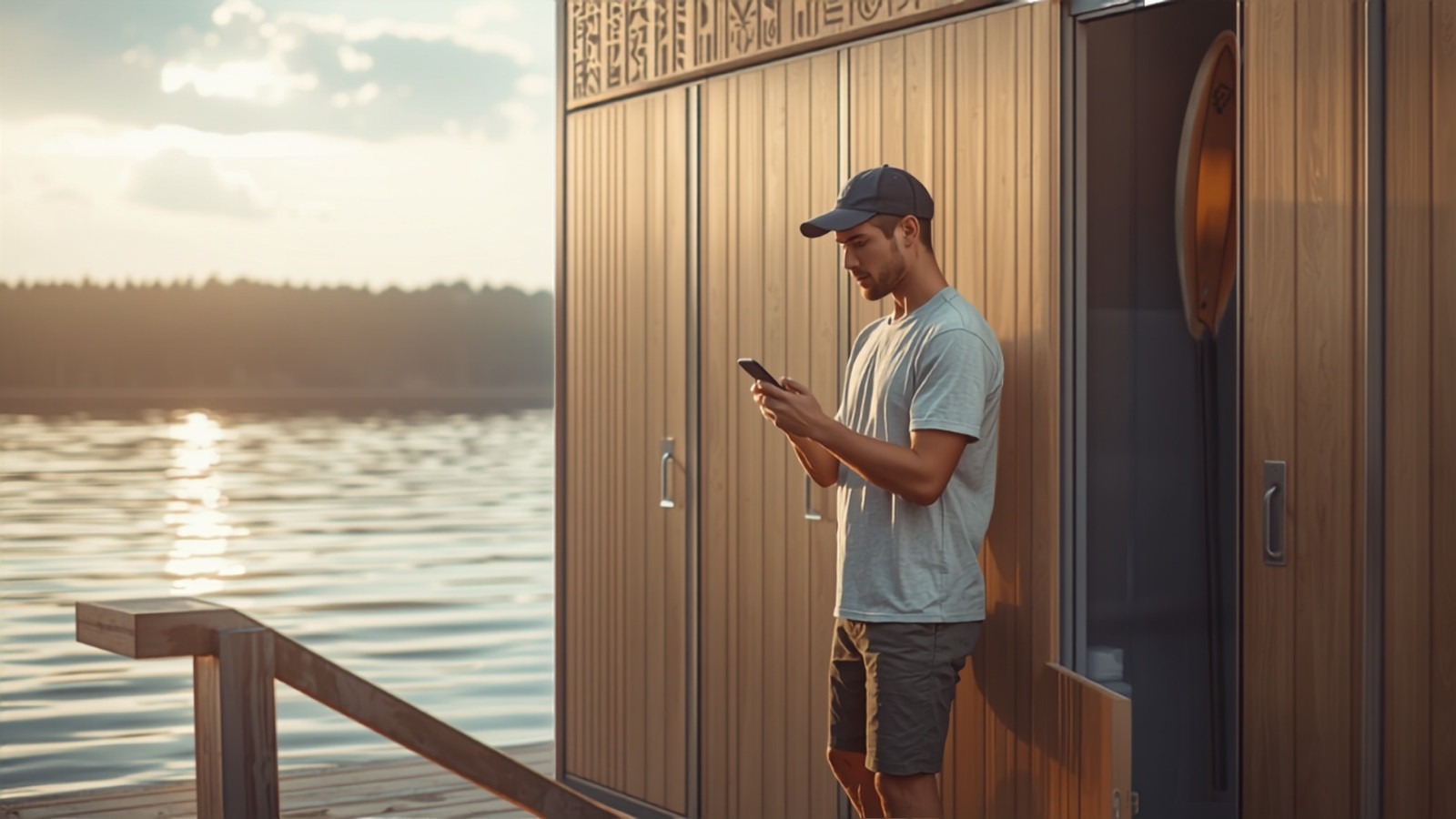
8:12 a.m., a July morning, beside a lake still smooth as glass. A holidaymaker in flip-flops walks down the path, a towel over his shoulder, and stops in front of a row of large lockers lined up facing the water. He takes out his phone and frames the QR code on the front. The campsite snack bar has not yet raised its shutter, but here the day is under way.
What exactly happens between that gesture and the moment the board returns to its locker? That is the subject of this guided tour of a self-service rental station: each step, from the scan to the door closing, then the behind-the-scenes view: what the operator experiences, what is hidden under the hood, what this changes at the water’s edge.
This QR code is the entry point of the system: it tells the booking page which station it is, and without this scan there is no remote booking journey. Opened in the phone’s browser, with nothing to install, it lets our holidaymaker choose their equipment, pick a duration from those the page offers, 1 h, 2 h, 4 h or 8 h, then pay online by card. This booking and payment web application is provided by Wave-Up to the operator, owner of the station.
Once payment is confirmed, a personal code is issued. This code is the key to the rest of the journey: it matches their booking, their locker and their time slot. No physical key to collect, no counter to return it to. The full process is presented on the page booking your board.
Back in front of the station. The holidaymaker enters their personal code; a click, and the door of their locker opens. The equipment for the outing is waiting: the board in its slot, the paddle on its clip, the life jacket and leash in the accessories locker. They asked no one for anything: the station recognised the code and opened the locker their booking assigns them.
They take out the board, tuck the paddle under an arm, put on the life jacket, push the door shut and head down to the water. Seen from the bank, the gesture looks like nothing; technically, a rental has just started without any human intervening on the renter’s side.
What follows no longer concerns the machine: glassy water, an unimpressed heron, arms finding their rhythm, life jacket adjusted, leash on the ankle and the outing announced to a relative, as recommended by the French Surfing Federation. At sea, beyond 300 metres from a shelter, individual buoyancy equipment becomes mandatory. Then, at 10:05 a.m., the board comes back, dripping.
The return comes down to one instruction: put everything away. The board in its housing, the paddle and life jacket in their place, the door closed before the end of the slot, and the outing is over. No checkout, no one to notify. The holidaymaker leaves hands free, with the feeling of having put a book back on its shelf.
Let us rewind the morning, seen this time from the manager’s desk. At 8:12 a.m., he was perhaps still asleep. At 8:16 a.m., he unlocked nothing. At 10:05 a.m., he checked nothing. The booking, the payment, the locker assignment, the opening: everything happened without him. His role was played beforehand: equipping the station with its boards, paddles and life jackets, setting his prices and defining the access conditions of his establishment.
In its place, each locker stays locked by an electric strike and opens only with the code for the current booking; the lockers’ status is monitored remotely. The solar panels and the battery, built in as standard, run the station off the grid, without a connection. That is what allows it to be placed far from any meter, on a beach or beside an isolated body of water.
| Step | What the customer does | What happens on the station side |
|---|---|---|
| Booking | Scans the QR code, chooses a duration, pays online | Checks availability, takes payment, issues a personal code |
| Pickup | Enters their code on the station | Unlocks the assigned locker |
| On the water | Paddles, navigates, enjoys | The locker stays locked until the return |
| Return | Puts back board, paddle and life jacket, closes the door | The locker gets its equipment back for the next time slot |
A Wave-Up station lines up 8 slots for boards, 8 lockers for the life jacket, leash and waterproof pouch, and 8 clips for the paddles: enough to store the complete equipment for an outing. It can be configured for stand up paddle or for surfing, and for kayak depending on configuration, on quote: a leisure-park lake does not call for the same kind of glide as an ocean beach. The version dedicated to stand up paddle is detailed on the page self-service SUP station.
The station is delivered as a kit and assembled on site, with no connection or works; its price is provided on quote. And because all the equipment fits inside the station, there is no premises to fit out, no storage shed: the station is at once the shop, the till and the stockroom.
Described this way, the mechanism might pass for a curiosity: a remotely controlled lock with boards behind it. That would be misreading it. A locker that unlocks by itself is not a gadget: it is infrastructure, just like a pontoon or a slipway.
What it unlocks first is time: with no counter to staff, it no longer depends on the hours when someone can stand behind it. The rental hours, for their part, remain those that the establishment hosting the station allows. It then unlocks places: the banks, coves and lagoons too modest to justify premises and an employee. We have devoted an article to this model, opening a water sports rental without premises or employees, and another to the underlying movement of self-service, the revolution of self-service lockers. Here, we have taken the machine apart; there, you will see the market it opens.
No, and booking begins in front of the station in any case. It is the QR code on it that opens the booking page and tells it which station it is: without this scan, there is no remote booking journey. On site, from your phone, you choose a duration of 1 h, 2 h, 4 h or 8 h, you pay by card and you receive your personal code.
The station gathers the complete equipment for the outing: the board, paddle or surf, in its slot, the paddle on its clip, the life jacket and leash in the accessories locker. On return, you put everything back, close the door, and the outing is over.
Booking, payment and locker assignment are done online after scanning the station’s QR code, and the personal code replaces handing over keys. Each locker opens only with the code for the current booking, the lockers’ status is monitored remotely, and the solar panels and battery built in as standard power the station off the grid. The holidaymaker books in front of the station, from their smartphone, with nothing to install.
Wherever a body of water attracts users: campsite, seaside hotel, leisure park, private or municipal beach. The solar panels and battery, built in as standard, run the station with no electrical connection or major works; permits, however, remain your responsibility. On private land, a structure with a footprint of no more than 5 m² and under 12 m high is exempt from any planning formality, except in a classified site, near a historic monument or in a remarkable heritage site. On a concession beach, the framework is stricter: only removable facilities are allowed, and they must be folded away outside the authorised operating period.
That is the whole mechanism: a QR code, a time slot, a code, a door, and at the end, the water. If you are curious, the most direct way to understand is still to walk through the booking journey. If you are an operator, the free profitability simulator gives a first idea for your site, and a quote request receives a reply within 24 working hours. At Wave-Up, we like taking the machine apart as much as watching it run at the water’s edge.

Leaving the station in service, putting it on standby or dismantling it: what each scenario implies for the battery, the…
Rinsing, life jackets, solar panels, management records: the honest list of what a self-service station still leaves you to do, and…

Manufacturer warranty, hidden defects, after-sales service, maintenance: four regimes that get confused. What each covers on a connected locker, and the clauses…
Estimate the revenue of a self-service rental station on your site, then request your free quote.
