Product & behind the scenes
Do you need a concrete slab to install a station by the sea?
No, the slab is not mandatory, and on a concession beach it is prohibited. Load-bearing capacity, ballast, wind, footprint: this…

On 15 October, the site is empty and the boards go to the shed. One question remains: what do you do with the machine. A self-service rental station is electrical, connected and locked equipment, standing outside facing the wind for six months while nobody passes by.
There are three answers, and only one can be imposed on you by law: leave the station in service, put it on standby, or dismantle it. Here is what they involve, with sources: the European Commission for winter solar, the General Code of Public Property for beaches, Météo-France and BRGM for wind and sea. We are talking about the machine, not the boards.
| Scenario | What it demands | When it is the right choice |
|---|---|---|
| Leave in service | 4G connection maintained, someone on site | Establishment open off-season |
| Put on standby | Lockers emptied, anchoring checked, solar left connected | Site closed but accessible |
| Dismantle and store | Handling of about 180 kg empty, a dry sheltered space, battery stored charged | Conceded beach, flood-prone area |
Standby takes the fewest steps. Dismantling is the only option that puts the machine under cover, and the only one that costs handling twice a year. An empty station is not necessarily left in peace, see our article on vandalism and theft on outdoor equipment.
Article R2124-16 of the General Code of Public Property, in force since 1 January 2016, authorises only removable or transportable equipment on a beach, with no element designed to anchor it durably to the ground. It adds a sentence often discovered late: the conceded area must be free of any removable equipment outside a period defined in the concession, which cannot exceed six months.
Article R2124-17 allows this period to be extended to a maximum of eight months a year in classified resorts, if the host municipality has declared itself in favour by a deliberation reasoned with regard to tourist numbers. Articles R2124-18 and R2124-19 allow a presence outside the period, but only for beach establishments and under strict conditions. See our guide on the installations allowed on a beach lot.
The six sites equipped by Wave-Up are campsites in the Hérault, where the station stays on the establishment’s own land: the six-month rule does not apply there. Before ordering, state the status and calendar of your site in your quote request.
The station runs on solar panels and a 12 V 15 Ah battery as standard, with no electrical connection, for a consumption of about 3 W. The winter question is not the power of the panels, it is what they receive in December. PVGIS, the tool of the European Commission’s Joint Research Centre, provides it free of charge. For La Grande-Motte (43.56 N, 4.08 E), 2016 to 2020 average, fixed panel facing due south, in kWh per m² per month.
| Month | Horizontal plane | Tilted at 38° (annual optimum) | Tilted at 60° |
|---|---|---|---|
| December | 48 | 96 | 109 |
| January | 54 | 102 | 114 |
| July | 225 | 216 | 177 |
Remember the ratio. Flat, a panel receives 4.7 times less in December than in July. Raised to 60°, only 1.6 times less, because a tilted plane faces the low sun head-on. The tilt that maximises the year is therefore not the one that secures December, a point developed in our article on solar energy applied to water leisure. Practical consequence: shade. A pine with no shade in July casts one in December.
It is not the cold that kills a stored battery, it is leaving it discharged. The Power-Sonic technical manual gives the orders of magnitude for sealed lead batteries, the most common format for this type of equipment. Check the chemistry of yours before applying these values.
Two rules. Station in place: keep the panels connected, they recharge the battery all winter. Station dismantled: battery fully charged, stored dry and frost-free, reminder at six months.
The station carries a 4G LTE modem, which lets you monitor the state of the lockers remotely. Leave it in service during the closure: it is the only link with a machine standing on an empty site, and it saves you from discovering in April a problem that appeared in January. An offline station reports nothing.
The network generation, for its part, is not an issue here. Arcep recommends that businesses run a diagnosis of their connected equipment, because operators are switching off 2G in mainland France during 2026 and 3G between 2028 and 2029. The targets are alarms and remote monitoring, lift emergency phones, heating control, intercoms and video intercoms. 4G and 5G are not affected, and 4G covers more than 99.9% of the mainland population.
Météo-France points out that the tramontane affects the south of the Hérault and blows all year round, with more force in winter and spring. A tramontane day is counted from gusts of 60 km/h: the 1981 to 2010 average is 144 days a year at Narbonne, with peaks of 140 km/h.
The BRGM report on marine storms in Languedoc-Roussillon specifies the calendar. From May to September is the usual lull; most major events occur from October to February. Most regional storms raise waves of 3 metres significant height, the threshold for partial flooding of the beach; at 4 metres the dune front erodes; at 5 metres and beyond, the low areas facing the swell are overrun. Since 1979, 39 storms have been recorded at the Espiguette and 38 at Sète.
Hence the end-of-season list: check the anchoring and tightening, detailed in our article on the concrete slab and anchoring of a seaside station; empty the eight lockers; lock the doors; rinse the fasteners and strike plates; photograph the site with the date.
The full calendar is in our beach and water sports centre opening checklist.
Growth is no longer decided at the height of summer. According to Insee, Occitanie recorded 47.2 million overnight stays in collective accommodation from April to September 2025, up 2.2% on 2024, including 29.6 million in campsites, up 2.7%. The detail: June is up 12.0%, driven by the shift of Pentecost, and September 1.2%. A station dismantled on 30 September serves nobody in October, whereas a station left in service runs as long as the establishment stays open, a season described in our article on paddle in autumn and winter. Access depends on the establishment, which alone sets its hours.
No, unless the status of the land requires it. On private land, in a campsite or at a leisure centre, standby is almost always enough. On a conceded beach, article R2124-16 requires you to clear the area outside the period defined in the concession.
If the panels stay connected, yes: solar produces less than in July but without interruption, and there are no rentals left to power. The problem is the battery that is disconnected and forgotten in a dark room.
Yes. The 4G modem is the only link with the station while the site is empty, and it is how the state of the lockers is reported. The station consumes about 3 W and runs on its panels and its battery, with no electrical connection: leaving it online requires nothing more. In April, you start again from a known state.
In the Mediterranean, the cold is not the issue, salt is. The station is in powder-coated 316 stainless steel, the so-called marine grade, and its eight strike plates resist sea mist. The manufacturer warranty is two years parts and labour, excluding vandalism.
Yes, it is delivered as a kit, so it can be taken apart. Plan the means: about 180 kg empty, a 1.30 m by 1.30 m footprint, a pallet truck or a few pairs of arms, and a vehicle.
Winter storage is not an October chore, it is an installation parameter: winter exposure and shade, type of anchoring, distance from the zone the swell can overrun, land status and authorised period. Decided upstream, winter becomes a non-event. Discovered in October, it becomes an end-of-season emergency. Before all this comes the potential of the location itself: that is what GeoScan, our in-house technology, assesses from public data.
If the prospect of a machine sleeping for six months holds you back, describe your site to us. Request a Wave-Up quote: it is free, with no commitment, and you get a reply within 24 working hours.

No, the slab is not mandatory, and on a concession beach it is prohibited. Load-bearing capacity, ballast, wind, footprint: this…
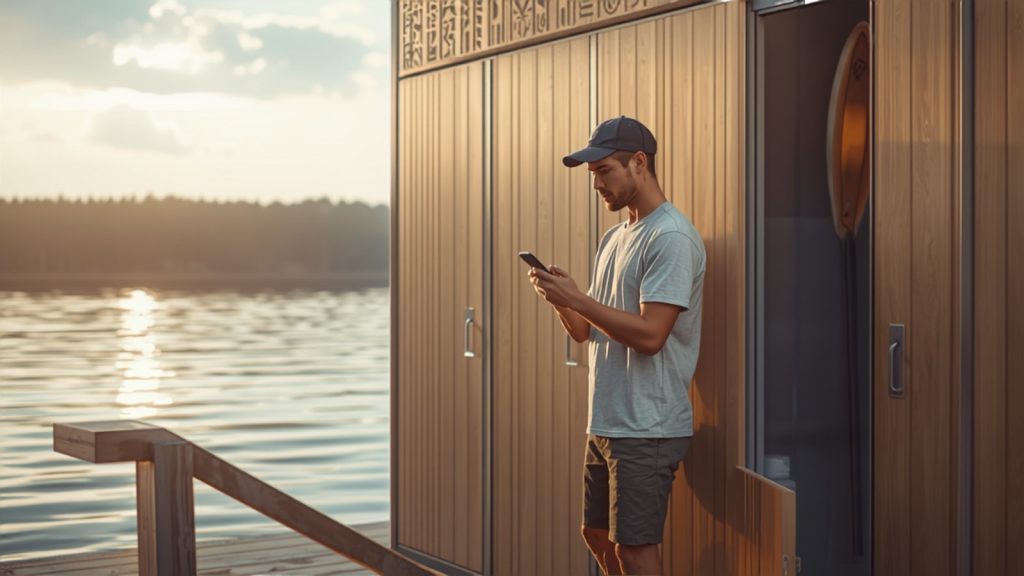
8:12 a.m., a holidaymaker scans a QR code beside a lake. A guided tour of a self-service rental station, from the code…
Rinsing, life jackets, solar panels, management records: the honest list of what a self-service station still leaves you to do, and…
Estimate the revenue of a self-service rental station on your site, then request your free quote.
