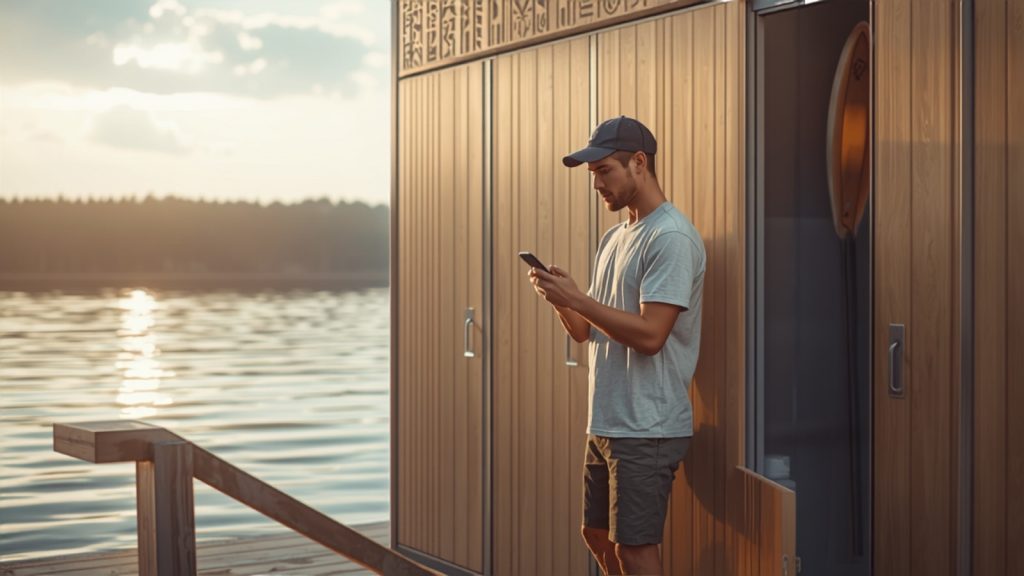
You have a plot by the water, a riverbank, a stretch of beach away from buildings. No meter, no cabinet. You describe your project, and the first answer talks about a trench.
A self-service rental unit works without a connection and without wifi, provided it is frugal. Here is what the trench costs according to the Enedis tariff, and what a panel covers over a year according to the European Commission's PVGIS off-grid simulator. The limits are written down too.
Contents
What a connection costs
The price comes from a public tariff, the document Enedis-NMO-RAC_009E version 7.2, approved by the Commission de régulation de l’énergie on 17 April 2025 and applicable since 17 July 2025. It remains the reference until 27 October 2026: the next version, in force on 28 October 2026, changes these amounts, so check the one that applies on the day of your request.
The full connection, which links your installation to the existing network, costs €2,340 excluding VAT up to 36 kVA. The extension, the low-voltage network to be built when nothing runs in front of the plot, is counted as a fixed part plus a price per metre: €2,549 excluding VAT and €105 excluding VAT per metre in ZFA, €3,296 excluding VAT and €138 excluding VAT in ZFB. These amounts are excluding tax and before the 40% tariff reduction set for consumers by the order of 30 November 2017; they leave the trench on private land, and the supply and laying of the conduit, to the applicant. The lower averages published elsewhere by Enedis, €430 and €1,690 including tax, are stated including all taxes and net of the reduction.
| Distance to the network |
Connection and extension, ZFA |
After reduction |
| 150 m |
€20,639 excl. VAT |
€12,383 excl. VAT |
| 300 m |
€36,389 excl. VAT |
€21,833 excl. VAT |
On bare land, point 5° of article L342-21 of the French Energy Code is clear: when the extension connects a consumer outside an authorised construction or development operation, the corresponding contribution is paid by the applicant, that is, by you.
Lead times are counted in months: about two on serviced land up to 36 kVA, three on unserviced land, six as soon as an extension is needed. The lead time then weighs as much as the price, as detailed on our page on making your land profitable.
What a unit consumes
A trench is justified when the machine is power-hungry. A connected locker produces neither cold, nor heat, nor movement: the current goes to the door strikes, a few seconds per opening, then to the modem.
The Wave-Up station consumes about 3 W, that is 72 Wh per day and nearly 26 kWh over a year. The 2023 survey of the Association française de l’éclairage, relayed by Cerema, counts 12 million light points for 2.42 TWh per year.
| Equipment |
Power |
Annual consumption |
| Wave-Up station |
about 3 W |
about 26 kWh |
| Public light point, 2023 average |
about 87.5 W |
about 200 kWh |
Over a year, a station consumes a little more than one eighth of a street lamp. It is this order of magnitude that decides, as with the low-power machines on our page installing a vending machine.
Solar and battery over a year
The station comes with solar panels and a 12 V 15 Ah battery as standard, that is 180 Wh for a need of 72 Wh per day. The right question is not how many days it lasts, but how many days a year it runs flat. PVGIS, from the European Commission's Joint Research Centre, answers it.
Result for a point on the Hérault coast (43.30 N, 3.45 E), discharge limited to 40%, panel at 35° facing due south, PVGIS-SARAH2 data from 2005 to 2020, programming interface 5.2, whose radiation database differs from the online version.
| Panel |
Days when the battery runs flat |
January |
From June to September |
| 50 Wp |
6,45 % |
18,4 % |
from 0% to 0.62% |
| 100 Wp |
1,45 % |
5,0 % |
from 0% to 0.4% |
In this simulation, on a day when the battery runs flat, the equipment has no power until the light returns: about five days a year with 100 Wp, almost all in winter. The simulated battery reaches full charge on 93.36% of days. These results apply to the assumptions of the calculation, not to a measurement on the Wave-Up station. Sizing is therefore decided in January, not in summer, a subject covered in our article on solar energy in water leisure.
A 4G modem instead of the site's wifi
A campsite's wifi covers buildings, not an isolated point two hundred metres from reception. It depends on a router that someone restarts, a password that changes, a guest network that cuts off connected objects. The station comes with its own 4G LTE modem. What remains is the generation, which Arcep settles through its timetable.
- 2G. Orange began on 31 March 2026 in the South-West and is rolling out from late September to late December 2026. SFR announces 15 November 2026, Bouygues Telecom follows Orange.
- 3G. Orange in 2028, SFR at the end of 2028, Bouygues Telecom at the end of 2029.
Arcep lists among the equipment concerned alarms, lift emergency phones, heating controls and intercoms, and recommends a diagnosis now. For a new project, a 2G or 3G module is a dead end, one more reason why the autonomous station needs neither a socket nor a network cable.
Check coverage and exposure
- Mobile coverage. Mon réseau mobile, from Arcep, compares the four main operators. Since 2 September 2024, its maps distinguish four levels of 4G mobile internet coverage.
- Existing antennas. Cartoradio, published by the Agence nationale des fréquences, shows sites carrying an antenna with an equivalent isotropically radiated power above 5 W, declared under article L.43 of the French Postal and Electronic Communications Code.
- Sun exposure. PVGIS calculates the horizon from a terrain model: it sees the hill, not the umbrella pine or the wall of the sanitary block. This must be checked on site, on a winter day.
State the exact address of the plot in your quote request, with what you have noted about mobile coverage and sun exposure. Wave-Up also has GeoScan, an in-house technology that assesses a location from public data.
What does not work off-grid
Autonomy is a ratio between what is consumed and what is captured. Four cases where it does not hold.
- Cold and heat. A refrigerated appliance or a hot drinks machine is a different order of magnitude. Read the rating plate and compare with the 26 kWh of a locker.
- Multiplied load. The PVGIS model is proportional: ten times the consumption requires ten times the panel and battery, hence a structure and a footprint on the ground.
- No mobile coverage. Without a network, no remote supervision, no online booking or payment. No panel makes up for a missing antenna.
- Permanent shade. A wall to the north or a dense pine wood cannot be fixed with a bigger battery.
Maintenance and winter storage
Off-season, nothing stops: the modem runs, the panel charges, there is nothing to unplug.
The station is made of thermo-lacquered 316 stainless steel, the marine grade, and its 8 door strikes withstand sea mist. In autumn, clean the panel and check that nothing has grown in front of it: a hedge that gains a metre per season costs days of production. The manufacturer's warranty covers two years, parts and labour, excluding vandalism, detailed in our article on breakdown, warranty and after-sales service for a station.
FAQ
Is an electricity meter needed to install a self-service station?
No. The Wave-Up station comes with solar panels and a 12 V 15 Ah battery as standard, for about 3 W, and needs no connection. The check concerns sun and mobile coverage.
How much does an Enedis connection cost on bare land?
The full connection up to 36 kVA is €2,340 excluding VAT, plus an extension at €2,549 excluding VAT and €105 excluding VAT per metre in ZFA. At 150 metres, €20,639 excluding VAT, that is €12,383 excluding VAT after reduction, and about six months lead time. Only Enedis's offer is binding.
And if there is no sun for several days in a row?
The battery takes over and the panel recharges it as soon as the light returns. On the Hérault coast, the PVGIS simulation with 100 Wp and 180 Wh gives 1.45% of days in the year when the battery runs flat, of which 5% in January and 0.4% in August.
Isn't the establishment's wifi enough?
Rarely. An isolated point quickly falls out of range of the access points, and a guest network often filters connected objects. The station has its own 4G LTE modem: it depends neither on the router nor on the site's password.
Does the station really belong to me?
Both: the station is purchased (price on quote, answer within 24 working hours, delivered as a kit), then Wave-Up provides the app, manages rentals and holidaymaker service, and handles after-sales support. It is neither a rental nor a subscription: the station belongs to you, and its maintenance remains your responsibility.
Check the plot before the trench
A plot without a meter is not a plot without a project. Check mobile coverage and sun exposure before having a trench priced: if both are a yes, the meter is useless for 3 W equipment.
Send us the address of the plot and what you intend to offer there. Request a Wave-Up quote, free and with no commitment, answer within 24 working hours.
The same reasoning applies to a left-luggage locker: a connected, low-power model needs neither a trench nor wifi, whereas a key locker goes through reception and a coin locker requires collection. Our guide automatic left-luggage locker: types, suppliers and quotes compares these families and the lines to demand from a supplier.
Before choosing a point on your plot, also check the space: the technical sheet of the solar paddle locker gives the station's footprint, about 1.30 × 1.30 m on the ground and 1.80 m high excluding boards, with a 3D view from every angle.
Sources
- Enedis, Tariff for invoicing connections to the Public Electricity Distribution Network, Enedis-NMO-RAC_009E version 7.2, applicable as of 17 July 2025
- Enedis, General information on the price and lead times of a connection
- Enedis, What is the lead time for an electrical connection
- Commission de régulation de l’énergie, approval of Enedis's new connection tariff, in force on 28 October 2026
- Légifrance, order of 30 November 2017 on the coverage of connection costs to public electricity networks
- Légifrance, French Energy Code, article L342-21
- Service Public Entreprendre, estimate of the price and lead times of a connection to the electricity grid
- European Commission, Joint Research Centre, Photovoltaic Geographical Information System
- European Commission, PVGIS user manual, off-grid calculation and horizon accounting
- Arcep, shutdown of 2G and 3G mobile networks, practical guide for businesses
- Arcep, mobile coverage maps
- Arcep, Mon réseau mobile, compare operators' coverage and quality of service
- Agence nationale des fréquences, presentation of Cartoradio
- Cerema, public lighting figures, survey of the Association française de l’éclairage