
Operator advice
Developing your private beach: the guide to combining experience and revenue
Zoning, materials, services, off-season: the method for developing a private beach that delights customers, and earns its living all…
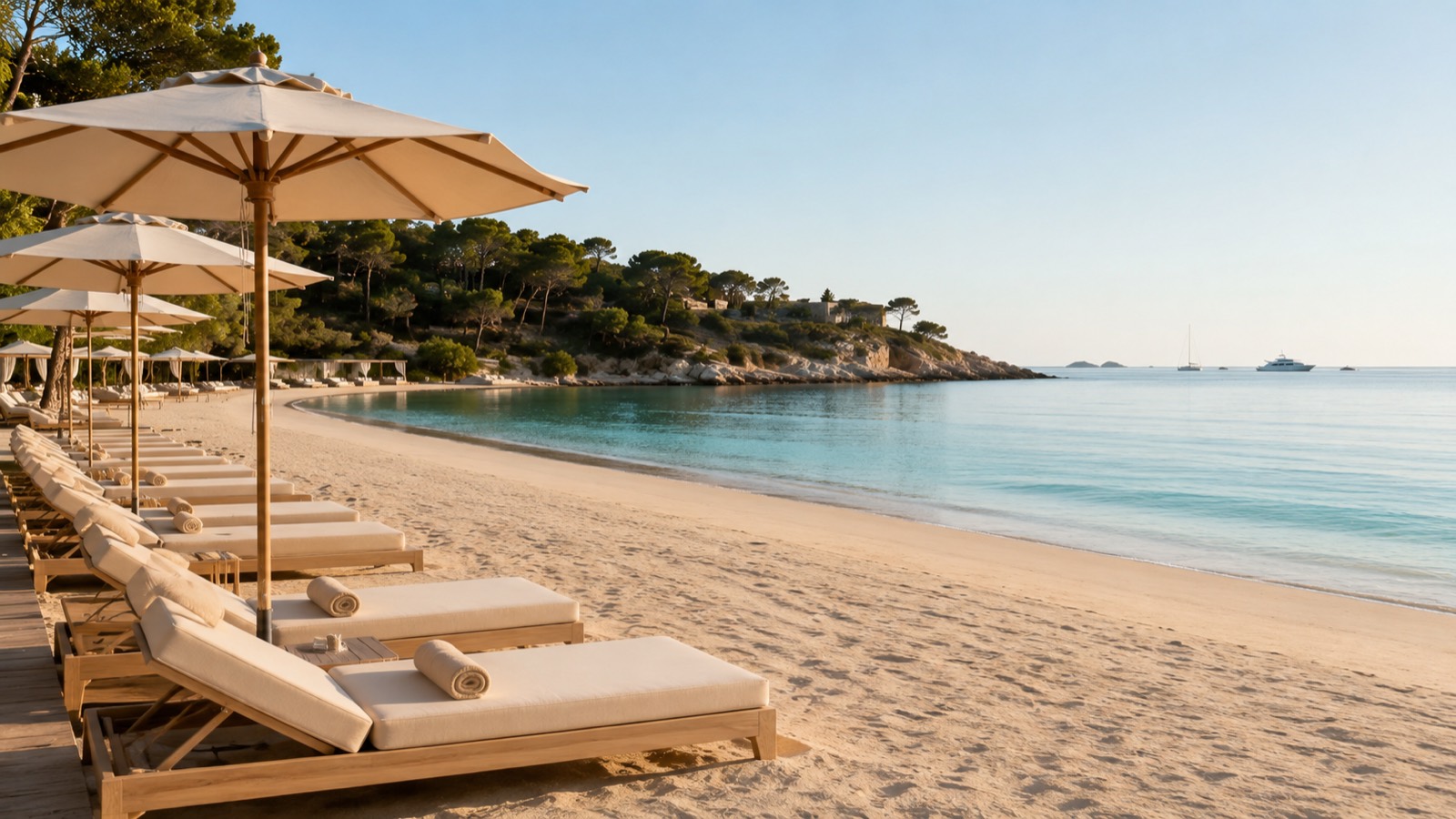
You are looking for usable access to the water, and the listings talk about a private beach, a beach business, a property with direct access to the sand. The wording suggests that a beach can be bought like a house.
The answer is clear: on the seaside, you do not buy a beach. The shoreline belongs to the State's natural public maritime domain, inalienable and imprescriptible. What can be bought is a plot of land behind the shoreline, buildings, sometimes an operating value, and a right to occupy the sand for a limited period. The sources are Légifrance, the Ministry of Ecological Transition and the Hérault prefecture.
Article L2111-4 of the General Code of Public Property places in the natural public maritime domain the soil and subsoil of the sea up to the shoreline, made up of everything the sea covers and uncovers up to where the highest tides can reach in the absence of exceptional weather disturbances. A physical definition, not a cadastral one: it follows the water.
Article L3111-1 closes the door: property belonging to the public domain is inalienable and imprescriptible. The Ministry of Ecological Transition adds that this domain cannot be seized. Filling in land therefore privatizes nothing in itself: land artificially removed from the action of the tide remains part of this domain, subject to concession deeds transferring ownership that were lawfully made and properly carried out.
The boundary is determined by the State (article L2111-5); the deed is notified to the neighboring owners and ownership claims are time-barred after ten years.
| What we are talking about | Can it change hands? | Text |
|---|---|---|
| The shoreline, the sand, the foreshore | No, inalienable and imprescriptible | CG3P L3111-1 |
| A plot of land behind the shoreline boundary | Yes, ordinary property sale | common law |
| The buildings on that land | Yes, together with the land | common law |
| A business (fonds de commerce) on a natural beach | No, excluded from the natural public domain | CG3P L2124-32-1 and L2124-35 |
| The title that authorizes occupying the sand | No, it is not an asset: it is temporary, precarious and revocable | CG3P L2122-2 and L2122-3 |
The law of 18 June 2014 opened the business (fonds de commerce) to the public domain, subject to an own clientele (L2124-32-1), but article L2124-35 excludes it from the natural public domain, which a beach belongs to. What remains is the occupancy title (L2122-2 and L2122-3): no commercial lease, no right to renewal. What an operator sells lies in the activity and its installations, never in the ground.
Article R2124-13 allows the State to grant the development, operation and maintenance of a beach under concession, for twelve years at most. Article L2124-4 gives priority to metropolitan authorities and, outside their territory, to municipalities or their groupings; if they decline, the concession may go to public or private persons after advertising and prior competitive tendering. Any operating sub-concessions are awarded the same way, after advertising and competitive tendering.
The State services in the Hérault sum up the process: the State grants natural beaches under concession to the local authorities that request them, the municipality allocates lots to sub-concession holders, and the departmental directorate for territories and the sea checks compliance with the specifications. This sub-concession, and it alone, authorizes installing anything on the sand.
| Rule | What the text says | Article |
|---|---|---|
| Concession duration | Twelve years at most | R2124-13 |
| Area left free | 80% of the shoreline length and surface, 50% on an artificial beach | R2124-16 |
| Nature of installations | Removable or transportable, with no lasting anchoring to the ground | R2124-16 |
| Operating period | Six months at most, eight months in classified resorts if the municipality decides so by reasoned resolution | R2124-16 and R2124-17 |
| Fee | Taking into account the benefits of every kind obtained by the holder | L2125-1 and L2125-3 |
| Early termination | Termination without compensation after two years without sufficient operation | R2124-35 |
The right to operate a beach is therefore limited, seasonal, and ends with dismantling. See our articles on obtaining a lot and on what you are allowed to install there.
A plot of land that runs down to the shoreline boundary is still crossed by the public. Article L121-31 of the Urban Planning Code burdens private properties bordering the public maritime domain, over a width of three meters, with a pedestrian right of way that applies by operation of law.
The right of way spares land within fifteen meters of dwellings built before 1 January 1976 and land enclosed on that date, unless it is the only means of ensuring continuity of passage (L121-33). Finally, article L321-9 of the Environment Code states that pedestrian access to beaches is free and that their free and unpaid use by the public is their fundamental purpose.
Above the shoreline boundary, private property regains its rights, but the coastal law governs what can be placed there. Article L121-16 of the Urban Planning Code prohibits buildings and installations, outside urbanized areas, within a coastal strip of one hundred meters from the upper limit of the shoreline; article L121-17 exempts those needed for public services or for economic activities requiring immediate proximity to the water.
Since the law of 22 August 2021, coastline retreat has been added: the municipalities concerned delimit a zone exposed within thirty years and another between thirty and one hundred years (L121-22-1 and L121-22-2). In the first, in an urbanized area, article L121-22-5 admits a new installation only if it is removable.
One word comes up everywhere: removable. Equipment that is placed, mobile and autonomous therefore passes through doors that are closed to a building. A self-service paddle or surf rental station takes up about 1.7 m² on the ground, weighs about 180 kg empty and runs on solar panels, with no electrical connection: see our page on a station on a private beach. The formality exemptions of articles R421-2 and R421-5 of the Urban Planning Code nevertheless rest on thresholds of footprint, height and duration, assessed by the urban planning department.
Away from the sea coast, the bed of non-state watercourses belongs to the owners of both banks, each for half in the absence of title or contrary prescription (L215-2 of the Environment Code). A pond or enclosed body of water can therefore be fully private property, with other constraints, gathered in our dedicated article.
If the project concerns the municipal public domain rather than a conceded beach, see our article on setting up a leisure service on the public domain.
No. The shoreline cannot be sold, and the seller of a "private beach for sale" only transfers what surrounds it: buildings, a plot set back from the shore, a business (fonds de commerce) or the shares of the company operating a lot.
The sub-concession itself cannot be freely transferred. The code provides for its transfer only to the spouse, civil partner, an ascendant or a descendant of an operator who is an individual, if the agreement allows it, and always with the prior consent of the concession holder (article R2124-34). At expiry, the concession holder, most often the municipality, puts the lot out to tender again: it chooses the next operator, not the seller.
Sand has no price, since it is not sold: the only public figures are those published by municipalities when they put their beach lots out to tender again, on the BOAMP.
| Notice published in 2026 | Duration | Estimated value excluding VAT | What the operator pays |
|---|---|---|---|
| La Grande-Motte, 3 lots in a remarkable natural area (18 June) | 3 seasons | €420,000 for the three lots | An annual fee: the proposed amount counts for 20% of the score |
| Agde, 2 lots (9 August) | 7 years | €1.7 million (la Roquille and the Môle) and €3.6 million (les Battuts) | An annual fee with a fixed part and a variable part, paid before 1 September, and investments to be amortized over the 7 years |
| Palavas-les-Flots, 7 lots (21 October) | 5 seasons | From €125,000 (sports activity or children's games) to €15,475,000 (equipment rental and catering) | Not specified in the notice |
This estimated value corresponds, under article R3121-1 of the Public Procurement Code, to the holder's total turnover excluding taxes over the whole duration of the contract. These are municipal estimates, not operating results. The land and buildings, for their part, are paid for at the local market price.
Not on the seaside: the shoreline belongs to the natural public maritime domain, inalienable and imprescriptible (article L3111-1). You buy a plot of land behind that boundary, never the shoreline.
A plot of land and buildings behind the shoreline, with an activity carried out on the sand under a sub-concession, itself backed by a concession limited to twelve years.
There is no price for sand: it is not part of the transaction. Three lines are paid for: the property behind the shoreline, at the local market price; the operating value, negotiated by mutual agreement and secured on the remaining years of the concession; and the annual fee, which takes into account the benefits of every kind obtained by the holder (L2125-3). Ask for the fee notices of the last three seasons.
No. It occupies a lot under a sub-concession granted by the concession-holding municipality, or under a public domain occupancy authorization. Pedestrian access to beaches remains free.
Not on the three-meter strip burdened by the pedestrian right of way. Exceptions exist near dwellings built before 1976, unless the right of way is the only means of ensuring continuity of passage.
Turn the question around. Rather than buying sand, look at what you can operate on the part you already have: hotel lawn, establishment beach, campsite access. The texts favor what can be dismantled and moved. Our guide on developing a beach details the framework and the simulator tests your revenue assumptions. To price an installation, request a quote: free, no obligation, answer within 24 business hours.

Zoning, materials, services, off-season: the method for developing a private beach that delights customers, and earns its living all…
7,370 campsites, 848,302 pitches, 147.6 million overnight stays in 2025: the key figures of French outdoor hospitality in…
Warranty, spare parts, CE compliance, data, contract: the twelve questions to ask an equipment supplier in writing, and the answers…
Estimate the revenue of a self-service rental station on your site, then request your free quote.
