Operator advice
Campsite profitability: is a campsite really profitable?
Is a campsite profitable? Sector accounts published by Insee, occupancy rate by rating, average price under pressure,…
You have a pond, a reservoir or a former gravel pit at the end of your land. It came with the farm, it is used for fishing, sometimes for nothing, and it costs upkeep.
The answer comes down to two points. You own the bed and the banks, not the water, and each added use falls under a different text. Before any project, find the administrative title of the lake: it governs everything else. Here are the uses one by one, with articles checked on Légifrance.
Article 552 of the civil code sets the rule: “Ownership of the soil carries ownership of what is above and below.” The pond bed and its banks are yours. The water is not: under article L210-1 of the environment code, it “is part of the common heritage of the nation”.
The extent of the property, though, does not follow the water level: article 558 of the civil code leaves the owner “the land that the water covers when it is at the height of the pond’s outlet”.
Article R431-7 of the environment code defines closed water as a lake whose configuration “prevents the natural passage of fish, apart from an exceptional hydrological event”. An interception device “cannot, on its own, be regarded as an element of the configuration of the site”: a grate placed at the outlet of a pond fed by a stream is not enough.
Article L431-3 subjects all watercourses, canals, streams and lakes to the title on freshwater fishing, except those covered by articles L431-4, L431-6 and L431-7. The first places closed waters under “the provisions of chapter II alone”.
| What changes | Closed water | Open water |
|---|---|---|
| Applicable fishing rules | Chapter II alone | The whole of title III |
| Membership and fee of the angler | Outside chapter II, therefore not required | Required under chapter VI |
A lawfully created lake has a deed: a prefectoral authorisation order or a declaration receipt. It carries the water regulation: normal level, drainage device, flow released downstream, filling periods.
Article L214-6 of the environment code deems regular the structures declared or authorised under legislation prior to 4 January 1992, like structures founded on title; those that had escaped the obligations could be regularised by providing the requested information before 31 December 2006. Look in the sale deed, then at the water police service. Article R214-1 then classifies the operations.
| Heading | What it covers | Authorisation | Declaration |
|---|---|---|---|
| 3.2.3.0 | Lakes, permanent or not | 3 ha and more | More than 0.1 ha and less than 3 ha |
| 3.3.1.0 | Draining, flooding, waterproofing, backfilling of wetlands or marshes | 1 ha and more | More than 0.1 ha and less than 1 ha |
This nomenclature covers installations, structures, works and activities that have an impact on water: backfilling a bank or raising a dyke may fall under it, putting a board on the water of a lake that is already regular does not. Under heading 3.2.3.0, the order of 9 June 2021 adds general technical requirements, drainage included.
As soon as you welcome third parties, article 1242 of the civil code applies: one is liable for the damage caused by “things in one’s custody”.
Swimming is the tipping point. Article L1332-1 of the public health code requires anyone who develops a swimming area, public or private for collective use, to declare it at the town hall before opening. Article L1332-3 makes that person responsible for the bathing water: water profile, monitoring programme, analyses, public information, health control by the regional health agency. If access is paid, article L322-7 of the sports code requires “constant supervision by qualified staff holding a diploma issued by the State”.
The mayor keeps control: article L2213-23 of the general code of local authorities entrusts the mayor with the policing of swimming and of water sports activities practised from the shore with beach craft and unregistered craft. Hence a possible trade-off: ban swimming and open only navigation.
Renting water sports equipment at the water’s edge makes you, in most cases, an establishment offering physical and sports activities: according to the Conseil d’État (11 June 2010), the mere provision of equipment is not enough, but a rental point close to the place of practice, which supplies equipment and safety instructions, is one. State services apply four cumulative criteria: a legal structure with a sports purpose, a place, a physical or sports activity, a duration of any length. The prior declaration was abolished by law no. 2014-1545 of 20 December 2014, and the law of 3 August 2026 restores the principle pending a decree (article L322-2-1 of the sports code). The obligations remain: hygiene and safety, display of qualifications and of the insurance certificate, rescue organisation chart. Article L321-7 of the sports code requires insurance covering the liability of the operator and of the people admitted, a subject covered in our guide to insurance for a paddle rental business.
On the planning side, article R*421-2 of the urban planning code exempts from any formality new constructions meeting three cumulative criteria: at most 12 metres high, at most 5 square metres of ground footprint and at most 5 square metres of floor area, except in a remarkable heritage site, near a historic monument and in a listed site or one awaiting listing.
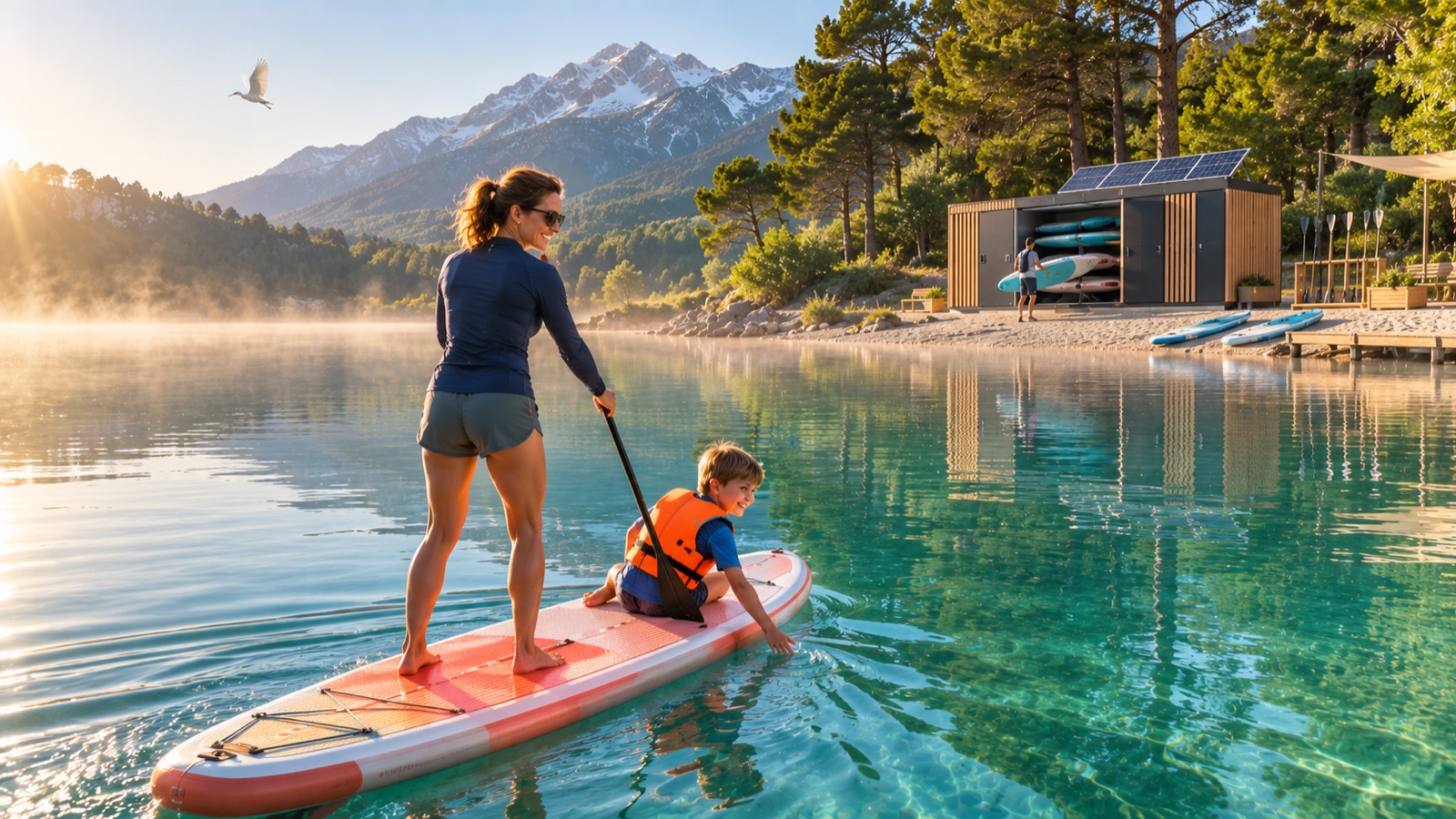
Outside a protected site, a self-service station fits within this window. The Wave-Up one takes up about 1.7 m² of ground and is 1.80 m high excluding boards: 8 slots for stand up paddle or surf boards, 8 lockers, 8 paddle clips, solar panels and a 12 V 15 Ah battery as standard, no electrical connection. No premises and no staffing, as in opening a water sports rental without premises.
The operator buys the station and sets its own prices. The holidaymaker scans the QR code displayed on the station, books 1 h, 2 h, 4 h or 8 h in their smartphone browser, pays by card and opens their locker with a code, and Wave-Up takes over the management of rentals and after-sales service, maintenance not included. Delivered as a kit, price on quote: request a quote while you process the file, and see making your land profitable.
The Ministry of Ecological Transition counts 1,756 Natura 2000 sites, of which 221 marine and mixed, and 7 million hectares on land, which is 13% of mainland land area, across 13,041 host municipalities. Being affected forbids nothing: article L414-4 of the environment code requires an impact assessment, with regard to the site’s conservation objectives, of programmes or projects of activities, works, developments, structures or installations likely to significantly affect a site.
Article L211-1 for its part defines wetlands: land “usually flooded or waterlogged” or whose vegetation is dominated by water-loving plants for part of the year. The surroundings of a pond often tick this box, and the slightest access backfill falls back under heading 3.3.1.0.
If the lake is closed water within the meaning of article R431-7, article L431-4 subjects it to the provisions of chapter II alone of the title on freshwater fishing. Membership of an approved association and the fee, which appear in chapter VI, do not apply there.
Yes, by declaring it at the town hall before opening, as article L1332-1 of the public health code requires. You become the person responsible for the bathing water within the meaning of article L1332-3, and if access is paid, article L322-7 of the sports code requires State-qualified staff.
On a lake that is already regular and with no new works, recreational navigation appears under no heading of the nomenclature annexed to article R214-1, which covers installations, structures, works and activities that have an impact on water. The obligations arise from welcoming the public and from rental, not from navigation.
Start by dating its creation. Article L214-6 of the environment code deems regular the structures prior to 4 January 1992 that were regular under the legislation of the time, as well as structures founded on title. For the others, regularisation remains possible.
The water police service of the departmental directorate of territories. State services present it as the contact for owners and buyers, able to say whether the structure is regular and to specify the steps in case of irregularity. The town hall comes next for swimming, and the regional health agency for the health control.
A private lake is not a blank slate, it is a structure with an administrative history. Call the water police service of the departmental directorate of territories first, then the town hall for swimming and the regional health agency for the health control. Then decide on the uses. The economic question remains: which use keeps the lake alive without premises or staffing. For a self-service paddle or surf rental station, request a quote: free, no obligation, reply within 24 working hours.
By the sea, the reasoning is reversed: the shore belongs to the State’s public maritime domain, inalienable, and no advertisement can sell you the sand. To tell apart a pond you own from a beach you merely occupy, read our article can you buy a private beach in France.

Is a campsite profitable? Sector accounts published by Insee, occupancy rate by rating, average price under pressure,…
Non-buildable does not mean unusable. The thresholds of the planning code, agricultural and natural zones, the coast, camping,…
Removability, 80% of the beach left free, six months of operation, restoration: the rules that decide what you can…
Estimate the revenue of a self-service rental station on your site, then request your free quote.
