Operator advice
Installing equipment at a campsite: what permission is needed?
Exemption, prior declaration or permit: the thresholds of the planning code applied to an already classified campsite, with the timeline for processing…
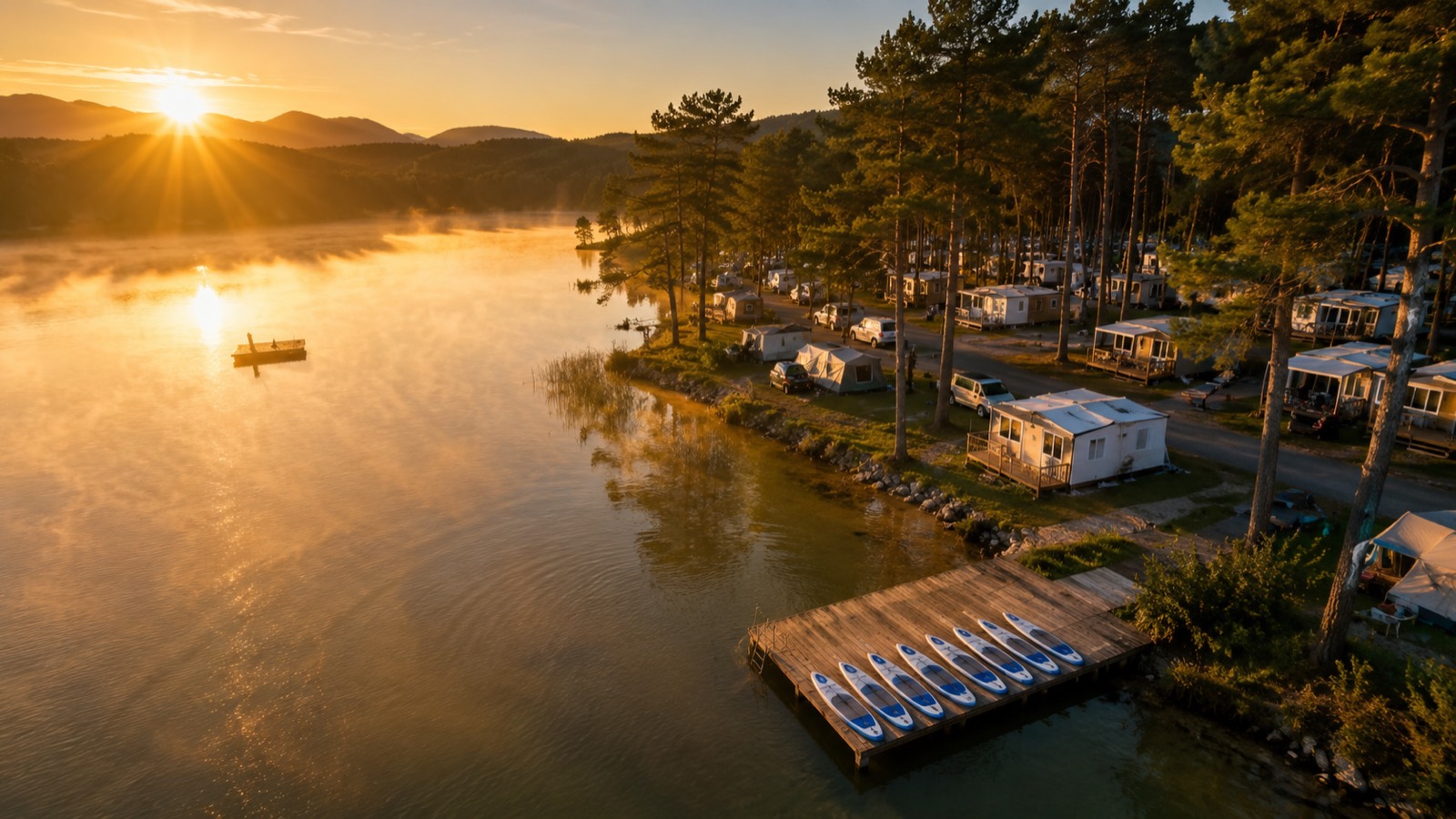
You have the space. Between the reception, the grocery, the pool and the gate leading to the water, three or four places would host a paddle rental station without bothering anyone. It will be the same station everywhere. The revenue will not.
Four criteria decide, in this order: the flow passing in front, the real distance to the launch point with a board under your arm, the legibility from the lane, and what the ground and planning rules allow. Here is how to measure them in one day, with sources.
Your revenue is a product: the people walking past, the share who book, the price you set. The location affects the first two, the equipment neither.
The window is short. The Insee Focus on the 2025 summer tourist season covers four months, May to August: the coast concentrated 104.6 million overnight stays, all collective accommodation combined. A bad location cannot be made up in September, and it is chosen before the order, not on delivery day.
Take out the site plan and mark the compulsory crossing points, those in the table below. Then count instead of assuming: three 20-minute slots on the same busy day, around 9 am, 12:30 pm and 5 pm.
| Site | What it brings | What it costs |
|---|---|---|
| Entrance barrier | Seen by every arrival | Motorised flow, nobody stops |
| Home | Your team explains and directs | Traffic limited to arrivals and departures |
| Grocery or snack bar | Daily footfall, queue | Congestion at service hours |
| Pool surroundings | Guests in swimwear | Noisy area, access sometimes filtered |
| Path to the water | Intent already formed, shortest trip | Barely visible, tighter planning rules |
The compromise is often between the last shop and the path to the water, as detailed in our location criteria for a water-sports activity.
Do not measure on the plan, walk. Carry a board, time from each candidate spot, note steps, loose sand and gates. A staircase disqualifies a location, whatever its footfall.
This trip comes out of the rental time, not on top of it. Rentals last 1 h, 2 h, 4 h or 8 h: over one hour, ten minutes’ walk each way cuts a third of the paid time. Two minutes of carrying, on the other hand, makes the short rental sellable several times a day.
The station is 1.80 m high excluding boards, and the boards stick out: it can be identified from afar if nothing hides it. A hedge or a truck parked every morning is enough to erase it.
The test comes down to one photo taken twenty metres away in the lane: can you tell it is a paddle rental? If the answer needs an explanation, the location is bad. Booking starts in front of the station, by scanning its QR code: nobody in front, nobody booking.
The station takes about 1.30 m by 1.30 m, or nearly 1.7 m² of floor space, for 8 boards, 8 lockers and 8 paddle clips. A campsite pitch, for its part, measures at least 80 m² from 3 stars, for an average area required of 100 m² at 4 stars and 114 m² at 5 stars, according to annex I of the order of 10 April 2019. You are therefore not sacrificing commercial land, unlike the heavy equipment in our comparison of profitability per square metre.
The footprint is not the space needed: you need room to take a board out and turn it around. Now a campsite is an installation open to the public, the Ministry of Housing recalled on 25 August 2015 in answer to a written question to the National Assembly. The order of 20 April 2017, which covers these installations when they are developed, gives the reference: 1.40 m wide free of any obstacle, steps limited to 2 cm, slope under 5%, rest landing every 10 m beyond 4%.
Then there is the ground: about 180 kg empty, before the boards. Flat, load-bearing, drained, with anchoring suited to sand and wind, the subject of our article on the slab and anchoring.
Sunshine first: solar panels and a 12 V 15 Ah battery as standard, about 3 W consumed, several days without sun, no electrical connection. You choose the spot with no trench or meter, avoiding the pine that shades the module all morning. PVGIS, the European Commission’s free tool, calculates the irradiation and the shading horizon of a specific point.
Then mobile coverage: the station has a 4G LTE modem and the locker status is monitored remotely. Check the address on Mon réseau mobile, the Arcep’s comparison tool, which publishes the coverage of the four operators, then confirm with a phone in hand. See also our self-service equipment with no electricity or wifi.
Article R*421-2 of the Planning Code exempts from any formality constructions of at most twelve metres in height whose footprint and floor area do not exceed five square metres. A station of about 1.7 m² stays under these thresholds, but the exemption does not release you from the local urban plan, which can be consulted free of charge on the Géoportail de l’urbanisme. Three reservations change the picture.
One call to the planning department settles these three points, detailed in our guide to planning permissions in campsites.
This sheet contains the only figures that belong to you. For revenue, our estimates, to be treated as such, put the revenue of a station over an April to September season at €10,900 in the cautious case, €19,800 in the realistic case and €29,600 in the optimistic case, of which 80% comes back to you. Our simulator displays its assumptions, which you can replace with your own.
As a general rule, no. Article R*421-2 of the Planning Code exempts from formalities constructions under twelve metres in height and five square metres, in both footprint and floor area. In a protected area, article R421-11 requires a prior declaration, processed in two months.
It depends on the status of the land. Outside urbanised areas, article L121-16 prohibits constructions and installations in the hundred-metre coastal strip, and article L121-17 excepts only activities requiring immediate proximity to the water. The processing department decides.
No. Solar panels and a 12 V 15 Ah battery are fitted as standard, consumption is around 3 W and the station lasts several days without sun. The link goes through a built-in 4G LTE modem, so through the mobile network.
Nothing connects it to the electrical grid or to a water supply, and it weighs about 180 kg empty: moving it remains a handling operation, which depends on the anchoring chosen at the start. So choose from the survey stage an anchoring compatible with a later move, rather than deciding after the first season.
In part. The station is delivered as a kit and stays the same from one site to another. The town and the type of site are enough for a first costing; the precise location then affects the installation.
The best location combines a counted flow, a short trip to the water, an immediate read from the lane and a clear regulatory situation. Wave-Up works on the same bases, with GeoScan, its in-house technology for assessing a location from public data. Attach your sheet to the request: we cost the kit station and the installation on your real constraints. Request a quote, it is free, with no commitment, and the answer reaches you within 24 working hours.
Once the spot is chosen, see how the station will work there: the self-service paddle rental station page describes the guest’s journey, from opening the locker by code or QR code to the return of the board in the same locker. It also cites the six equipped campsites in the Hérault, where the station is installed within the site’s grounds.

Exemption, prior declaration or permit: the thresholds of the planning code applied to an already classified campsite, with the timeline for processing…

Activity ideas for children at the campsite, from toddlers to teens, safety rules for the pool, the playground…
The dates of the campsite off-season, Insee figures month by month, the 2027 long weekends and the customer groups…
Estimate the revenue of a self-service rental station on your site, then request your free quote.
