
Operator advice
Water activities at the campsite: what to offer and how to organise them
Paddleboard, kayak, sailing: what each stretch of water allows, what the law requires to supervise or rent out, and three ways…
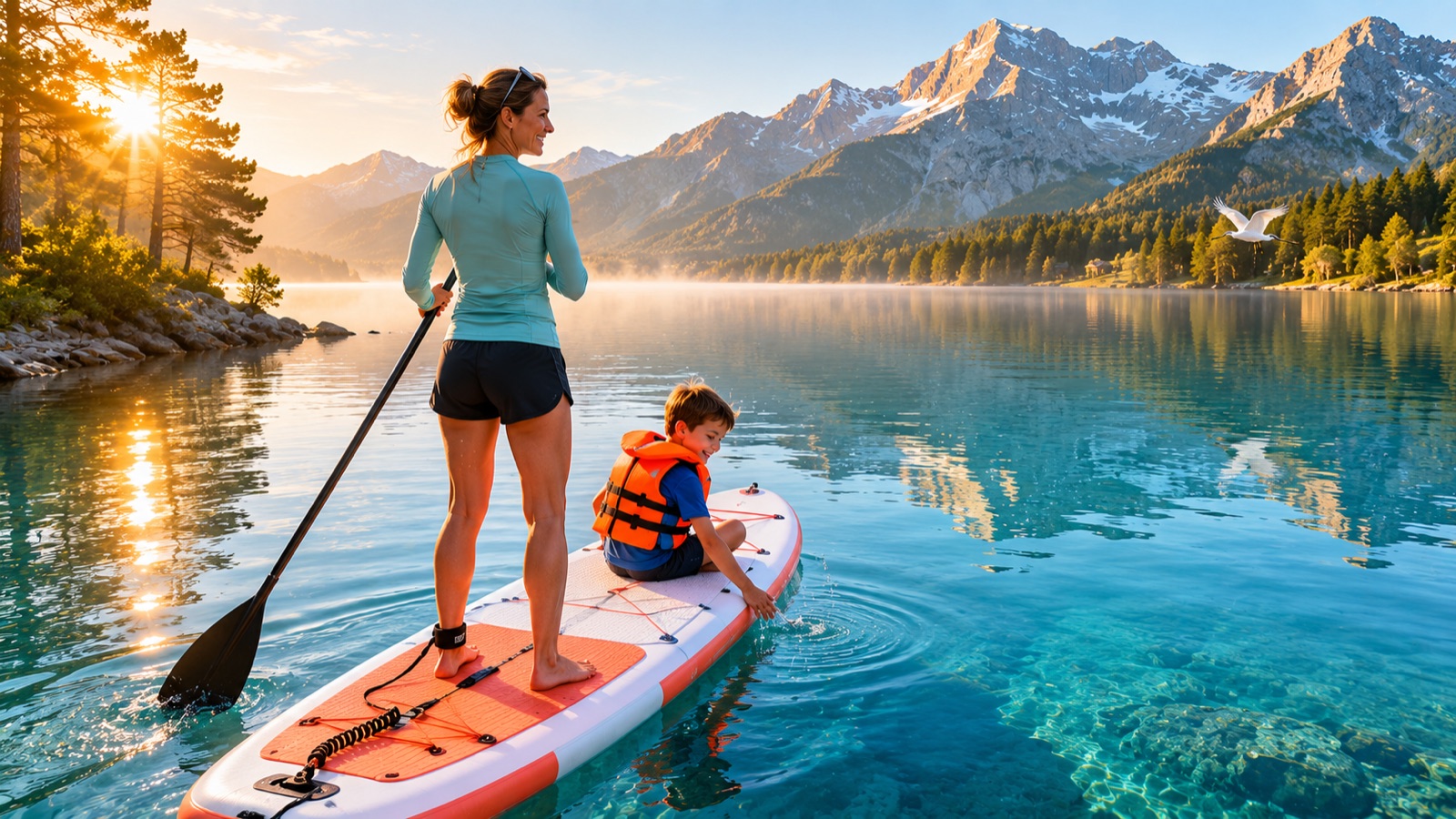
A customer in a wheelchair asks at reception whether they will be able to get to the water and try paddle. Your answer depends on what the law requires of your buildings and their surroundings, on what you display and on how the activity is organised at the water’s edge.
Here, backed by official texts, are the legal obligations, the campsite rating criteria, the useful labels, the contacts for adapted sport and some concrete ideas.
Within the meaning of the French Construction Code, an establishment open to the public (ERP) is any building, premises or enclosure where people are admitted, freely or on payment (Article R143-2). ERPs and facilities open to the public must be accessible to all (Article L161-1).
Accessible means allowing everyone, with the greatest possible independence, to move around, use the facilities, find their way, communicate and benefit from the services, whatever their motor, sensory, cognitive, intellectual or psychological limitations (Article L111-1).
For existing ERPs, the order of 8 December 2014 sets the rules for outdoor routes:
At the reception point, the necessary facilities must be able to be located, reached and used by a disabled person. When several reception points are close together, at least one is accessible, open as a priority and signposted from the entrance. Think of your rental counter if it is separate from reception.
Each ERP also keeps a public accessibility register (order of 19 April 2017), available at the main reception point or on its website. It includes in particular the certificates, the derogations obtained and a guide for welcoming disabled people.
The Atout France rating table devotes a section to disabled people or people with reduced mobility (PMR):
| Criterion | Status, from 1 to 5 stars |
|---|---|
| At least 1 accessible pitch per 50 | Mandatory |
| PMR washbasin, toilet, shower and laundry sink | Mandatory; washbasin, toilet and shower per block of pitches, depending on category |
| Accessibility information (guide, website) | Mandatory, to be justified during inspection |
| Staff awareness of welcoming disabled customers | Mandatory, to be justified during inspection |
| Staff training, all types of disability covered | Pick-and-choose, 5 points |
| Wheelchair suited to the environment | Pick-and-choose, 3 points |
Awareness is required, training earns points: the calculation is detailed in our article on moving from 4 to 5 stars.
Tourisme & Handicap has existed since 2003, at first as a national tourism mark: the order of 18 April 2024 made it a state label. The process is voluntary and covers accommodation, catering and leisure in particular.
The Tourisme & Handicaps association helps Atout France roll out the label; its website describes the application, but the conditions to follow are those of the order.
Destination pour tous targets a territory, not an establishment. According to the Direction générale des Entreprises, this state label is awarded for five years, after an external audit and review by a national commission.
Created in 2000 by the Handiplage association, this label identifies accessible beaches: more than 157 in 2026, according to Mon Parcours Handicap. The levels are cumulative:
| Level | Main criteria added |
|---|---|
| 1 | Supervised beach, lifeguard post nearby, PMR parking, wheelchair-friendly route from the car park to the swimming area, adapted toilets |
| 2 | Adapted shower, trained handiplagistes to help with bathing |
| 3 | Adapted changing room or PMR changing cabin, sun shelter |
| 4 | Guidance for blind people to the swimming area, audio information posts, tactile (raised) paving strips from the car park to the beach |
For a private beach, this grid is a working basis (see our guide to fitting out your private beach).
For a supervised session, the rules on instructor qualifications are in our guide to watersports at campsites.
These ideas are not a certificate of compliance.
No, the process is voluntary. ERP accessibility obligations apply with or without a label, and the label assumes you are already compliant.
To be rated, yes: the Atout France grid requires at least one accessible pitch per 50, from 1 to 5 stars. It also requires PMR sanitary facilities and trained staff.
No. According to Mon Parcours Handicap, you do not need to show one to access the facilities. An interactive map helps you choose a beach by label level.
No, this label is for territories. An establishment can, however, aim for the Tourisme & Handicap label.
The law sets a baseline, labels make it visible and honest information avoids disappointment. To add self-service paddle or surf rental to your offer, discover the paddle station for campsites, then request a Wave-Up quote: free, with a reply within 24 working hours.

Paddleboard, kayak, sailing: what each stretch of water allows, what the law requires to supervise or rent out, and three ways…

Clef Verte or EU Ecolabel: who issues these labels open to campsites, what they check, how to obtain them and what…
7,370 campsites, 848,302 pitches, 147.6 million overnight stays in 2025: the key figures of French outdoor hospitality in…
Estimate the revenue of a self-service rental station on your site, then request your free quote.
