Sports & spots
Does the Mediterranean have tides? What it changes for paddling
Yes, the Mediterranean has tides, but the tidal range does not exceed 0.3 metres off Occitanie according to Shom. The…
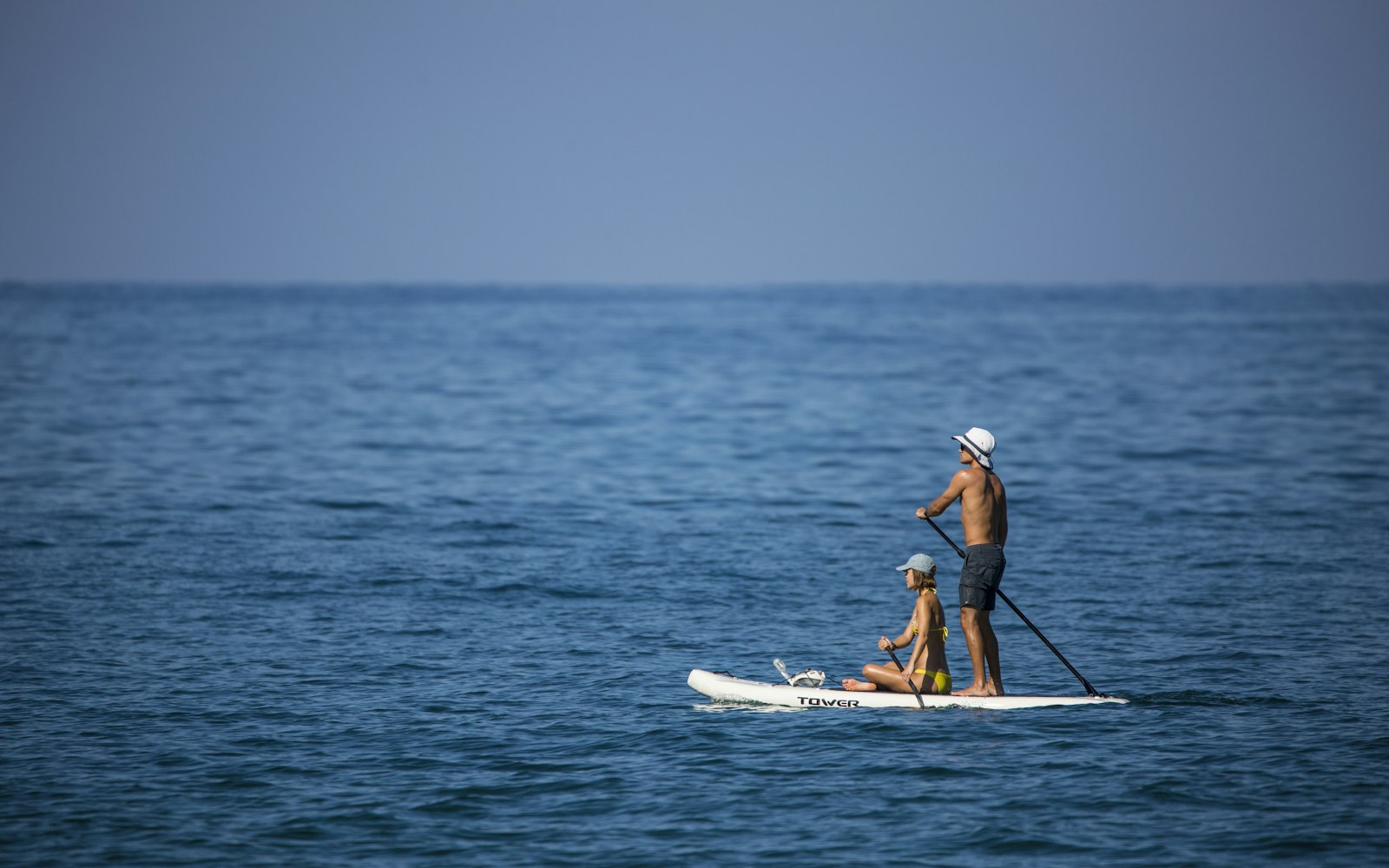
Paddling in the Mediterranean, jellyfish are not the leading cause of stings: it is the weever fish, buried in the sand at the water's edge, that account for 53% of marine envenomations recorded in France by poison control centres, against 19% for jellyfish. Dolphins, for their part, are watched from at least 100 metres away, board included.
A jellyfish does not aim at you: it drifts. Ifremer classes it as plankton, because its swimming counts for nothing against currents, and its body contains more than 90% water. In the Mediterranean, the one that burns is the mauve stinger (Pelagia noctiluca), purple in the male, brownish in the female. Two details noted by the institute:
In spring, the sheets of small discs edged in deep blue are by-the-wind sailors, close relatives of jellyfish, which southerly winds push to the coast from April to June.
Climb back onto the board and head home on your knees, so as not to fall in again. Once on dry land, follow Anses (2 July 2026):
These stings are most often of low severity, the agency notes, but the itching can last several days. Do not touch a stranded jellyfish: Ifremer advises avoiding its tentacles even on the sand.
Of 1,311 marine envenomations recorded from 2015 to 2024, Anses attributes more than half to weever fish. This fish with venomous spines, mostly found in the Mediterranean, buries itself in the sand of shallow areas: the accident happens when you walk barefoot on the bottom. On a paddle board, the exposed moment is when you push the board on foot, before the fin floats: see how to get into the water at sea as a beginner.
On the Gulf of Lion shelf, a study carried out from 2013 to 2015, taken up by an IUCN expert group, estimates at least 655 bottlenose dolphins present year-round. Close to shore, do not count on it: Hérault Tourisme only notes that they pass by from time to time in the marine protected area of the Cap d'Agde coast, described in our guide to paddle at Cap d'Agde.
The rule comes down to one figure:
In practice: no chasing, no change of course, no head-on approach, and never encircle a group, recommends the ministry. On 3 April 2022, leaving the port of Port-Cros, a boater who had gone into the water to approach three dolphins received a 135 euro fine, the national park reports.
Yes, there are sharks in the Mediterranean: 33 species have been reported on the French Mediterranean coast, according to a guide distributed by the IRD. This document from the late 1990s recorded, for the whole Mediterranean, 60 accidents or attacks on a person or a vessel in a century, most of them in southern Italy and Sicily, and two bites reported on the French coast, undocumented. For scale, it recalled that in France dogs bite at least 50,000 times a year.
The danger runs the other way. The Red List of IUCN France and the Muséum national d'histoire naturelle (2013) counts at least 11 species of sharks and rays threatened in mainland France. The common angelshark, which spends its days buried in the sand, was so abundant that it may have given its name to the Baie des Anges in Nice: its populations have dropped by more than 80% in 50 years.
The Posidonia meadows you glide over on the Cap d'Agde coast are not algae but a flowering plant, the Office français de la biodiversité reminds us: its fruit looks like an olive and its vertical stems grow only one centimetre a year. It has been protected since 1988.
On the sand, a leaflet from the Conservatoire du littoral, distributed by the Hérault Méditerranée conurbation, warns that from 1 April to 15 August plovers and other birds lay eggs and raise their chicks on the beach. If you land, respect the markings and walk along the waterline, dog on a lead.
No encounter excuses you from the basics: life jacket on, leash attached, weather checked, never alone, back to shore as soon as the wind rises.
In the Hérault, six campsites equipped by Wave-Up offer self-service boards: booking starts in front of the station, by scanning its QR code. Each station is inside its campsite, whose opening dates and access conditions apply: ask at reception and see the page paddle rental in the Hérault. Do you run a campsite, a hotel or a water sports centre? Request a quote.
Anses only advises it for Portuguese man o'war, which it reports on the Atlantic coast: white vinegar mixed with seawater. For a jellyfish: seawater, never fresh water.
Not within 100 metres. The rule applies in marine protected areas and, according to the maritime prefecture, in all French territorial waters in the Mediterranean.
Do not paddle towards it and let it pass. The Port-Cros National Park reminds us that you never get in the water near dolphins, even when they are the ones approaching.
The guide distributed by the IRD recorded only 60 accidents in a century for the whole Mediterranean, mostly in Italy. The Red List rather describes species in decline.
Water shoes for weever fish, seawater for jellyfish, 100 metres for dolphins. For the rest, a board glides along silently: standing up, you see everything passing underneath.

Yes, the Mediterranean has tides, but the tidal range does not exceed 0.3 metres off Occitanie according to Shom. The…
Core strength, endurance, quality of life: what six weeks of paddling change, what we know about balance and the effect of…
Sport in 2026 is practised outdoors and to feel good. INJEP figures, this year's trends, why…
Estimate the revenue of a self-service rental station on your site, then request your free quote.
