Operator advice
Renting your land to campers or to a leisure activity
Thresholds for hosting campers, declaration at the town hall, lease with an operator, liability, insurance and taxation of rents: the rules, official sources…
You have inherited a few hectares in an agricultural zone, or bought land you do not farm. The taxes fall due every year and the offers you receive contradict each other: a neighbour who wants to mow, a solar developer who promises rent.
This article goes through the legal options, text by text, with each rule sourced at the end of the page. One thing first: your municipality’s planning document takes precedence, and the town hall is your first point of contact.
Land classified as an agricultural zone is in principle not buildable. The exceptions come from the local urban plan (PLU) or the municipal map. Service-Public cites, among what a PLU may authorise, buildings needed for the farm, farm camping, rooftop photovoltaics and certain collective facilities. Planning permission is still required.
Article L151-11 of the Planning Code provides this flexibility: the regulations may authorise collective facilities, designate the buildings that may change use, and authorise the processing and marketing of agricultural products when they extend production. This change of use requires the binding opinion of the CDPENAF, the departmental commission for the preservation of natural, agricultural and forest areas.
Renting to a farmer is the most frequent route, and the least negotiable. Article L411-1 of the Rural Code subjects to the farm tenancy statute any paid provision of a property for agricultural use for the purpose of farming it, and declares this rule a matter of public policy. Proof of the contract can be provided by any means: a verbal agreement and cashed cheques are enough to create a farm lease. Service-Public Entreprendre reminds us of what you cannot set aside:
Two relaxations exist. The small-plot lease, whose ceiling area is set by order of the prefect, escapes part of these rules. And if you are waiting for a descendant to take over, a renewable annual lease is possible, six years at most.
The precarious occupation agreement seems to escape the nine years, but it is not an à la carte tool. Article L411-2 admits it only in specific cases: a succession pending before the court, the tenant staying on after a lease that was not renewed, property whose main use is not agricultural.
More solid: article L142-6 allows rural property free of tenancy to be entrusted to a Safer, a land development and rural establishment company, by agreement for a maximum of six years, renewable once. The leases it grants fall under the farm tenancy statute only as regards price.
Article L311-1 of the Rural Code deems agricultural the activities of controlling a plant or animal biological cycle, as well as those carried out by a farmer as an extension of the act of production or using the farm as a base. The decisive word is “farmer”: welcoming visitors, direct sales and processing become agricultural only because a farmer ties them to their farm. An owner who farms nothing cannot rely on them.
Many diversification projects therefore assume a partnership with an established farmer. A commercial activity open to the public, for example a self-service paddle rental station like those Wave-Up has installed in campsites in the Hérault, requires zoning that allows it. If your plot borders a body of water without being classified as agricultural, our page on making a waterside plot profitable covers this case.
The thresholds, for their part, are national. Article R*421-19 of the Planning Code requires a development permit to create or extend a campsite taking more than twenty people or more than six leisure accommodation units (tents, caravans, mobile homes, light dwellings). Below that, the habitual provision of land to campers falls under the prior declaration of article R*421-23.
The natural camping area is a separate and stricter classification. According to the Directorate General for Enterprise, it takes only tents, caravans and motorhomes, has at most thirty pitches per hectare of at least 300 m² each, and does not open more than six months a year. Guest rooms, limited by article D324-13 of the Tourism Code to five rooms and fifteen people, assume hosting provided by the resident and a declaration to the mayor. See also our ideas for making a campsite profitable.
This is the most frequent proposal, and the most regulated since 2024. Article L314-36 of the Energy Code defines an agrivoltaic installation as a solar installation whose modules, on an agricultural plot, durably contribute to agricultural production. It must provide at least one service among four: agronomic potential, adaptation to climate change, protection against weather hazards, animal welfare. The qualification is ruled out if production ceases to be the main activity of the plot, if the installation is not reversible or if it substantially harms one of these services.
Decree no. 2024-318 of 8 April 2024 quantifies the rest: at most 10% of the area made unusable, height and row spacing allowing normal farming, coverage rate limited to 40% above 10 megawatts peak for technologies not recognised as proven, dismantling within the year following the end of operation. For ground-mounted photovoltaics that is not agrivoltaic, a departmental framework document, proposed to the prefect by the chamber of agriculture, identifies the open plots and notably excludes protected agricultural zones. Our article on solar energy and water leisure shows a more modest use.
| Project | Applicable regime |
|---|---|
| Renting for a farm rent | Farm tenancy statute, nine years minimum |
| Entrusting land to a Safer | Six-year agreement, renewable once |
| Campsite of more than twenty people | Development permit |
| Guest rooms | Declaration to the mayor |
| Agrivoltaic installation | Planning permission, CDPENAF opinion |
| Change of use | PLU and binding opinion of the CDPENAF |
If the idea is rather to sell, the Safer are systematically informed of projects to sell rural property by notaries and can buy in place of the chosen purchaser. In 2023, they received 393,800 sale notifications and exercised 3,750 pre-emptions, about 1%. For a plot with no agricultural use, our article on non-buildable land explores other options.
It all depends on the facts. Article L311-1 lists the preparation and training of domestic equines among agricultural activities, excluding shows, which may bring the rental within the farm tenancy statute. Article L411-2, on the other hand, rules out agreements concluded to maintain land close to a dwelling and forming its dependency.
Nine years is the minimum term and the statute is a matter of public policy. The small-plot lease, whose ceiling area is set by order of the prefect, allows partial departure from it. An annual lease while waiting for a descendant to take over remains possible, six years at most.
Your municipality’s planning regulations decide first, and farm camping is among the possibilities only because a farmer attaches it to their farm. Beyond twenty people or six leisure accommodation units, a development permit is required.
Yes. An installation is not agrivoltaic if agricultural production ceases to be the main activity of the plot, if it is not reversible or if it substantially harms one of the four expected services.
Farmland is made profitable by knowing two things: the classification of the plot in the PLU and the legal nature of the commitment signed. The farm lease is the clearest solution, the Safer agreement the most flexible, agrivoltaics the most regulated. Go through the town hall before answering an offer.
If your land borders the sea, a lake or a river and its zoning allows a leisure activity, a self-service rental station is another avenue. Request a quote: Wave-Up replies within 24 working hours, free of charge and with no commitment.
If your plot’s zoning allows you to host campers, also watch the tax treatment: renting a pitch falls in principle under property income for bare land, and industrial and commercial profits for developed land. Our guide to renting your land to campers details this point, with the contract, insurance and the owner’s liability.

Thresholds for hosting campers, declaration at the town hall, lease with an operator, liability, insurance and taxation of rents: the rules, official sources…
Non-buildable does not mean unusable. The thresholds of the planning code, agricultural and natural zones, the coast, camping,…
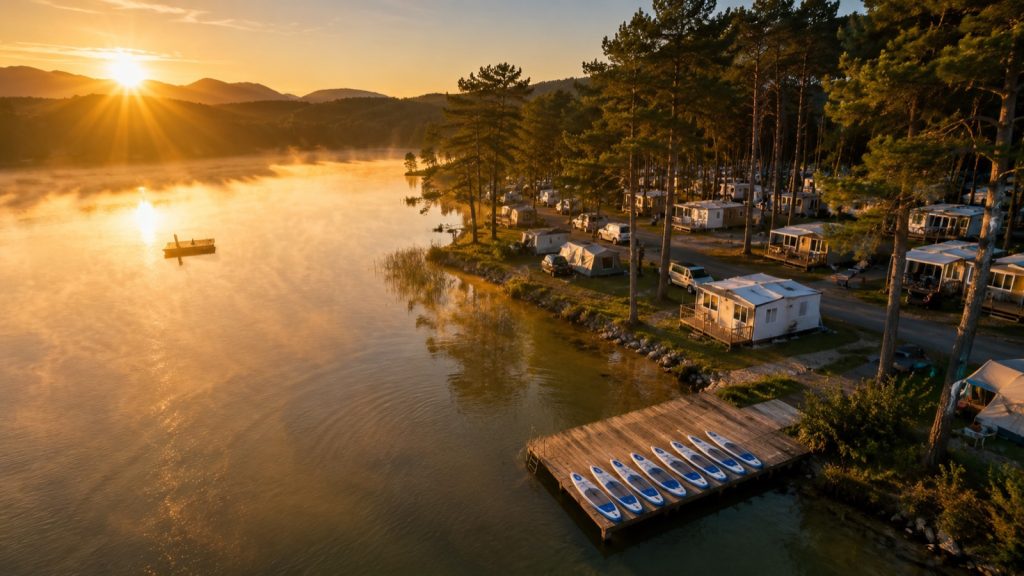
Short season, long overheads: seven practical ways to raise a campsite’s income, without building anything or hiring a team.
Estimate the revenue of a self-service rental station on your site, then request your free quote.
