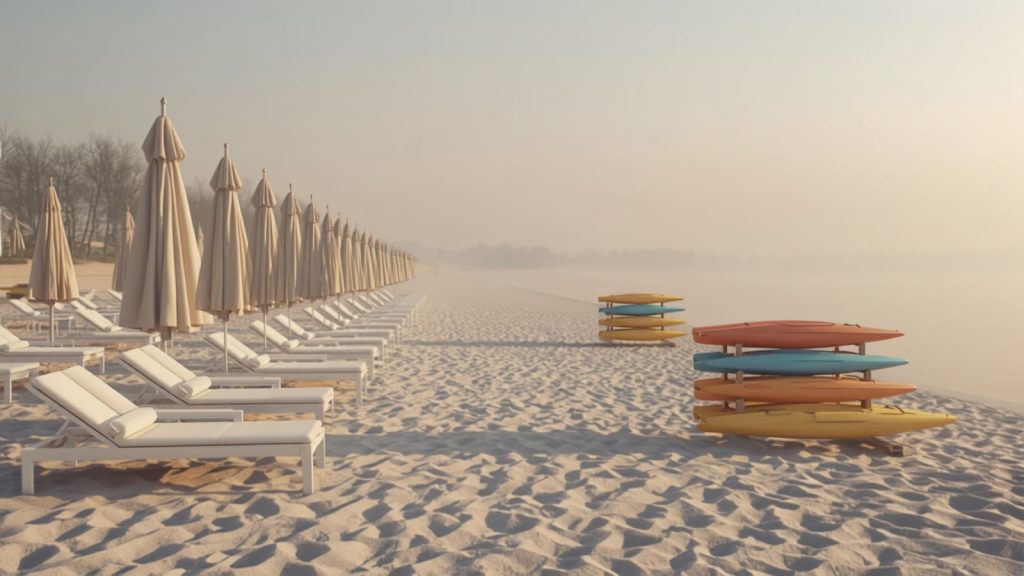
Operator advice
Leased beach: what you are allowed to install
Removability, 80% of the beach left free, six months of operation, restoration: the rules that decide what you can…

You own a plot classified as non-buildable: a meadow beside a pond, a strip of land behind a beach. It earns nothing, the property tax on unbuilt land is still due, and every project runs into the same sentence heard at the town hall: "it is non-buildable".
Non-buildable does not mean unusable. Here is what remains possible, and under which authorization, according to Légifrance and service-public.gouv.fr. Nothing here replaces the opinion of your town hall, the only one that reads your plot in its planning document.
A plot is non-buildable because a planning document classifies it that way. The local urban plan (the PLU, the rulebook that sets land use in a municipality) delimits urban zones (U), zones to be urbanized (AU), agricultural zones (A), and natural and forest zones (N), under articles R151-18 to R151-25 of the Urban Planning Code. Some municipalities have a simpler municipal map instead of a PLU.
Zone A is protected for the agronomic potential of the land (article R151-22), zone N for the quality of sites and landscapes or risk prevention (article R151-24). Nothing is built there, except in the cases listed by the regulations.
The code reasons by thresholds, with two notions: ground footprint, the area the project occupies seen from above, and floor area, the enclosed and covered interior surface. Article R. 421-1 sets the principle, the building permit; articles R. 421-2 and following exempt certain structures from it, and articles R. 421-9 and following reduce others to a prior declaration.
| Project | Formality | Text |
|---|---|---|
| Height of 12 m at most, footprint and floor area of 5 m² at most | No formality | R. 421-2 |
| Height of 12 m at most, footprint or floor area up to 20 m² | Prior declaration | R. 421-9 |
| Beyond these thresholds | Building permit | R. 421-1 |
| Installation for three months at most | No formality | R. 421-5 |
These exemptions lapse in a remarkable heritage site, around historic monuments and in a classified site. And a formality exemption is not an exemption from rules: the zone regulations apply.
Does equipment simply placed on the ground escape planning rules? Not automatically. The code reasons in ground footprint, floor area, height and duration: a foundation is not a criterion.
Two doors exist. Article R. 421-2 exempts the small structure described in the table, outside protected areas, with all three criteria having to be met. Article R. 421-5 exempts those set up for a period not exceeding three months, longer in cases strictly listed.
A storage chest or rental furniture falls into one of the boxes of the table, depending on its dimensions and its duration. A self-service paddle or surf station like Wave-Up's takes up about 1.7 m² on the ground and stands 1.80 m high excluding boards; zoning and the local regulations remain, and the qualification belongs to the town hall. Never assume that a piece of equipment is exempt from authorization.
Article R151-23 authorizes in zone A the buildings needed for farming; article R151-25 does the same in zone N, for farming and forestry. The local regulations may go further.
These are options, not acquired rights: if your municipality has not opened them, they do not apply.
In a coastal municipality, article L121-16 prohibits buildings and installations outside urbanized areas, within a strip of one hundred meters from the upper limit of the shoreline. Article L121-17 exempts those needed for public services or for economic activities requiring immediate proximity to the water. Article L121-18 prohibits the development and opening of campsites or caravan parking areas there, and article L121-8 requires continuity with existing towns and villages.
In the remarkable areas of the coast, article R121-5 authorizes only light developments: paths neither cemented nor paved, public information furniture, wildlife observation posts, removable equipment related to hygiene and safety, designed to allow the site to return to its natural state.
Finally, heading 3.3.1.0 annexed to article R214-1 of the Environment Code subjects the draining, waterproofing or filling of a wetland to a declaration beyond 0.1 hectare, and to authorization from 1 hectare.
Camping is freely practiced away from public roads and ways, with the agreement of the person who has the use of the land (article R111-32). Article R111-33, however, prohibits it, except by derogation, on sea shores, in registered and classified sites, around historic monuments and within a 200-meter radius around drinking water intakes. The mayor may prohibit it by order (article R111-34).
Welcoming the public on a regular basis changes the regime. Article R. 421-19 subjects to a development permit the creation of a campsite accommodating more than twenty people or more than six leisure accommodations. Below that, article R. 421-23 requires a prior declaration, as for installing a caravan more than three months a year, consecutive or not.
Light leisure dwellings, those removable or transportable structures for seasonal use (article R111-37), may only be set up in the places listed in article R111-38, notably leisure residential parks, holiday villages classified as light accommodation and lawfully created campsites.
If the plot remains too constrained, look at uses that need little area: our page on making the most of a plot of land and the one on installing a vending machine. For a waterfront, see developing a beach and water sports rental without premises.
It all depends on the dimensions. Up to 5 m² of ground footprint and floor area, article R. 421-2 exempts from any formality outside protected areas. Beyond that, up to 20 m², a prior declaration is required. The zone regulations may still prohibit it.
Not as a rule. Article R. 421-5 exempts only structures set up for a period not exceeding three months. An installation that stays in place for a whole season, then the next one, no longer falls under it.
Making land available to campers on a regular basis is subject to formality: a development permit beyond twenty people or six leisure accommodations (article R. 421-19), a prior declaration below that (article R. 421-23).
No. It concerns the procedure, not the substance: the zone regulations, easements, coastal rules and water regulations still apply. In a classified site, the exemptions of article R. 421-2 do not apply.
A non-buildable plot is rarely made valuable by a construction, often by a use. Have the project qualified by the planning department first, then put figures on the investment and the expected revenue. If your plot borders a body of water, a self-service paddle or surf station needs little area. Request a Wave-Up quote, free and with no obligation, with an answer within 24 business hours, then test your assumptions in the simulator.
If you would rather make the plot available to an operator than operate it yourself, the contract matters as much as the zoning: area, authorized use, duration, rent, insurance and the fate of the installations. Our guide on renting out your land to a leisure activity also details the taxation of rents and the risk of a commercial lease.

Removability, 80% of the beach left free, six months of operation, restoration: the rules that decide what you can…

Farm lease, Safer agreement, accommodation, photovoltaics: a tour of the legal options on agricultural land when you do not farm it yourself.
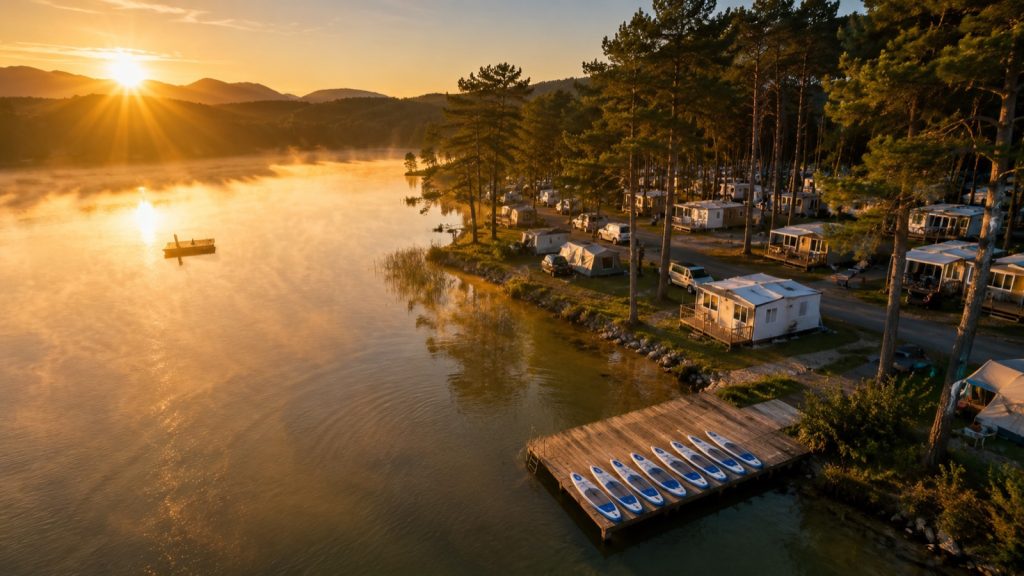
Internal flow, distance to the water, visibility, planning: the criteria that decide turnover, and the method to settle it in one…
Estimate the revenue of a self-service rental station on your site, then request your free quote.
