
Operator advice
Leasing or buying leisure equipment
Cash purchase, bank loan, equipment leasing or finance rental: ownership, balance sheet, tax, real cost and entry threshold for financing equipment…

You have land that is hardly used: a meadow behind the house, a plot by a pond, a field next to a campsite. Each summer, holidaymakers ask whether they can pitch a tent there, or an equipment renter offers to set up their business there.
Here are the rules, with official sources: town hall declaration thresholds, places where camping is prohibited, contract, insurance, taxation of rent, permits for installations.
Renting means making the ground available to a third party who operates: a rent known in advance, nothing to buy, nobody to hire, but no share of the revenue. Operating means collecting that revenue and carrying everything else.
| Criterion | Renting the land | Operating it yourself |
|---|---|---|
| Income | Rent set in the contract | Variable revenue |
| Taxation | Property income | Business profits |
Our page making your land profitable goes through the possible uses; the guide opening a paddle rental business describes running it yourself.
The Planning Code sets a principle: camping is freely practised, outside the right-of-way of roads and public highways, with the agreement of whoever has the use of the ground (article R111-32). Everything changes when hosting becomes habitual.
This second case is the declared site, that of farm camping. The Directorate General for Enterprise summarises the regime: six leisure accommodation units or twenty people at most, tents, caravans and motorhomes only, sanitary facilities in good condition with drinking water, declaration at the town hall by Cerfa form, no star rating.
Beyond that, it is the developed site, with an optional rating from one to five stars issued by Atout France for five years. The natural area is a category with no stars, limited to tents, caravans and motorhomes, operated six months a year at most. Parking a caravan for more than three months a year outside a campsite also requires a prior declaration.
Also check that your plot is not in a closed zone. Isolated camping and the creation of campsites are prohibited in four cases, except by exemption granted after the opinion of the architect of the Bâtiments de France or the competent commissions (article R111-33):
Two local filters are added (article R111-34): the local urban plan may prohibit camping outside developed sites, and the mayor may prohibit it for reasons of public health, safety or tranquillity. These prohibitions can be enforced only if they have been posted at the town hall and signalled at the access points.
The contract with an operator is written point by point: area, authorised use, term, rent and charges, insurance, inventory of fixtures, fate of the installations.
The commercial lease statute also covers bare land on which buildings for commercial, industrial or craft use have been erected with the owner’s express consent (article L145-1 of the Commercial Code). The tenant then obtains a right of renewal and, failing that, an eviction indemnity, the sum due when the lease is not renewed. If the plot is agricultural, the farm tenancy statute may also apply (article L411-1 of the Rural Code).
You are also liable for damage caused by things in your custody (article 1242 of the Civil Code): a tree, a fence, a jetty often remain so, even when the plot is let. New circumstances that aggravate the risk must be declared to the insurer by registered letter, within fifteen days of your becoming aware of them (article L113-2 of the Insurance Code). Ask each year for the operator’s professional liability insurance certificate.
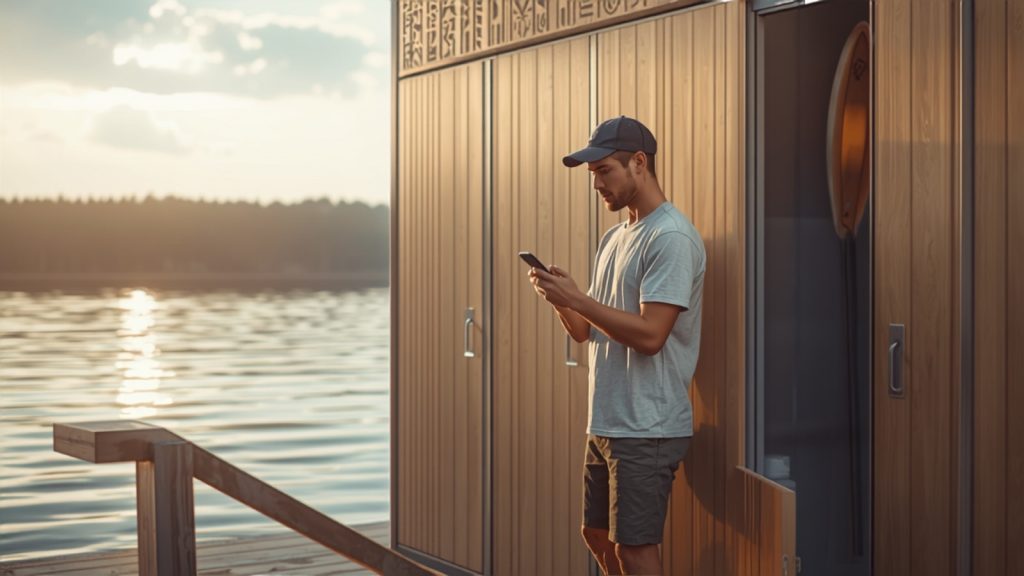
Not everything calls for a building site: a self-service station like Wave-Up’s takes about 1.7 m² of floor space, with no electrical connection. See opening a water-sports rental with no premises.
Income from undeveloped properties of every kind falls under property income, except when it is included in the profits of an industrial, commercial or craft business, a farm or a non-commercial profession (article 14 of the General Tax Code).
The tax authority applies this line to camping: renting a pitch on bare land is a purely civil act, taxed as property income; if the land is developed, or a caretaking service is provided there, it becomes in principle commercial and falls under industrial and commercial profits.
In property income, two regimes: the micro-property regime below €15,000 of annual receipts, with a flat-rate allowance of 30%; the actual regime beyond, with deduction of justified costs and a declaration on form 2044. Social contributions are added at the rate of 17.2%. Check your case on impots.gouv.fr.
Leisure land ends up receiving a shelter, a storage unit or rental equipment. The Planning Code reasons in terms of area and height.
A light leisure dwelling set up under the conditions provided by the Planning Code is exempt from formalities up to 35 m² of floor area, and declared beyond.
Processing takes one month, generally two months in a protected area; the authorisation is valid for three years, extendable twice by one year. Equipment that fits within 5 m² therefore often escapes the formality, but a local regulation may be stricter: ask the planning department. See locker for leisure parks.
Camping is freely practised with the agreement of whoever has the use of the ground. As soon as the provision becomes habitual, a prior declaration at the town hall is needed, and a development permit beyond twenty people or six accommodation units.
Four tents stay under the threshold of six accommodation units, but not necessarily under that of twenty people. If both ceilings are respected, a prior declaration is enough.
It depends on the zoning of the local urban plan. Any paid provision of a property for agricultural use in order to carry out an agricultural activity falls under the farm tenancy statute, a matter of public policy. Have the set-up checked by a notary.
Yes, by registered letter, within fifteen days of your becoming aware of the change. The insurer may then propose a new premium or terminate the contract, which is better than finding out after a claim.
Renting bare land falls in principle under property income. Under €15,000 of annual receipts, the micro-property regime applies a 30% allowance; beyond that, it is the actual regime, with form 2044.
Three steps unlock most situations: the planning department for the local urban plan, your insurer for the change of use, your usual adviser for the contract and taxation. Our article making a campsite profitable gives transferable ideas.
If you are considering hosting a self-service paddle and surf rental station on your land, or operating one, request a quote from Wave-Up: answer within 24 working hours, free of charge and with no commitment.
Before signing with an operator, check the zoning: in an agricultural or natural zone, the local urban plan’s regulations may close off a use that the area thresholds left open. Our article non-buildable land: what you can install on it details zones A and N, the coastal strip and the planning certificate.

Cash purchase, bank loan, equipment leasing or finance rental: ownership, balance sheet, tax, real cost and entry threshold for financing equipment…
Warranty, spare parts, CE compliance, data, contract: the twelve questions to ask an equipment supplier in writing, and the answers…
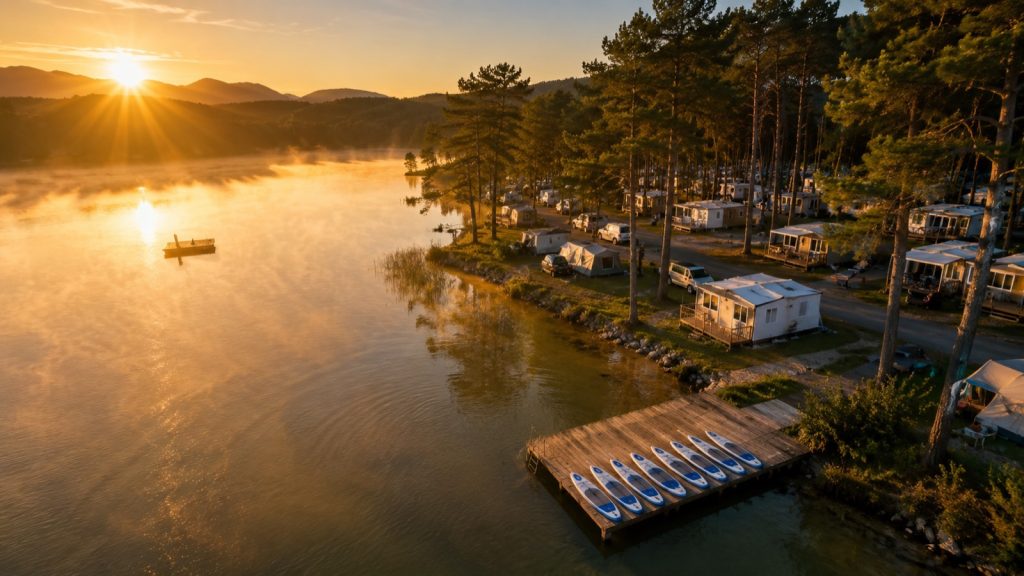
Equipment, insurance, signage, staff, end of season: the real budget of a water-sports activity in a campsite, item by item, with the amounts…
Estimate the revenue of a self-service rental station on your site, then request your free quote.
