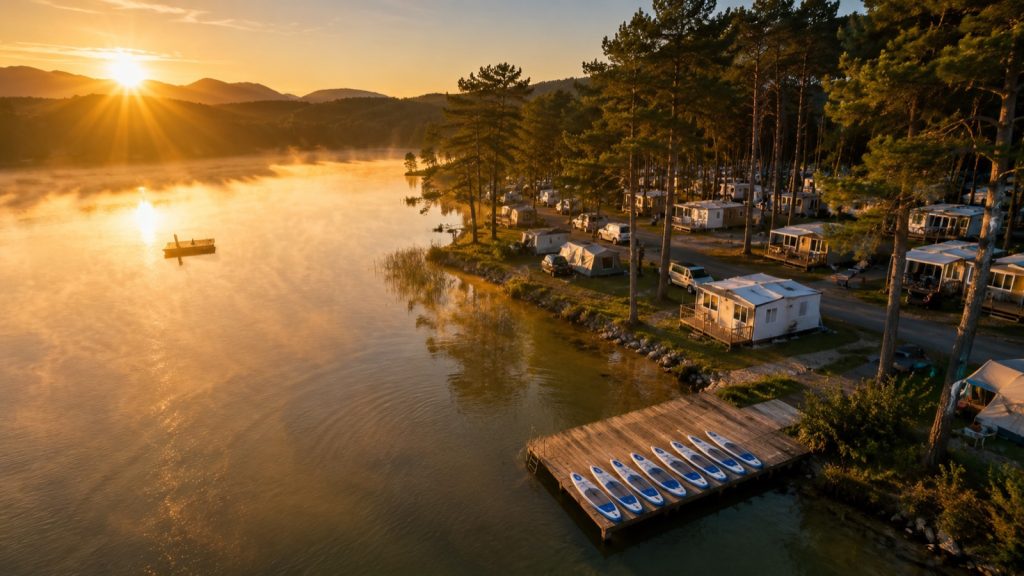
Operator advice
Where to install a rental station in a campsite
Internal flow, distance to the water, visibility, planning: the criteria that decide turnover, and the method to settle it in one…

In spring, the boards wait near reception and one question keeps coming back: how much should you charge per hour of paddle? Too low, and every outing wears out the equipment without earning anything. Too high, and your holidaymakers compare with the neighbouring beach and give up.
A rental price is built: it covers your costs, stays clear and is positioned against the prices displayed around you. Here is the method in six steps, from costs to the estimate of your turnover, with technical terms explained.
First list your costs over a season: they set the limit below which renting earns nothing.
The floor price is the hourly rate below which rental no longer covers your costs. It is calculated in three steps:
With the default assumptions of our simulator, 6 hours per day and 20% occupancy, a board is rented on average only 1.2 hours per day over the season.
Commissions proportional to the price, on the other hand, are not divided by hours: if they take, for example, 10% of each rental, divide the floor price by 0.9. If you are subject to VAT, calculate excluding tax, then add VAT at the rate your accountant will confirm: you get the price including all taxes to display. That leaves your margin: the floor price is a limit, not a selling price.
Three or four durations are enough: 1 hour, 2 hours, half-day, full day, specifying how many hours the half-day and the full day last.
If the hourly rate is lower as the rental gets longer (a decreasing grid), keep a reasonable discount in high summer: a board that goes out for the day cannot be rented again. Compare its price with what several short rentals would earn, at your occupancy rate.
Around the grid, add a few simple packages:
With a Wave-Up station, the web booking and payment app offers 1 h, 2 h, 4 h or 8 h, and you set the price of each duration. Wave-Up's share, once the station is purchased, is treated like the commissions in step 2 (see our offer).
April demand is not August demand. In Occitanie, July and August accounted for 57% of overnight stays in the 2025 summer season (April to September) in hotels, campsites and other collective tourist accommodation, according to Insee. For quiet months, reduce opening hours or the rate.
On the customer side, your guests are already on site: reserved rate, hours included in the stay or public price, it is up to you. External visitors, on the other hand, can compare with renters in the area; if you open rental to them, check that in high summer there are boards left for your own customers. To decide between what is charged for and what is offered, see our 7 ideas to make a campsite more profitable.
Displaying your prices is an obligation. For services, Service Public Entreprendre reminds us that:
In practice: life jacket included or rented separately, write it down; guest rate and external visitor rate, display both. Online, use the same grid as at reception.
With your floor price in hand, look at the prices displayed around you. Our survey of paddle rental prices in France gathers public grids, with sources. Compare what is comparable: same type of water body, same duration, same content (life jacket, leash, wetsuit), same year. If your floor price exceeds the prices in your area, first review your costs. A higher price can be defended if it brings a real service, such as a launch point a few steps from the accommodation.
It remains to move from rate to turnover. The profitability simulator starts from displayed assumptions, which you replace with your own: €15 per hour, April to September season, 6 hours of rental per day, 20% occupancy, insurance of €500 per year. It then deducts 25% as a precaution (payment commissions, breakage, unsold hours). For its part, Wave-Up estimates the turnover of a station over an April to September season at €10,900 (cautious scenario), €19,800 (realistic) or €29,600 (optimistic). These are estimates, never promises: your location, your footfall and your grid determine the result.
There is no single price: the right rate covers your costs given your occupancy rate and is positioned against the prices displayed near you. The simulator uses €15 per hour as a starting assumption, to be replaced with your own.
It is first of all a commercial choice. A rate reserved for guests adds value to their stay, a single price simplifies display. If you use two, display both.
Yes, the displayed price is expressed in euros including all taxes. If you are subject to VAT, calculate excluding tax, then add VAT before displaying.
At the end of the season, with the real figures: hours rented, empty slots, breakage, customer comments. Recalculate your floor price with your real occupancy rate and correct the grid before the next summer. Our guide to water sports activity in the off-season offers a timetable for this review.
Costs, floor price, grid, season, display, comparison: follow this order, then adjust your grid after each summer. If you are considering renting your paddles on a self-service basis with a Wave-Up station, which you own and whose rates you set, request a quote: it is free, with no commitment, and you receive an answer within 24 working hours.

Internal flow, distance to the water, visibility, planning: the criteria that decide turnover, and the method to settle it in one…

Rinse, dry, store inflated or rolled, check valves and bonding, inspect life jackets: the winter storage routine for paddles, based on the manuals…
The French sports code requires a qualification only to supervise for payment, not to rent. The obligations that remain, the reinstated declaration…
Estimate the revenue of a self-service rental station on your site, then request your free quote.
