July, ten o’clock, at the reception of a waterside campsite. A family wants to rent a paddleboard, a couple is looking for a sailing lesson, and your team is already juggling arrivals and the kids’ club. The water is a stone’s throw away, but the water offer sometimes boils down to a leaflet.
Here is what each body of water allows, what the law requires, three ways to organise the offer without overloading the team, and what the Atout France rating makes of it for a 4- or 5-star campsite.
Contents
Sea, lake, river: what each body of water allows
| Body of water |
Common non-motorised activities |
Rules to consult |
| Sea |
Paddle, kayak, light sailing, windsurfing, surfing if there are waves |
Mayoral orders, national recreational boating rules |
| Lake, lagoon |
Paddle, canoe, kayak, pedal boat, swimming |
Town hall (activities and swimming permitted) |
| River |
Canoe, kayak, paddle on calm stretches |
Police regulations, prefectoral orders |
At sea, the mayor regulates swimming and water activities practised from the shore with beach craft or unregistered craft, up to 300 metres from the water’s edge. Division 240 classes boards under 3.50 metres and single-chamber inflatable boards among “beach craft”: they sail by day and within 300 metres of a shelter, which is not the same as the 300-metre strip counted from the water’s edge.
On a river, the movement of non-motorised recreational craft is in principle free, subject to police regulations and the rights of riparian owners; the prefect may regulate it on certain watercourses. On a lake as on a river, the Ministry of Sports advises checking with the town hall that the activity and swimming are permitted (details in our guide to opening a water sports centre).
Supervising or renting
Supervising. Only holders of a recognised qualification or diploma may, for payment, teach, lead or supervise a sports activity, even on a seasonal or occasional basis. Paddle lessons, guided kayak outings, sailing introductions: all are concerned, including with a campsite employee as entertainer. The instructor must also declare themselves to obtain their professional card.
Renting. The Sports Code requires a qualification only to teach, lead, supervise or coach for payment: a simple rental, without lessons or supervision, therefore requires no qualification. The Ministry of Sports nevertheless classes sports equipment renters among physical or sports activity establishments, subject to the rules that follow, whereas the Conseil d’État ruled on 11 June 2010 that the mere provision of equipment is not enough to constitute such an establishment: what matters is the organisation of the activity on site. If in doubt, ask the departmental sports service.
Safety: what the law requires
A physical or sports activity establishment must in particular provide:
- civil liability insurance covering the operator, its supervisors, its staff and the participants;
- a first-aid kit and a means of alerting emergency services, with an emergency organisation chart displayed;
- the display of qualifications and professional cards, safety texts and the insurance certificate;
- a water proficiency check for canoe, kayak, rafting and sailing instruction (see the FAQ).
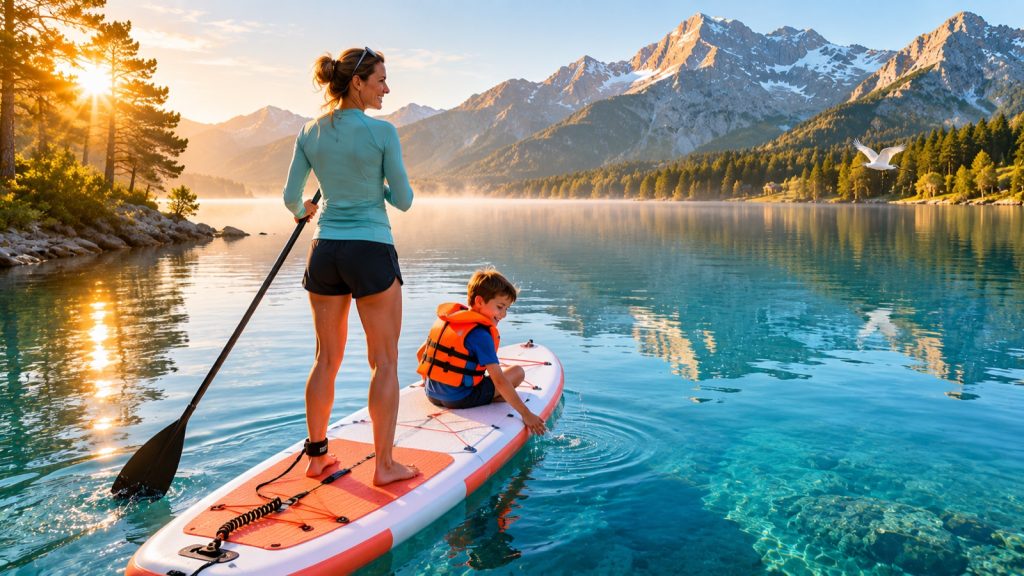
For participants, the ministry responsible for the sea advises wearing a life jacket or wetsuit and being wary of the offshore wind, which carries you away from the coast. On fresh water, the Ministry of Sports recommends a CE-approved life jacket fitted to each person and, for paddle on calm water, the leash (the cord linking the board to the participant); on a river with current, it states on the contrary that the leash is prohibited. Display these instructions where the equipment is handed out.
Three ways to organise the offer
Your reception has neither the time nor, often, the qualifications to manage everything. Three set-ups exist, and they can be combined.
| Set-up |
Activities |
Load on the team |
To be checked |
| Provider (club, school, instructor) |
Lessons, guided outings |
Informing holidaymakers |
Professional card, insurance, written agreement |
| Rental at reception |
Paddle, kayak, pedal boat |
Hand out, collect, take payment, check |
Insurance, instructions, life jackets in all sizes |
| Self-service |
Paddle, surf |
Regular equipment checks |
Location, instructions, booking method |
The provider covers what requires a qualification; a written agreement sets who takes payment and who insures the equipment. Rental at reception starts up quickly, but ties up someone at every departure. Self-service avoids that presence: see water sports rental without premises or employees and, for siting, permits and location.
What the Atout France rating says
The campsite rating rests on a grid of 192 criteria and 3 prerequisites, in force since 1 July 2019, compliance with which is checked every five years by a body accredited by Cofrac. You must validate the points of the mandatory criteria (a gap of 5% at most can be offset) and a share of the “optional” points, meaning à la carte: 30% at 4 stars, 40% at 5 stars. On the activities side:
- activities led by an entertainer (criterion 130): mandatory at 4 and 5 stars, with at least two categories in high season;
- natural swimming area (criterion 124) within the establishment, for example a lake where swimming is permitted: 3 optional points;
- supervised water activity sessions (criterion 169), such as aquagym, organised within the establishment: 3 optional points;
- bike rental (criterion 172), in-house or through a provider: 3 optional points.
No criterion covers the rental of paddle, kayak or sailing: it earns no points as such, and its value is measured by the holidaymakers’ experience. See also making a campsite profitable: 7 ideas.
Self-service, for which activities?
Self-service suits simple rental, for a holidaymaker able to paddle alone. It does not replace the lesson: the instructor introduces, the station takes over.
That is the principle of the Wave-Up station, installed in six campsites in the Hérault: 8 slots for stand up paddle or surf boards, 8 lockers for the life jacket, leash and waterproof pouch, solar power, with no electrical connection. You buy the station, price on quote, and set your own rates; Wave-Up then handles booking, payment and after-sales service (our offer). The holidaymaker books in front of the station, by scanning its QR code, for 1 h, 2 h, 4 h or 8 h, pays by card and opens their locker with a code or QR code: your reception no longer has to hand out each board.
FAQ
Do holidaymakers need to take a swimming test?
Yes, if you organise canoe, kayak or rafting, or if you teach sailing. The participant attests that they can swim 25 metres and submerge (for a minor, their legal representative attests), presents a recognised certificate or takes the Pass-nautique test. Stand up paddle is excluded from this scheme.
Can a provider run the campsite’s activities?
Yes. Atout France allows outsourcing of the entertainment under criteria 130 and 131, provided it remains transparent for customers. If they supervise a sports activity, ask for their instructors’ professional cards and their insurance certificate.
Does a water activity earn points in the rating?
Not rental: no criterion covers paddle, kayak or sailing. A natural swimming area and supervised water activity sessions within the establishment each earn 3 optional points. For a supervised session on your body of water, ask your inspection body.
Is self-service suitable for a lake or a river?
On a lake, yes, if the activity is permitted there. On a river, be careful: the Ministry of Sports points out that a strong flow makes it very difficult to control or stop the craft. Reserve self-service for calm stretches.
Water activities without weighing down the season
A water offer comes down to three decisions: what your body of water allows, what must be supervised, and what can run on its own. Entrust supervision to a qualified professional and let self-service absorb simple rental. Discover self-service paddle rental for campsites, then request a Wave-Up quote: free, with a reply within 24 working hours.
To judge on the facts, the page self-service stand up paddle station details point by point who does what: purchase of the station, revenue sharing, booking and payment, rental management, after-sales service and maintenance. You will know before the quote what remains the responsibility of your reception.
Sources
- Code du sport, article L212-1
- Sports Code, article L212-4
- Ministry of Sports, supervision for payment
- Ministry of Sports, EAPS sheet (March 2017)
- Sports code, article L321-7
- Sports Code, articles R322-4 to R322-7
- Sports Code, articles A322-3-1 to A322-3-5
- Sports Code, article A322-42
- Sports Code, article A322-64
- CGCT, article L2213-23
- Environment Code, article L214-12
- mer.gouv.fr, water leisure at sea (March 2024)
- Ministry of Sports, freshwater water leisure activities
- National nature sports resource centre, stand up paddle, regulations
- Atout France, campsite rating
- Atout France, campsite rating framework
- Atout France, camping inspection guide
- Atout France, camping and PRL FAQ