Sports & spots
Benefits of paddling for body and mind: what science says
Core strength, endurance, quality of life: what six weeks of paddling change, what we know about balance and the effect of…
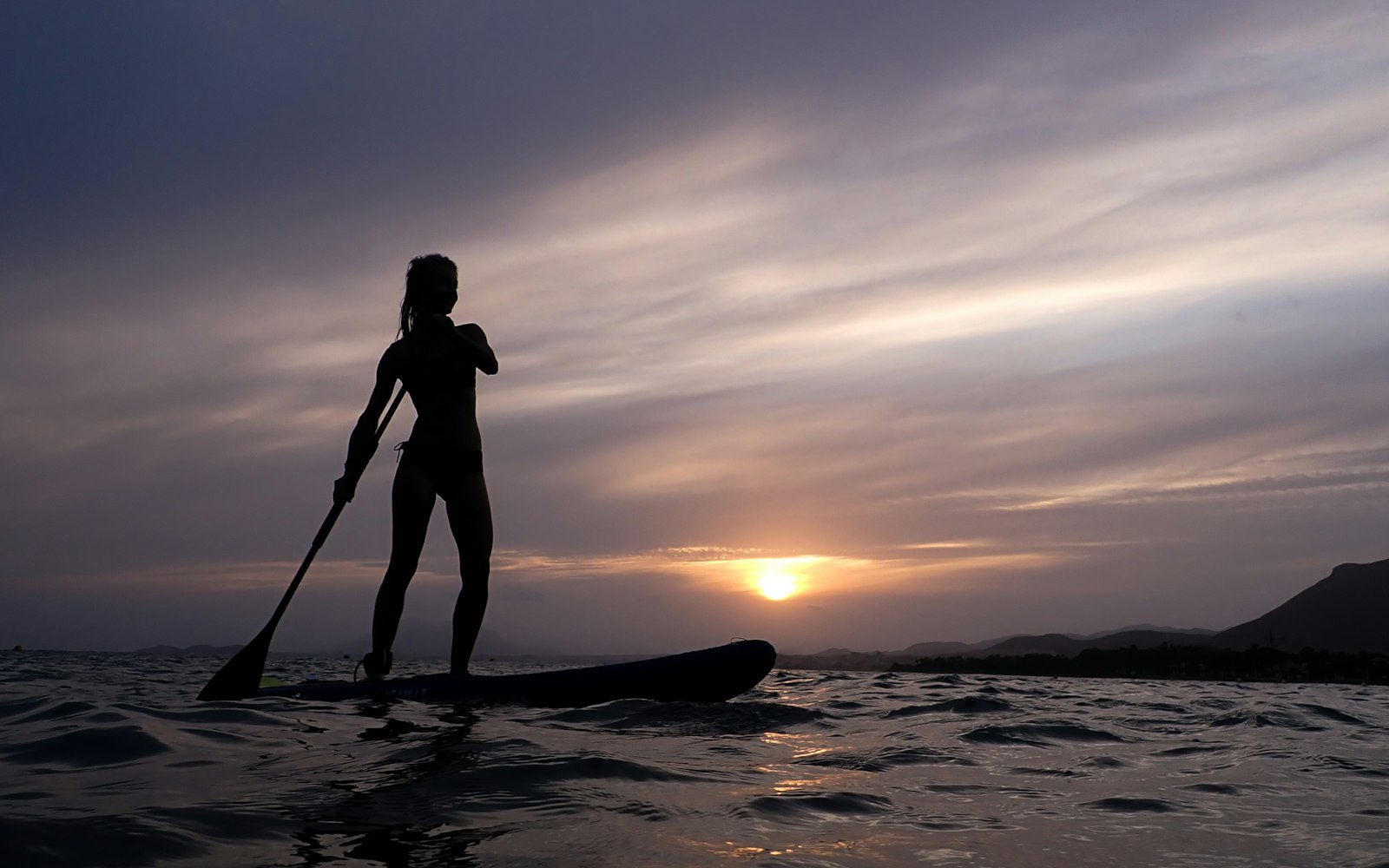
In paddling, the muscles used are first the abs and back, then the triceps, shoulders, glutes and lower legs. As for calories, count 200 to 270 kcal per hour on an outing for 70 kg, like walking, and nearly 700 at racing cadence.
On the water, though, a beginner burns two to three times less than on a simulator, and staring at the nose of the board costs more than a quarter of the speed.
At the University of Wisconsin at La Crosse, 13 volunteers paddled with electrodes on the abdomen and back, board tethered in the steeplechase water jump of the athletics track. The rectus abdominis and the spinal erectors exceeded 45% of their maximum contraction from the lightest of the three efforts: the threshold at which, according to earlier work, a muscle strengthens. The obliques, on the flanks, reached it only at the hardest effort, when the torso rotates more.
A Portuguese team recorded 14 recreational paddlers over 65 metres. When the paddle comes back forward, the triceps worked at between 18 and 42% of its maximum contraction depending on the trials. The biceps never exceeded 12% on average, pull included. As for the deltoid, none of these teams measured it; the upper trapezius, between neck and shoulder, worked between 10 and 28%.
To counter the rotation created by each paddle stroke, the trunk, glutes and lower leg contract without moving, write Australian researchers from Bond University. The Portuguese electrodes give 10 to 22% for the tibialis anterior, in front of the shin, and 8 to 12% for the calf.
Balance, the most cited benefit, remains the least demonstrated: see SUP yoga and paddle fitness.
The Portuguese study compared three gaze instructions, at equal effort: about 140 beats per minute each time. With eyes on the nose of the board, paddlers moved at 3.1 km/h (0.87 metres per second). Looking where they wanted to go, at 4.3 km/h: 38% better for the same heart. “Look up” therefore has its measure, and features among our beginner mistakes in stand up paddle.
At Bond University, 7 experienced paddlers and 19 novices paddled on a simulator, under six cameras. The novices mostly moved the shoulder (79° of range against 57°) and little the hips (50° against 66°). The experienced lean and plant the paddle with an almost straight arm.
In a survey of 240 practitioners, the shoulder and upper arm accounted for 32.9% of injuries, ahead of the lower back (14.3%) and the elbow or forearm (11.8%). Researchers still do not know whether the “all shoulder” movement predisposes to them. Six respondents out of ten never warmed up.
The unit is the MET. According to the World Health Organization, 1 MET is the energy expended by a person sitting still, or 1 kcal per kilo per hour. The calculation: MET × weight in kilos × duration in hours.
The 2024 Compendium of Physical Activities gives stand up paddle five values depending on cadence. Count your paddle strokes for one minute, then read your line.
| Strokes per minute | MET | kcal per hour at 60 kg | at 70 kg | at 80 kg |
|---|---|---|---|---|
| 10 to 19 | 2,8 | 168 | 196 | 224 |
| 20 to 29 | 3,8 | 228 | 266 | 304 |
| 30 to 39 | 5,0 | 300 | 350 | 400 |
| 40 to 49 | 9,8 | 588 | 686 | 784 |
| 50 to 69 | 11,0 | 660 | 770 | 880 |
Between 20 and 29 strokes, paddling is worth 3.8 MET, like walking at a moderate pace (4.5 to 5.5 km/h) in the same table. And from 39 to 40 strokes, the value jumps from 5.0 to 9.8, almost double, without the table saying why.
In Australia, thirteen sedentary adults followed three one-hour sessions a week for six weeks. Their aerobic capacity improved by 23.57%. Their weight did not: 85.45 kg before, 84.91 kg after, a non-significant difference.
The authors explain it: diet had not changed, and it usually takes twelve weeks to see weight move. No promise of weight loss, then. What remains is endurance: the Ministry of Sports recommends adults at least 150 minutes of moderate-intensity endurance a week, or 75 of vigorous intensity.
Raising the cadence tires you: do it near the shore, life jacket on. The French Surfing Federation asks you to be able to swim, never to go out alone, to check the weather, to give up in a storm or strong wind and to keep your leash on at sea as on a lake; on a river with current, it bans it.
Choose flat, sheltered water, like that of our calm-water paddle outings in the Hérault, stay out of swimming areas and read the rules posted by the municipality, which change from one beach to another.
For 70 kg, the 2024 Compendium gives 196 to 350 kcal between 10 and 39 strokes per minute, 686 to 770 beyond. These totals include resting expenditure and assume continuous effort. The novices followed in California were rather between 120 and 250 kcal per hour, based on their heart rate.
Nothing allows us to promise it. In the Australian study, six weeks of three weekly sessions did not change the weight of sedentary people who ate as before.
The shoulder is the most often injured area, and novices move it more than the experienced, who bend at the hips instead. Shorten the outing, warm up, and see a doctor if the pain persists.
At a set effort, 16 students tested in Wisconsin reached 69 to 71% of their theoretical maximum heart rate from the lightest level. On a free outing, the Californian novices stayed at 55%.
The trunk works with every stroke, the triceps more than the biceps, and expenditure follows cadence: one minute of counting is enough to place your outing. Then look up.
To try without buying: Wave-Up sells self-service stand up paddle rental stations, and six campsites in the Hérault are equipped with them (see paddle rental in the Hérault). Booking starts in front of the station, by scanning its QR code. Each station is inside its campsite, whose opening dates and access conditions apply: ask at reception. Do you run a campsite, a hotel or a water sports centre? Request a quote.

Core strength, endurance, quality of life: what six weeks of paddling change, what we know about balance and the effect of…
Sport in 2026 is practised outdoors and to feel good. INJEP figures, this year's trends, why…
Pilates on water is the floor-based method on a stand up paddle board: principles, six exercises to get started,…
Estimate the revenue of a self-service rental station on your site, then request your free quote.
