Sports & spots
Benefits of paddling for body and mind: what science says
Core strength, endurance, quality of life: what six weeks of paddling change, what we know about balance and the effect of…
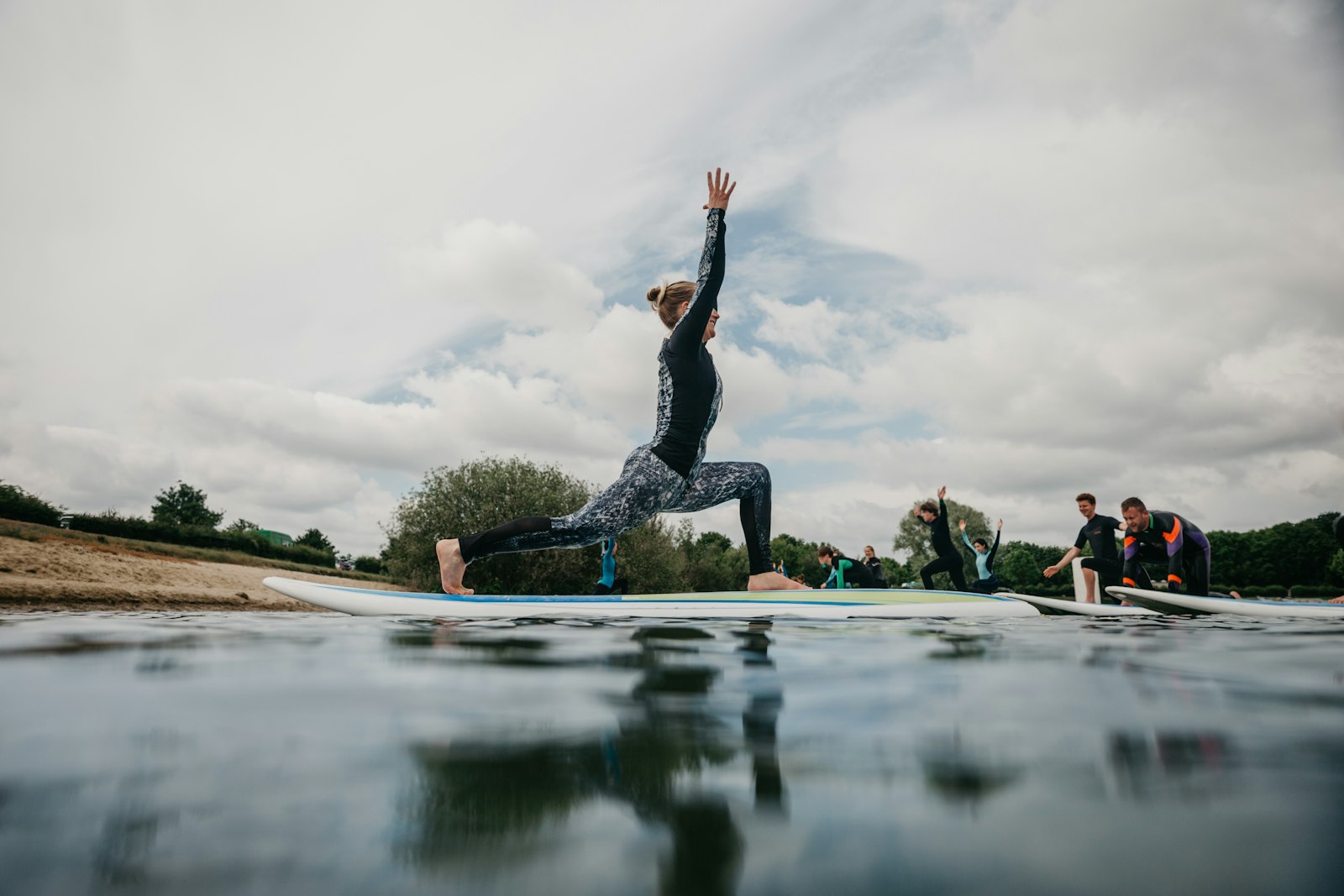
Paddle pilates is pilates on the water: the method's floor exercises, practised on a wide, stable stand up paddle board, on flat water. The board moves with every breath, and the body must constantly find its centre again. To try it, above all you need to be able to swim, keep your leash on your ankle and choose a sheltered stretch of water.
Picture a lake still smooth, a few boards lined up, arms rising together. Pilates seeks the centre of the body; the board brings you back to it with every ripple. Hence the appealing idea of stand up paddle as the new pilates.
Joseph Pilates called his method "contrology", a review published in 2011 in Sports Health recalls. A review of 119 scientific publications, published in 2012, describes it as an exercise that links body and mind: strength, core stability, flexibility, muscle control, posture and breathing. It is practised on a mat or on apparatus.
Six traditional principles structure it. On a board, none is optional.
| Principle | Definition | On the water |
|---|---|---|
| Centring | Starting from the centre of the body, the "powerhouse", from the pelvic floor to the rib cage | Relax your belly, the board tells you |
| Concentration | Attention paid to the exercise | Impossible to think about anything else |
| Control | Mastery of posture and movement | One abrupt move, and you are in the water |
| Precision | Technical accuracy | The pelvis stays above the central handle |
| Flow | Smooth transitions | You move from one exercise to the next by gliding, not jumping |
| Breathing | Breath coordinated with movement | You time your breath to the roll of the board |
On the floor, the mat does not move. On the water, every shift of weight tilts the board, and the body corrects before you even think about it. Centring, a somewhat abstract principle in a studio, becomes an immediate sensation.
Paddle itself has been measured. Researchers at Bond University in Australia had 13 sedentary adults, 46 years old on average, paddle for six weeks, three one-hour sessions a week. The endurance of their core muscles improved: by 19.78% in the front plank, which works the abdominals, and by 21.33% in the Biering-Sørensen test, which measures the endurance of the back muscles. Small sample, no independent control group: the authors speak of “some evidence”. The detail is in our article on the muscles worked and the calories burned in paddle.
Pilates on the water has not been the subject of any published study that we could find. On land, a 2015 Cochrane review (ten trials, 510 adults with low back pain) finds that pilates reduces pain more than minimal intervention, without proving superior to other exercises, with low to moderate quality evidence. The choice, its authors conclude, can be made according to preference. In other words, the best exercise is the one you feel like doing again.
Settle in the centre, level with the carry handle. Start seated or kneeling, slowly, with few repetitions.
| Exercise | Position | What the water adds |
|---|---|---|
| Lateral breathing | Seated cross-legged, hands resting on the ribs | Open the ribs sideways without rolling the board |
| The bridge | Lying on your back, feet flat on either side of the handle | Raise the pelvis vertebra by vertebra without the board tilting |
| The hundred | Lying down, head and shoulders lifted, straight arms beating the air | Keep the belly firm while the arms stir the surface |
| The quadruped | On all fours, then opposite arm and leg extended | Hold the diagonal when the board rocks |
| The swimmer | Face down, arms and legs extended, beating gently | Stay on the axis without tipping from one edge to the other |
| Side kicks | Lying on your side, propped on your forearm | The most unstable of the six: bottom leg and small movements at first |
Falling in is part of the session: it simply marks the limit of the day. Come back to sitting between exercises and look at the horizon rather than your feet. For held postures, try SUP yoga and paddle fitness.
The French Surfing Federation sets out simple rules: know how to swim, never go out alone, check the weather, give up in a storm or strong wind. And since pilates invites you to close your eyes, pick a visual landmark on the beach, a flag or a building, as the ministry in charge of maritime affairs advises, so you do not drift.
At sea, recreational paddle boards under 3.50 metres are beach craft, the same ministry reminds us: they must not go more than 300 metres from the shore, and wind blowing offshore is the first trap. A 10-foot board measures about 3.05 metres. Stay out of supervised swimming areas and find out about authorised zones.
Pregnant, recently had surgery, prone to back pain? Ask your doctor's advice before stepping onto the board.
The best studio is flat, sheltered water: lake, pond, protected cove, leisure centre water body. Away from channels and boats, deep enough to fall in without touching the bottom. For a first time, a session supervised by a water sports club or leisure centre builds confidence.
No board of your own? Six campsites in the Hérault are equipped with a Wave-Up station (see our equipped sites). In front of the station, you scan the QR code, book and pay from your smartphone, with no app to install; board, paddle and life jacket wait in the locker. Each station is installed inside its campsite: access conditions are those of the establishment, so ask at its reception.
No. The exercises stay simple: holding a basic position on a moving surface already demands all your attention. It is better, however, to know how to swim and to have already paddled on calm water.
SUP yoga links held postures and seeks stretching and calm. Paddle pilates follows the method's principles, centring, control and breathing, with slowly repeated movements, mostly lying, seated or kneeling. The two complement each other on the same flat water.
Nothing allows us to promise that. In the Australian study, six weeks of paddle, three hours a week, improved aerobic capacity and core endurance, but average weight only went from 85.45 to 84.91 kg.
Yes, in calm seas, within 300 metres of the shore, outside swimming areas and never when the wind blows offshore. A lake or a sheltered cove is more forgiving for beginners.
A wide board, flat water, six exercises and a willingness to accept falling in: paddle pilates asks for nothing more. The rest, the light and the silence between two breaths, comes by itself.
Do you run a campsite, a hotel or a leisure centre by the water? Picture your holidaymakers discovering pilates on the water, then coming back the next day with a board rented on a self-service basis, without tying up your team. A standalone stand up paddle station stores eight boards, paddles and life jackets by the water, runs on solar power and is booked in front of the station, from a smartphone. Request a quote, reply within 24 working hours.

Core strength, endurance, quality of life: what six weeks of paddling change, what we know about balance and the effect of…
Sport in 2026 is practised outdoors and to feel good. INJEP figures, this year's trends, why…
Jellyfish, weevers, sea urchins, bottlenose dolphins, sharks: what you really meet while paddling in the Mediterranean, with the Anses guidance in case…
Estimate the revenue of a self-service rental station on your site, then request your free quote.
