Sports & spots
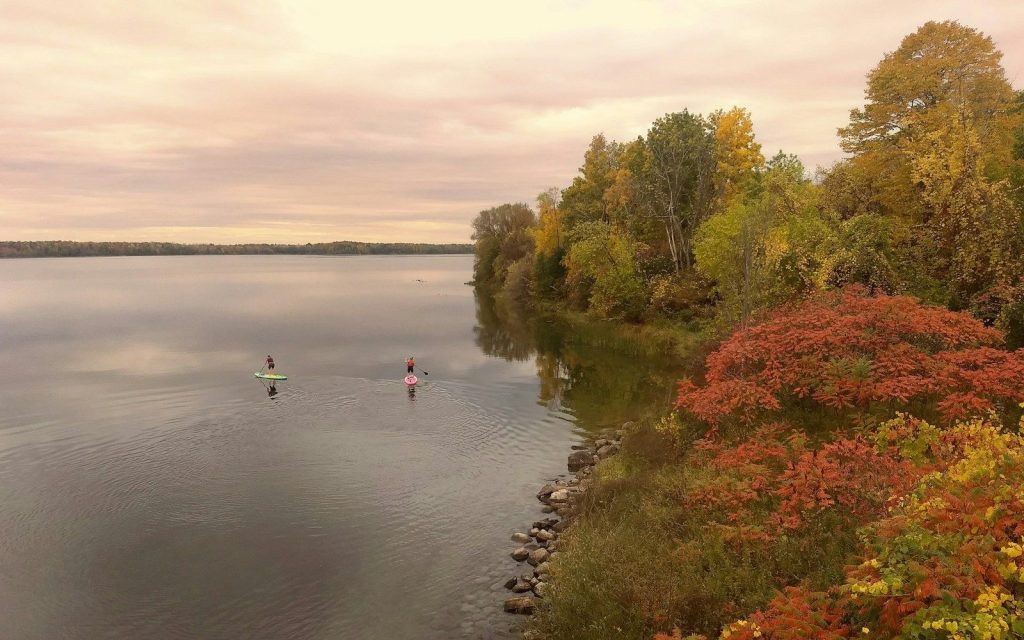
River paddling: current, obstacles and leash, the rules to know
No leash in a current, a life jacket worn at all times, weirs bypassed on foot and priority given to boats…
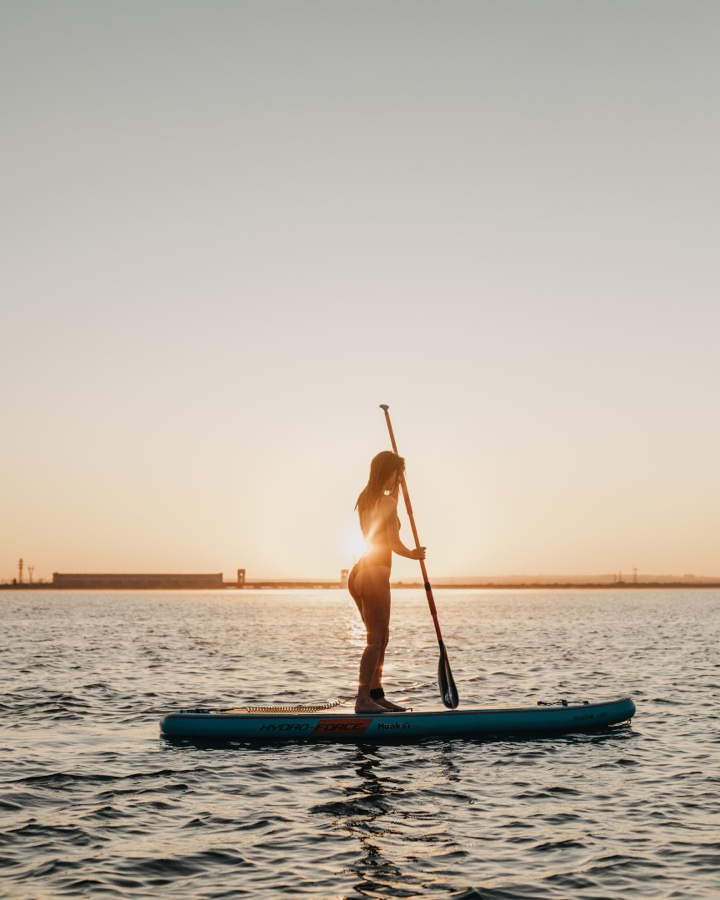
You are on the beach, the paddleboard under your arm. In the distance, yellow buoys; near the lifeguard post, red and yellow flags. How far can you go? Is a life jacket mandatory? And the leash, that cord linking your ankle to the board?
Here is what the official texts and the authorities say, separating what is mandatory from what is recommended.
At sea, stand up paddle falls under division 240, the safety regulation for recreational vessels under 24 metres, which calls it a “paddle board”. The Ministry of Sports distinguishes two cases:
| Your board | Category | Authorised zone | Required equipment |
|---|---|---|---|
| Single-chamber inflatable, or under 3.50 m (about 11 ft 6 in) | Beach craft | By day, within 300 m of a shelter | None |
| Rigid, over 3.50 m, fitted with a leash | Craft propelled mainly by human power | By day, up to 2 nautical miles (3,704 m) from a shelter | Beyond 300 m from a shelter: buoyancy aid (50 N minimum) or neoprene wetsuit, light signalling, tow line |
A shelter, according to the ministry responsible for the sea, is a place on the coast where you can land, take refuge and set off again without help, given the weather of the moment. If in doubt, apply the strictest rule: by day, within 300 metres. Our stand up paddle guide compares inflatable and rigid boards.
The 300-metre strip is measured from the water’s edge. Article L2213-23 of the General Code of Local Authorities entrusts the mayor with policing swimming and water activities practised from the shore with beach craft and unregistered craft, two categories that include paddleboards. Outside the supervision zones and periods that he sets, you paddle “at your own risk”.
The maritime prefect regulates registered vessels and craft; the two authorities draw up the beach marking plan together, according to the Mediterranean maritime prefecture. Rules therefore change from one beach to another: read the notices posted on site or ask at the lifeguard post.
The buoys of the 300-metre strip are yellow, says the Mediterranean inter-regional sea directorate (DIRM). Their shape matters:
A marked area is either reserved for swimming and closed to all water sports, or closed to swimming and assigned to activities shown by pictograms. The 300-metre limit is not marked everywhere.
On the sand, two red and yellow flags delimit the supervised swimming area. On the mast, green signals supervised swimming with no apparent danger, yellow a limited or marked danger, red swimming prohibited (decree of 31 January 2022). With no flag flying, the lifeguard post is closed, specifies the SNSM (the French sea rescue society).
For a beach craft at sea, division 240 imposes no equipment. The obligation targets rigid boards over 3.50 metres, beyond 300 metres from a shelter: a buoyancy aid of at least 50 N (the newton here measures the thrust that keeps you afloat) or a neoprene wetsuit.
Always wearing your life jacket is nonetheless among the essential actions of the ministry responsible for the sea. It must be CE-approved and fitted to size, in particular for children under twelve. In a Wave-Up stand up paddle locker, the life jacket and leash have their own locker, next to the board and the paddle.
Division 240 does not require a leash on a beach craft, but the ministry responsible for the sea recommends always attaching it to your ankle. If you can no longer get back to shore, stay on your board: according to the SNSM, it is your only chance of staying visible to rescuers. With children, read our guide to family paddle.
Météo-France distinguishes the sea breeze, which blows from sea to land by day, especially in the afternoon, and the land breeze, which blows from land to sea, especially in the second half of the night. Facing the sea, an offshore wind is felt on your back.
The SNSM warns against offshore winds, which flatten the sea but push you out: the outward trip seems easy, the return is made into the wind. For the west of the Hérault, Météo-France also cites the tramontane, a violent, cold wind from west to north-west, with gusts that can exceed 100 km/h.
Check the Météo-France beach forecast before setting off. From a strong breeze warning (force 7 on the Beaufort scale, which classes wind strength, i.e. more than 50 km/h on average), Météo-France issues special bulletins and the SNSM asks paddlers to stay ashore. Even below that, the wind can carry you far in a short time, warns Hérault Tourisme. Find other pitfalls in our 10 beginner paddle mistakes.
During the 2025 season, CROSS MED (the regional operational surveillance and rescue centre) coordinated 3,536 operations, up 14%, nearly 80% of them in five départements, the Hérault included. Operations linked to new practices, including paddle, rose markedly; users’ inexperience and lack of preparation are among the leading causes of intervention. The maritime prefecture sums up three principles under the acronym PEA:
Add three habits: pick a visual landmark on the beach and always set off again from that point (ministry responsible for the sea), follow the shoreline (Hérault Tourisme), come back before nightfall (daytime navigation only).
Not for a beach craft that stays within 300 metres of a shelter. Beyond that, a rigid board over 3.50 metres must have a buoyancy aid of 50 N minimum or a neoprene wetsuit. The ministry responsible for the sea nonetheless recommends always wearing a life jacket.
Where it is marked, the 300-metre strip stops at the outermost spherical buoys. A beach craft stays inside. Only a rigid board over 3.50 metres, fitted with a leash and the required equipment, may go up to 2 nautical miles from a shelter.
Division 240 does not require it on a beach craft. A rigid board over 3.50 metres must, however, be fitted with one to go up to 2 nautical miles from a shelter. The ministry responsible for the sea recommends always attaching it to your ankle.
At sea, 196, free from a landline or mobile, alerts the nearest CROSS. On land, call 15, 18 or 112.
Wave-Up has installed self-service rental stations in six campsites: Camping Maïana Resort in La Grande-Motte, Camping Palmira Beach in Vendres, Camping Roucan Plage in Vias, Camping La Tamarissière in Agde, Camping Nouvelle Floride and Camping Méditerranée Beach Garden (installation coming soon) in Marseillan-Plage. In front of the station, you scan the QR code displayed and book on your smartphone, with no app to install, pay by card and open the locker with a code or QR code. Each station is installed within the establishment’s grounds: access conditions are those of the establishment; ask at its reception. All the details on our page renting a paddle on a self-service basis in the Hérault.
Do you run a beach, a campsite or a water sports centre and want to offer self-service paddle? These rules belong in front of the station, where the holidaymaker takes their board after scanning the QR code. Describe your beach and its marking in a free quote request for a paddle station: reply within 24 working hours.
These general rules become more specific locally: our guide to paddle spots in the Hérault details the Étang de Thau prohibitions, the lagoons closed to navigation and the Lake Salagou regulations.
Knowing the rule does not tell you how the outing goes. Launching at the edge of the waves, setting off into the wind, climbing back on the board after a fall, moves that bring you back to shore if the wind carries you away: our beginner’s guide to paddle at sea tells the outing in order.
These rules also apply to a rented board. In the Hérault, self-service stations are installed in La Grande-Motte, Vendres, Vias, Agde and Marseillan-Plage: each locker contains a life jacket, and the 300-metre strip remains the limit of the paddling zone. See the stations in the Hérault.

No leash in a current, a life jacket worn at all times, weirs bypassed on foot and priority given to boats…
Paddleboarding works the abs and back first, then the triceps and shoulders. For 70 kg, expect 200 to 270 kcal per hour…
Night paddle boarding is banned at sea and limited to daytime on the Canal du Midi. The landmark: sunset…
Estimate the revenue of a self-service rental station on your site, then request your free quote.
