Sports & spots
Lac du Salagou: paddling, swimming, access and rules
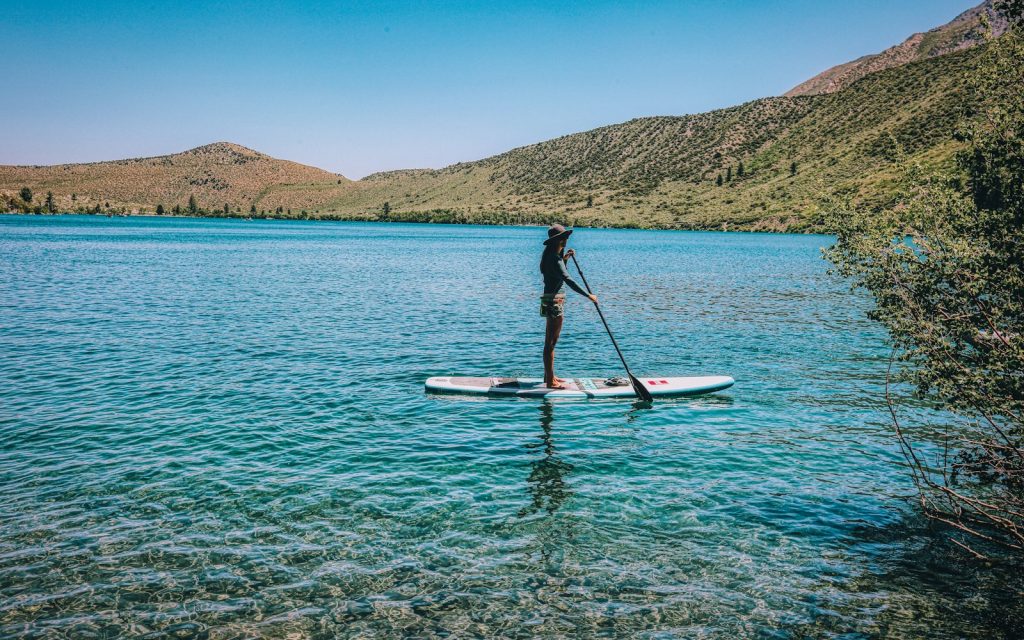
At Lac du Salagou, paddle and swimming are allowed and access is free, outside the dam area and, from 1…
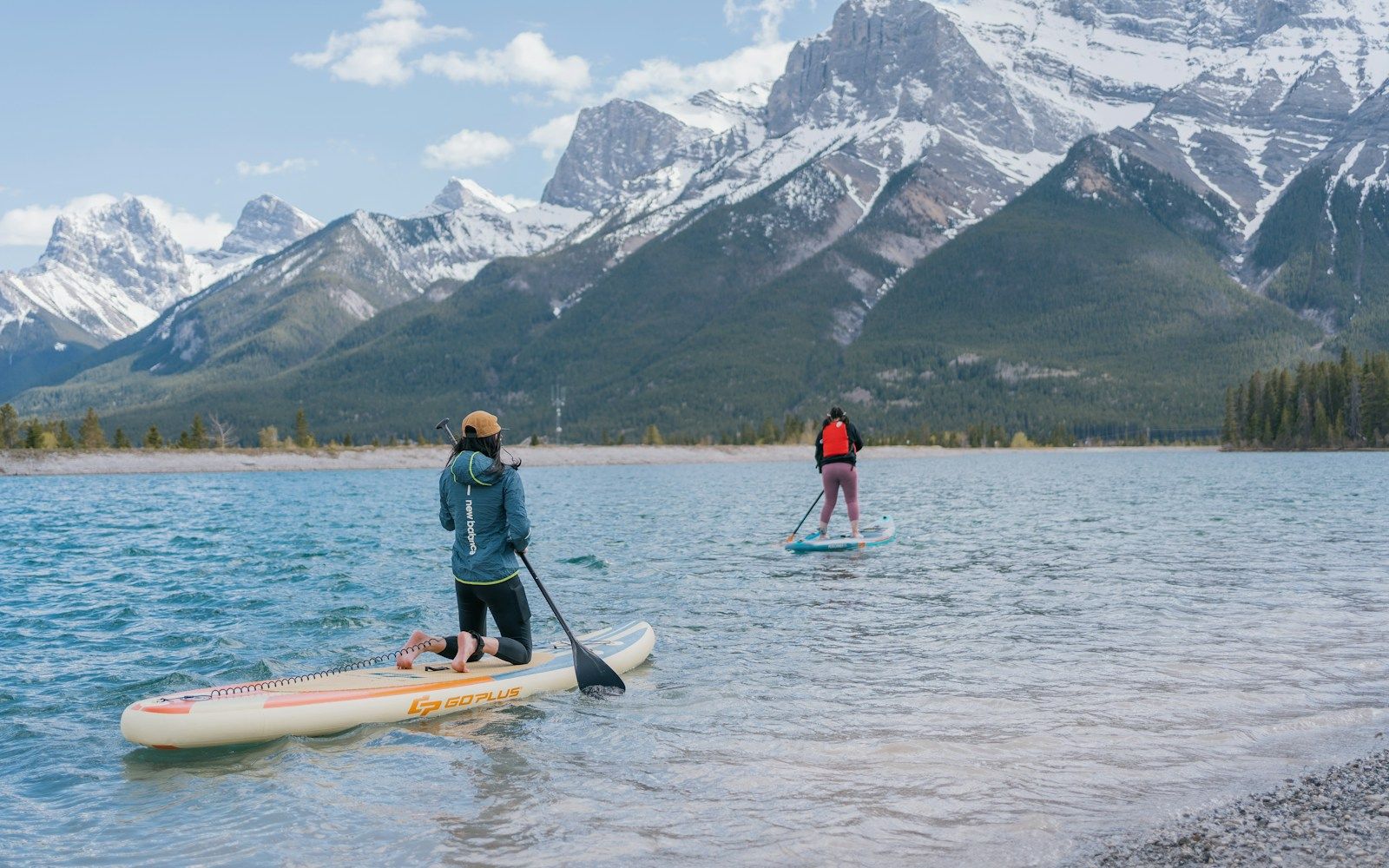
Paddling on a lake needs different preparation from an outing at sea: the rules change from one body of water to the next.
The short answer: the general regulation for inland navigation does not ban stand up paddle, the Ministry of Sports points out, but each lake can have its own rules. Read them before you set off, wear a buoyancy aid and beware of the afternoon breeze as well as the cold water below the surface.
On an enclosed body of water that does not connect to rivers, "the owner regulates its uses," sums up the Ministry of Sports. A closed, private body of water can therefore only be opened with the owner's consent: see what the law allows on a private body of water.
The owner can be a public authority: Lake Salagou and its shores belong to the Hérault Department, which signs its regulations.
The prefect can adapt the general regulation to a body of water through a specific police regulation: reserved zones, direction of travel, maximum speeds. Biotope protection orders are sometimes added, which can forbid approaching an islet or landing on a shore.
Article L2213-23 of the French general code of local authorities gives the mayor police powers over bathing and water activities practised from the shore with beach craft and unregistered craft. The mayor marks out the supervised zones and sets their supervision periods; outside them, you take part at your own risk. The mayor must also inform the public at the town hall and on site.
Look for the forbidden zones (dam, drinking water intake, military zone, protected area), the bathing zones, often closed to navigation, the shoreline strip, then the hours, the craft allowed and the equipment required.
The limit of 300 metres from a shelter, often quoted for paddle, comes from division 240, which governs pleasure boating at sea. On a lake, it is the local regulation that sets, where applicable, a shoreline strip and its rules.
Flat water is reassuring, and that is its trap. From 1 June to 30 September 2025, Santé publique France recorded 65 drownings ending in death in bodies of water, 34 of them in a lake, out of 409 in France.
In the sun, the land heats up faster than the water: warm air rises, and cooler air from the lake replaces it. Météo-France specifies that this breeze blows near lakes as on the coast, especially in the afternoon, at 15 to 30 km/h on average, sometimes up to 50 km/h. The terrain amplifies it: at Serre-Ponçon, the sailing club records near-daily breezes from midday to late afternoon, at 28 to 45 km/h in May, June and July.
In July, the Haute-Savoie prefecture describes water that is warm at the surface and cold below one metre of depth; mountain lakes stay cold after the thaw. The Savoie prefecture notes that the gap between air and water can often cause hydrocution, especially when bathing from craft. Wet your head, neck and belly before entering the water, advises the Ministry of Sports, and do not dive straight in, adds the Haute-Savoie.
Never set off alone, tell a relative your route and wear bright colours, asks the Ministry of Sports. In case of an accident on a body of water: dial 18 or 112.
Cyanobacteria are micro-organisms naturally present in lakes. According to the ARS Auvergne-Rhône-Alpes (10 July 2026), they proliferate with heat, sun, calm water and inputs of nitrogen and phosphorus, mostly from spring to the end of summer.
Signs to look for: turquoise-green, reddish or brown-yellow water, floating clumps that look like wet wool, foam pushed toward the shore. Not all of them produce toxins, but it is very hard to predict. Swallowing this water or touching the clumps can cause irritation, headaches or nausea, a few minutes to a few hours later. Dogs are particularly sensitive to it.
On inland waters, the order of 10 February 2016 requires stand up paddle and canoe-kayak users to wear a personal buoyancy aid at all times, or a compliant wetsuit or protective equipment. On Lake Geneva and so-called exposed waters, a personal, waterproof light signalling device is added.
The Ministry of Sports adds a closed vest and closed shoes in a kayak, and the leash at the ankle on a paddleboard. With children, read our guide to family paddle boarding; for equipment, see how to choose your board.
| Lake | Who sets the rule | Craft and equipment | Zones and hours |
|---|---|---|---|
| Salagou | The Department, as owner; the mayors for public order | Combustion engines banned, except service, rescue and safety boats of the operators | Free access to the estate, open to all; closed zones: see the guide cited below this table |
| Sainte-Croix | Inter-prefectoral order of 15 June 2017 | Combustion engines banned, except safety and rescue; buoyancy vest or wetsuit compulsory on a paddleboard, in a kayak and for any child under 12 | 50 m strip to be crossed perpendicularly; night navigation banned; gorges closed above 28 km/h of wind |
| Cazaux-Sanguinet | Inter-prefectoral order of 25 January 2024 | Jet skis banned on the Gironde side | 300 m strip at 5 km/h; military firing range open only from Friday 6:30 pm to Monday 8 am and on public holidays, unless the military authority decides otherwise; night navigation banned on the Landes side, restricted on the Gironde side |
Local rules do not carry over from one body of water to another: read those for yours. For details of the closed zones in the Hérault, see our guide to Salagou and Raviège.
On some lakes, operators rent boards from the shore. A rental operator based on the lake knows its rules in principle: ask about the closed zones, the time of the breeze and the state of the water.
Renting can also be done self-service. The Wave-Up station holds 8 stand up paddle or surf boards, with lockers for the vest and the leash; a kayak is possible depending on configuration, on quote. Booking starts in front of the station, by scanning its QR code, for 1 h, 2 h, 4 h or 8 h; you pay by card and open your locker with a code. The six equipped sites are campsites on the Hérault coast, none on a lake, and each station is installed inside the establishment's grounds: access conditions are those of the campsite.
Do you manage a leisure park or a municipal body of water? See the self-service rental station for a leisure park.
No. The general inland navigation regulation does not ban paddle, but each lake can close zones, hours or periods. A closed, private body of water can only be opened with its owner's agreement.
On the prefecture website, at the town hall or in the NAVI app from Voies navigables de France. Some regulations are also posted on site, as at Cazaux-Sanguinet. At Salagou, the Syndicat mixte du Grand Site answers the public.
At the surface, sometimes; deeper down, not necessarily. The Haute-Savoie prefecture describes it as cold below one metre of depth, and at Serre-Ponçon it stays under 19 °C until July, according to the sailing club. Enter the water gradually.
The order of 10 February 2016, which sets the safety equipment on inland waters, does not require it: it requires a buoyancy aid. But the Ministry of Sports recommends always attaching it at the ankle, as does the Haute-Savoie prefecture: a light breeze is enough to carry the board away. Also check the local regulation.
Sometimes, not always. The ban targets bathing first, but if it is due to cyanobacteria, the ARS asks you to follow the recommendations also issued for water activities. Read the sign; when in doubt, stay ashore.
Five checks before you set off: the lake's rules, the time of the breeze, the vest and the leash, a relative informed, the colour of the water. The rest follows, with our ideas for a day by the lake.
Do you run a site beside a body of water? Request a quote for a Wave-Up station: free, no obligation, reply within 24 working hours.

At Lac du Salagou, paddle and swimming are allowed and access is free, outside the dam area and, from 1…
No leash in a current, a life jacket worn at all times, weirs bypassed on foot and priority given to boats…
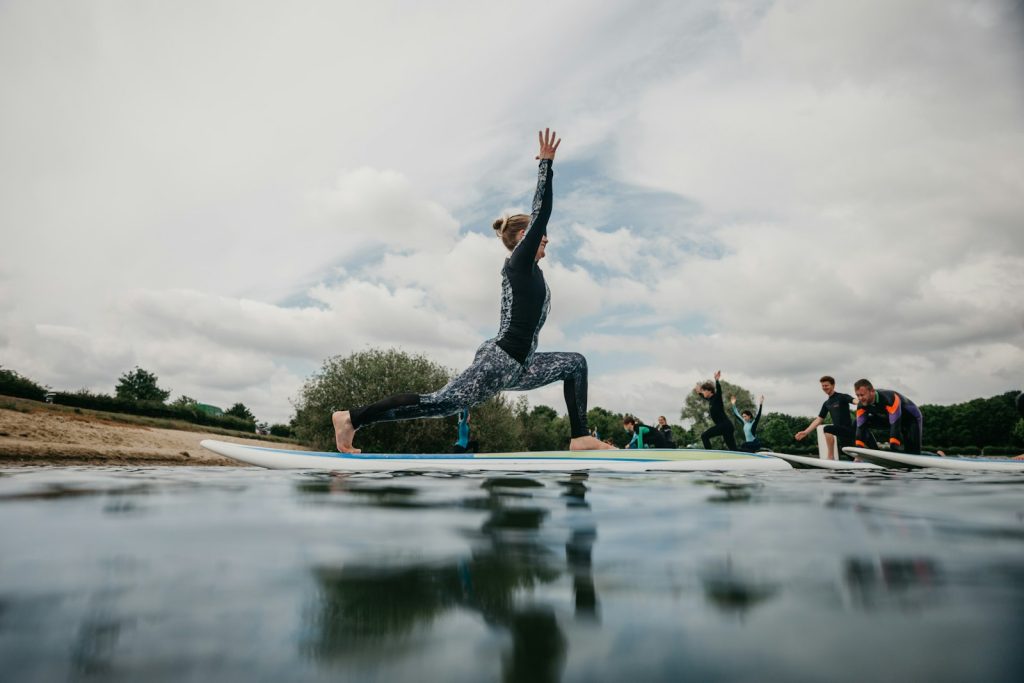
Le pilates sur l'eau, c'est la méthode au sol sur une planche de stand up paddle : principes, six exercices pour débuter,…
Estimate the revenue of a self-service rental station on your site, then request your free quote.
